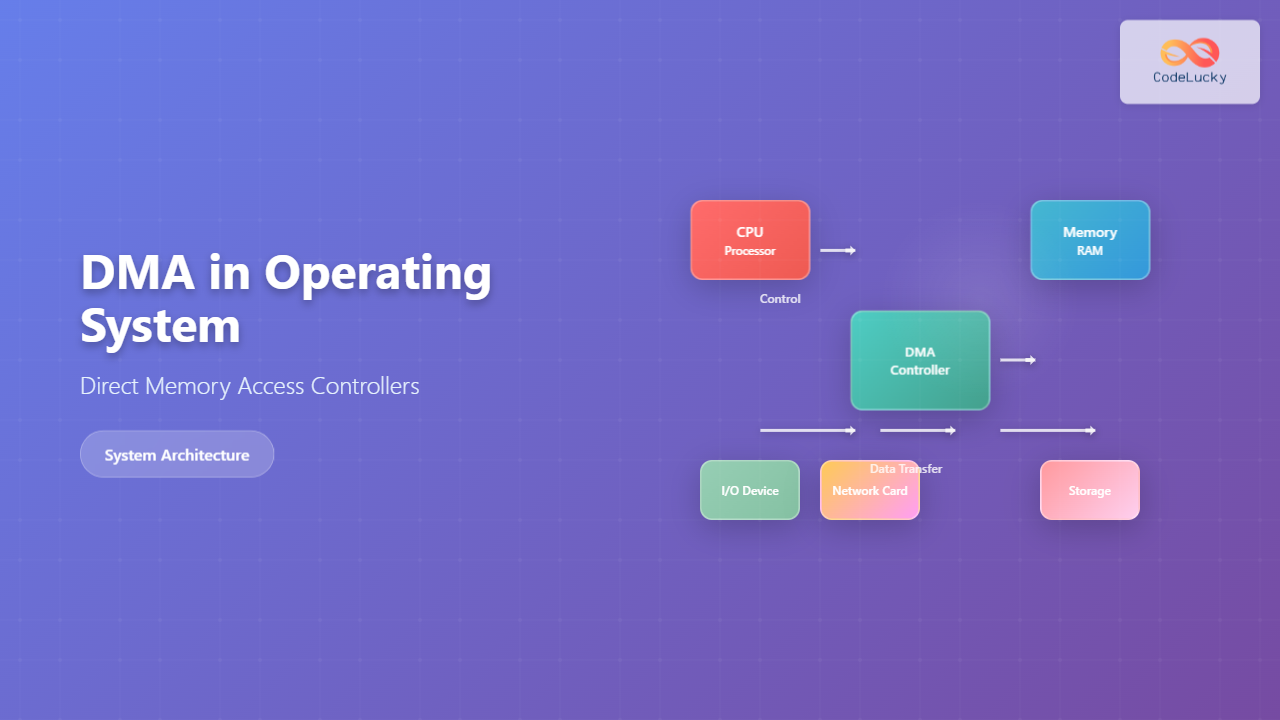
Direct Memory Access (DMA) is a crucial feature in modern operating systems that allows hardware devices to transfer data directly to and from memory without constant CPU supervision. This mechanism significantly improves system performance by freeing the CPU from routine data transfer operations, enabling it to focus on more complex computational tasks.
What is DMA (Direct Memory Access)?
DMA is a hardware feature that permits certain hardware subsystems to access main system memory independently of the central processing unit. Instead of the CPU handling every byte of data transfer between devices and memory, a specialized controller called the DMA controller manages these operations autonomously.
The primary advantage of DMA is that it eliminates the need for the CPU to be involved in every data transfer operation, which would otherwise consume valuable processing cycles. This is particularly beneficial for high-throughput operations like disk I/O, network communications, and multimedia processing.

How DMA Works in Operating Systems
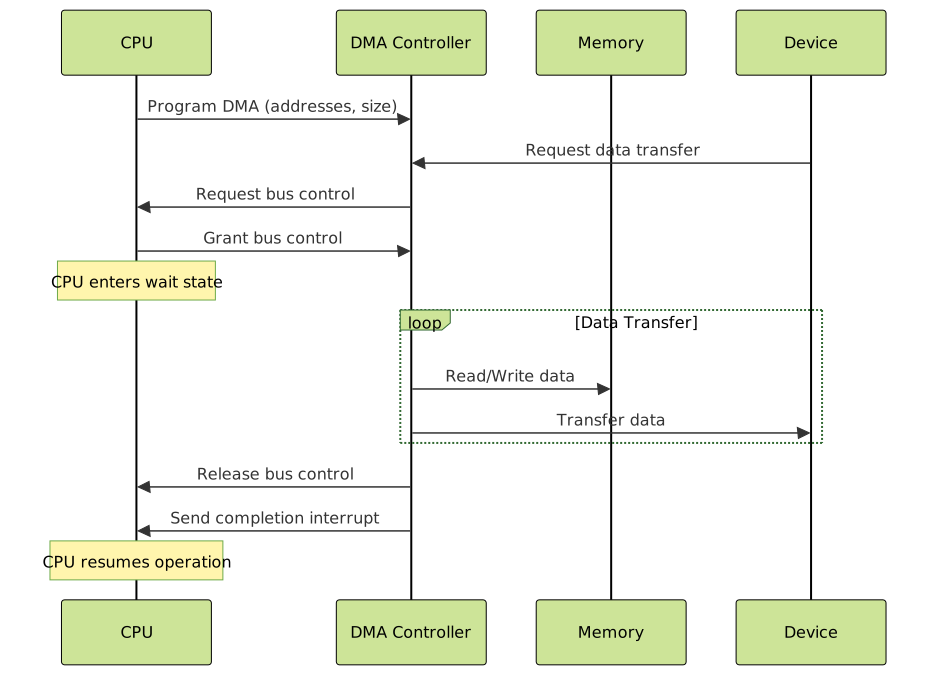
The DMA process involves several key steps that occur when a device needs to transfer data:
DMA Transfer Process
- Initialization: The CPU programs the DMA controller with transfer parameters including source address, destination address, and transfer size.
- Bus Request: When ready to transfer data, the DMA controller requests control of the system bus from the CPU.
- Bus Grant: The CPU grants bus control to the DMA controller and enters a wait state.
- Data Transfer: The DMA controller manages the actual data transfer between the device and memory.
- Completion: After transfer completion, the DMA controller releases the bus back to the CPU and signals completion via an interrupt.
Types of DMA Controllers
Operating systems work with different types of DMA controllers, each designed for specific use cases and performance requirements:
1. Single-Channel DMA Controller
The simplest form of DMA controller that can handle one transfer at a time. While cost-effective, it may create bottlenecks in systems with multiple devices requiring simultaneous data transfers.
2. Multi-Channel DMA Controller
Features multiple independent channels, allowing simultaneous data transfers between different devices and memory. Each channel can be programmed independently with its own transfer parameters.
3. Bus Master DMA
Advanced DMA controllers that can take complete control of the system bus, enabling more efficient and flexible data transfers. Common in modern PCI and PCIe devices.
4. Scatter-Gather DMA
Sophisticated DMA implementation that can handle non-contiguous memory regions in a single operation, reducing the overhead of multiple transfer setups.
DMA Implementation in Modern Operating Systems
Device Driver Integration
Operating system device drivers must be specifically designed to work with DMA controllers. Here’s a simplified example of how a driver might set up a DMA transfer:
// Simplified DMA setup in a device driver
struct dma_transfer {
    void *source_addr;
    void *dest_addr;
    size_t transfer_size;
    int channel;
};

int setup_dma_transfer(struct dma_transfer *transfer) {
    // Allocate DMA channel
    int channel = allocate_dma_channel();
    if (channel < 0) return -1;

    // Program DMA controller registers
    write_dma_register(DMA_SOURCE_ADDR, transfer->source_addr);
    write_dma_register(DMA_DEST_ADDR, transfer->dest_addr);
    write_dma_register(DMA_COUNT, transfer->transfer_size);
    write_dma_register(DMA_MODE, DMA_MODE_SINGLE | DMA_MODE_READ);

    // Enable DMA channel
    enable_dma_channel(channel);

    return 0;
}
Memory Management Considerations
DMA operations require special memory management considerations:
- Physical Memory Mapping: DMA controllers work with physical addresses, requiring the OS to maintain proper virtual-to-physical address mappings.
- Cache Coherency: The OS must ensure cache coherency between CPU cache and DMA-accessible memory.
- Memory Alignment: DMA transfers often require specific memory alignment for optimal performance.
- Buffer Management: The OS must manage DMA buffers to prevent conflicts and ensure data integrity.
DMA Modes of Operation
DMA controllers operate in different modes depending on system requirements and hardware capabilities:
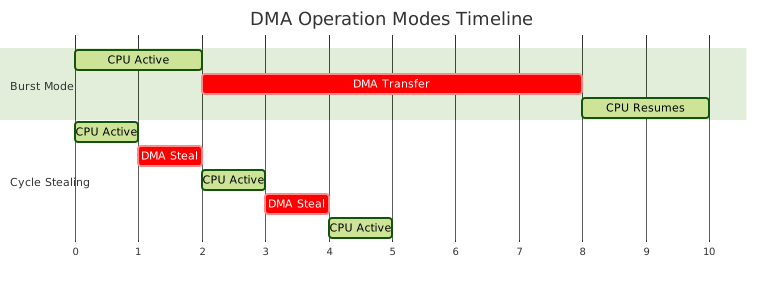
Burst Mode
In burst mode, the DMA controller takes complete control of the system bus for the entire duration of the data transfer. This provides maximum transfer speed but may impact overall system responsiveness.
Cycle Stealing Mode
The DMA controller “steals” bus cycles from the CPU when the CPU is not actively using the bus. This approach provides a balance between transfer efficiency and system responsiveness.
Transparent Mode
Data transfer occurs only when the CPU is not using the bus, such as during internal operations. This mode has minimal impact on CPU performance but may result in slower transfer rates.
Benefits of DMA in Operating Systems
Performance Improvements
- Reduced CPU Overhead: Frees CPU from routine data transfer tasks
- Increased Throughput: Enables parallel processing while data transfers occur
- Lower Latency: Direct memory access eliminates intermediate buffering
- Better Resource Utilization: Allows CPU to focus on computational tasks
System Efficiency
- Concurrent Operations: Multiple devices can transfer data simultaneously
- Reduced Context Switching: Fewer interrupts mean less context switching overhead
- Improved Multitasking: Better overall system responsiveness
Common DMA Applications
Storage Systems
Modern storage controllers use DMA extensively for high-speed data transfers between storage devices and system memory. SSDs and hard drives rely on DMA to achieve their maximum transfer rates.
Network Communications
Network interface cards (NICs) use DMA to transfer packets directly to and from memory buffers, enabling high-bandwidth network communications without overwhelming the CPU.
Graphics Processing
Graphics cards use DMA to transfer texture data, vertex information, and frame buffers, enabling smooth graphics rendering and video playback.
Audio Processing
Sound cards use DMA for continuous audio streaming, ensuring uninterrupted playback and recording without audio dropouts or glitches.
DMA Challenges and Limitations
Security Considerations
DMA can pose security risks if not properly managed:
- DMA Attacks: Malicious devices can potentially access sensitive memory regions
- Memory Protection: Requires proper implementation of IOMMU (Input-Output Memory Management Unit)
- Buffer Overflow: Improper DMA setup can lead to memory corruption
Hardware Limitations
- Address Space Restrictions: Some DMA controllers have limited addressing capabilities
- Transfer Size Limits: Maximum transfer sizes may be constrained by hardware
- Bus Contention: Multiple DMA operations can compete for bus bandwidth

Modern DMA Developments
IOMMU Integration
Modern systems implement Input-Output Memory Management Units (IOMMU) to provide virtual memory support for DMA operations, enhancing both security and functionality.
PCIe and Advanced DMA
PCIe devices implement sophisticated DMA capabilities including:
- Multiple virtual channels
- Quality of Service (QoS) management
- Advanced error reporting
- Power management integration
Virtualization Support
Modern DMA controllers support virtualization features, allowing secure DMA operations in virtual machine environments through technologies like Intel VT-d and AMD-Vi.
Programming DMA in Operating Systems
Kernel-Level Implementation
// Example interrupt handler for DMA completion
void dma_interrupt_handler(int irq, void *dev_data) {
    struct dma_device *dma_dev = (struct dma_device *)dev_data;

    // Check DMA status
    uint32_t status = read_dma_status(dma_dev->base_addr);

    if (status & DMA_COMPLETE) {
        // Signal completion to waiting process
        complete(&dma_dev->transfer_complete);

        // Clear interrupt
        write_dma_register(dma_dev->base_addr + DMA_STATUS,
                          DMA_COMPLETE);
    }

    if (status & DMA_ERROR) {
        // Handle DMA error
        dma_dev->error_count++;
        handle_dma_error(dma_dev, status);
    }
}
User-Space Interface
Operating systems typically provide user-space applications with high-level APIs that abstract DMA complexities:
// User-space API example for asynchronous I/O with DMA
int async_read(int fd, void *buffer, size_t count, off_t offset) {
    struct aiocb *aio_req = malloc(sizeof(struct aiocb));

    aio_req->aio_fildes = fd;
    aio_req->aio_buf = buffer;
    aio_req->aio_nbytes = count;
    aio_req->aio_offset = offset;

    // Submit asynchronous read request (uses DMA internally)
    if (aio_read(aio_req) == -1) {
        free(aio_req);
        return -1;
    }

    return 0; // Request submitted successfully
}
Performance Optimization with DMA
Buffer Alignment
Proper buffer alignment can significantly improve DMA performance:
// Allocate aligned buffer for optimal DMA performance
void* allocate_dma_buffer(size_t size) {
    size_t alignment = 4096; // Page alignment
    void *buffer = aligned_alloc(alignment, size);

    if (buffer) {
        // Lock pages in memory to prevent paging
        if (mlock(buffer, size) != 0) {
            free(buffer);
            return NULL;
        }
    }

    return buffer;
}
Scatter-Gather Lists
Advanced DMA controllers support scatter-gather operations for non-contiguous memory transfers:
struct sg_entry {
    dma_addr_t addr;
    uint32_t length;
    uint32_t flags;
};

int setup_sg_dma(struct sg_entry *sg_list, int num_entries) {
    for (int i = 0; i < num_entries; i++) {
        // Program each scatter-gather entry
        write_dma_register(SG_ADDR(i), sg_list[i].addr);
        write_dma_register(SG_LEN(i), sg_list[i].length);
        write_dma_register(SG_FLAGS(i), sg_list[i].flags);
    }

    // Start scatter-gather DMA transfer
    write_dma_register(DMA_CONTROL, DMA_START | DMA_SG_MODE);

    return 0;
}

Troubleshooting DMA Issues
Common Problems
- Cache Coherency Issues: Data inconsistencies between CPU cache and memory
- Address Translation Errors: Incorrect virtual-to-physical address mapping
- Timing Problems: Race conditions between CPU and DMA operations
- Resource Conflicts: Multiple devices competing for DMA channels
Debugging Techniques
- Hardware Debugging: Use logic analyzers to monitor bus transactions
- Software Tracing: Implement detailed logging in device drivers
- Performance Monitoring: Track DMA transfer rates and completion times
- Memory Analysis: Verify data integrity after DMA transfers
Future of DMA Technology
Emerging Trends
- AI/ML Accelerators: Specialized DMA for machine learning workloads
- Storage Class Memory: DMA optimizations for persistent memory
- Edge Computing: Low-power DMA implementations for IoT devices
- Quantum Computing: DMA adaptations for quantum control systems
Performance Enhancements
- Multi-Queue DMA: Parallel processing of multiple transfer queues
- Adaptive Algorithms: Dynamic optimization based on workload patterns
- Hardware Acceleration: Dedicated DMA processing units
- Software-Defined DMA: Programmable DMA controllers
Conclusion
Direct Memory Access (DMA) represents a fundamental optimization in modern operating system design, enabling efficient data transfer between devices and memory without constant CPU intervention. Understanding DMA principles, implementation techniques, and optimization strategies is crucial for system developers, device driver programmers, and anyone working on performance-critical applications.
As computing systems continue to evolve with faster storage devices, higher bandwidth networks, and more demanding applications, DMA technology will continue to play a vital role in achieving optimal system performance. The integration of advanced features like IOMMU support, virtualization capabilities, and scatter-gather operations ensures that DMA remains relevant and powerful in modern computing environments.
Proper implementation of DMA requires careful consideration of security implications, hardware limitations, and software design patterns. By following best practices and understanding the underlying principles, developers can harness the full potential of DMA to create efficient, high-performance systems that meet the demands of today’s computing challenges.
Related Posts
numactl Command Linux: Complete Guide to NUMA Policy Control and Optimization
The numactl command is a powerful Linux utility that allows system administrators and developers to control Non-Uniform Memory Access (NUMA)...
Memory Management in Operating System: Virtual and Physical Memory Fundamentals
Introduction to Memory Management Memory management is one of the most critical functions of an operating system, responsible for efficiently...
Memory Allocation Techniques: Contiguous vs Non-contiguous Management Strategies
Memory allocation is a fundamental aspect of operating system design that determines how programs and data are stored and accessed...
Garbage Collection in Operating System: Complete Guide to Automatic Memory Management
What is Garbage Collection in Operating Systems? Garbage collection is an automatic memory management technique used by operating systems and...
Memory Protection: Hardware and Software Mechanisms for Secure Computing
Understanding Memory Protection in Modern Computing Memory protection is a fundamental security mechanism that prevents programs from accessing memory regions...
Windows Memory Management: Virtual Memory Implementation and Optimization Guide
Introduction to Windows Virtual Memory Windows virtual memory is a sophisticated memory management system that allows programs to use more...
Multithreading in Operating Systems: Benefits, Challenges, and Implementation Guide
What is Multithreading in Operating Systems? Multithreading is a fundamental concept in modern operating systems that allows a single process...
Virtual Memory in OS: Complete Guide to Paging, Segmentation and Address Translation
Virtual memory is one of the most fundamental concepts in modern operating systems, enabling efficient memory management and providing crucial...
Buffering in Operating System: Complete Guide to Single, Double and Circular Buffer Implementation
What is Buffering in Operating System? Buffering in operating systems is a fundamental technique used to temporarily store data in...
Message Passing: Complete Guide to Inter-Process Communication in Operating Systems
Message passing is a fundamental inter-process communication (IPC) mechanism that enables processes to exchange data and synchronize their activities in...
Shared Memory: Complete Guide to IPC Through Memory Segments
Introduction to Shared Memory IPC Shared Memory is one of the most efficient Inter-Process Communication (IPC) mechanisms available in modern...
Input Output Systems: Complete Guide to Device Management and I/O Operations
Input/Output (I/O) systems form the critical bridge between a computer's internal processing capabilities and the external world. These systems manage...