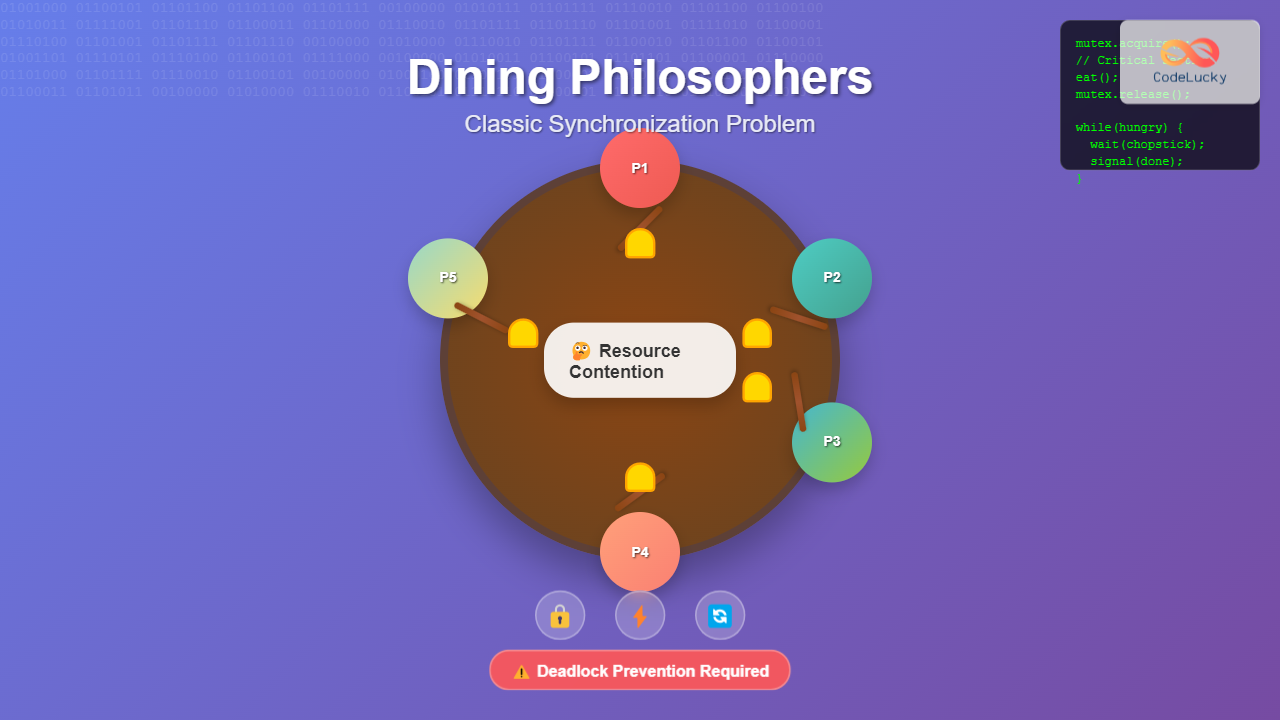
The Dining Philosophers Problem stands as one of the most iconic examples in computer science for understanding synchronization challenges in concurrent programming. Originally formulated by Edsger Dijkstra in 1965, this thought experiment elegantly illustrates the complexities of resource allocation, deadlock prevention, and process synchronization in operating systems.
What is the Dining Philosophers Problem?
The Dining Philosophers Problem presents a scenario where five philosophers sit around a circular dining table. Each philosopher alternates between two activities: thinking and eating. To eat, a philosopher needs both chopsticks (or forks) that are placed between adjacent philosophers. The challenge lies in designing a synchronization mechanism that allows all philosophers to eat without causing deadlock, starvation, or resource conflicts.

Core Components and Rules
The Philosophers
- Five philosophers represent concurrent processes or threads
- Each philosopher has two states: thinking and eating
- Philosophers think for a random amount of time
- When hungry, they attempt to acquire resources (chopsticks) to eat
The Chopsticks (Resources)
- Five chopsticks represent shared resources
- Each chopstick can be held by only one philosopher at a time
- A philosopher needs both adjacent chopsticks to eat
- Chopsticks must be released after eating
Fundamental Rules
- A philosopher can only eat when holding both adjacent chopsticks
- Chopsticks cannot be shared simultaneously
- A philosopher must release both chopsticks after eating
- The process continues indefinitely
The Deadlock Problem
The most critical issue in the Dining Philosophers Problem is deadlock. This occurs when all philosophers simultaneously pick up their left chopstick and wait indefinitely for their right chopstick, which is already held by their neighbor.

Deadlock Conditions
The dining philosophers scenario satisfies all four Coffman conditions for deadlock:
- Mutual Exclusion: Only one philosopher can hold a chopstick
- Hold and Wait: Philosophers hold one chopstick while waiting for another
- No Preemption: Chopsticks cannot be forcibly taken away
- Circular Wait: Each philosopher waits for their neighbor’s chopstick
Naive Solution and Its Problems
A straightforward approach might look like this:
class Philosopher:
    def __init__(self, id, left_chopstick, right_chopstick):
        self.id = id
        self.left_chopstick = left_chopstick
        self.right_chopstick = right_chopstick

    def eat(self):
        # Naive approach - PRONE TO DEADLOCK
        self.left_chopstick.acquire()   # Pick up left chopstick
        self.right_chopstick.acquire()  # Pick up right chopstick

        print(f"Philosopher {self.id} is eating")
        time.sleep(random.uniform(1, 3))  # Eating time

        self.right_chopstick.release()  # Put down right chopstick
        self.left_chopstick.release()   # Put down left chopstick
Problem: If all philosophers simultaneously execute left_chopstick.acquire(), they’ll all wait indefinitely for their right chopstick, creating a deadlock.
Classical Solutions
1. Asymmetric Solution
The most elegant solution breaks the circular wait by making one philosopher pick up chopsticks in reverse order:
import threading
import time
import random

class DiningPhilosophers:
    def __init__(self):
        self.chopsticks = [threading.Lock() for _ in range(5)]
        self.philosophers = []

    def philosopher(self, id):
        left = id
        right = (id + 1) % 5

        while True:
            self.think(id)

            # Asymmetric solution: philosopher 0 picks up in reverse order
            if id == 0:
                first, second = right, left
            else:
                first, second = left, right

            # Acquire chopsticks in determined order
            self.chopsticks[first].acquire()
            self.chopsticks[second].acquire()

            self.eat(id)

            # Release chopsticks
            self.chopsticks[second].release()
            self.chopsticks[first].release()

    def think(self, id):
        print(f"Philosopher {id} is thinking")
        time.sleep(random.uniform(1, 3))

    def eat(self, id):
        print(f"Philosopher {id} is eating")
        time.sleep(random.uniform(1, 2))

# Usage
dining = DiningPhilosophers()
threads = []

for i in range(5):
    t = threading.Thread(target=dining.philosopher, args=(i,))
    threads.append(t)
    t.start()
2. Semaphore Solution
Another approach uses a semaphore to limit the number of philosophers that can attempt to eat simultaneously:
import threading
import time
import random

class DiningPhilosophersSemaphore:
    def __init__(self):
        self.chopsticks = [threading.Lock() for _ in range(5)]
        # Allow only 4 philosophers to compete for chopsticks
        self.eating_semaphore = threading.Semaphore(4)

    def philosopher(self, id):
        left = id
        right = (id + 1) % 5

        while True:
            self.think(id)

            # Wait for permission to attempt eating
            self.eating_semaphore.acquire()

            # Acquire chopsticks
            self.chopsticks[left].acquire()
            self.chopsticks[right].acquire()

            self.eat(id)

            # Release chopsticks
            self.chopsticks[right].release()
            self.chopsticks[left].release()

            # Release eating permission
            self.eating_semaphore.release()

    def think(self, id):
        print(f"Philosopher {id} is thinking")
        time.sleep(random.uniform(1, 3))

    def eat(self, id):
        print(f"Philosopher {id} is eating")
        time.sleep(random.uniform(1, 2))
3. Monitor Solution
A more sophisticated approach uses monitors with condition variables:
import threading
import time
import random
from enum import Enum

class State(Enum):
    THINKING = 1
    HUNGRY = 2
    EATING = 3

class DiningPhilosophersMonitor:
    def __init__(self):
        self.state = [State.THINKING] * 5
        self.condition = [threading.Condition() for _ in range(5)]
        self.lock = threading.Lock()

    def philosopher(self, id):
        while True:
            self.think(id)
            self.pickup_chopsticks(id)
            self.eat(id)
            self.putdown_chopsticks(id)

    def pickup_chopsticks(self, id):
        with self.lock:
            self.state[id] = State.HUNGRY
            self.test(id)
            if self.state[id] != State.EATING:
                self.condition[id].wait()

    def putdown_chopsticks(self, id):
        with self.lock:
            self.state[id] = State.THINKING
            # Check if neighbors can now eat
            self.test((id + 4) % 5)  # Left neighbor
            self.test((id + 1) % 5)  # Right neighbor

    def test(self, id):
        left = (id + 4) % 5
        right = (id + 1) % 5

        if (self.state[id] == State.HUNGRY and
            self.state[left] != State.EATING and
            self.state[right] != State.EATING):

            self.state[id] = State.EATING
            self.condition[id].notify()

    def think(self, id):
        print(f"Philosopher {id} is thinking")
        time.sleep(random.uniform(1, 3))

    def eat(self, id):
        print(f"Philosopher {id} is eating")
        time.sleep(random.uniform(1, 2))
Advanced Solutions and Optimizations
Timeout-Based Solution
This solution prevents indefinite waiting by implementing timeouts:
class TimeoutDiningPhilosophers:
    def __init__(self):
        self.chopsticks = [threading.Lock() for _ in range(5)]

    def philosopher(self, id):
        left = id
        right = (id + 1) % 5

        while True:
            self.think(id)

            # Try to acquire left chopstick with timeout
            if self.chopsticks[left].acquire(timeout=2):
                # Try to acquire right chopstick with timeout
                if self.chopsticks[right].acquire(timeout=2):
                    self.eat(id)
                    self.chopsticks[right].release()
                else:
                    print(f"Philosopher {id} couldn't get right chopstick, backing off")

                self.chopsticks[left].release()
            else:
                print(f"Philosopher {id} couldn't get left chopstick, backing off")

            # Random backoff to prevent starvation
            time.sleep(random.uniform(0.1, 0.5))
Resource Hierarchy Solution
This approach assigns a global ordering to resources:

class HierarchicalDiningPhilosophers:
    def __init__(self):
        self.chopsticks = [threading.Lock() for _ in range(5)]

    def philosopher(self, id):
        left = id
        right = (id + 1) % 5

        # Always acquire lower-numbered chopstick first
        first = min(left, right)
        second = max(left, right)

        while True:
            self.think(id)

            self.chopsticks[first].acquire()
            self.chopsticks[second].acquire()

            self.eat(id)

            self.chopsticks[second].release()
            self.chopsticks[first].release()
Performance Analysis and Comparison

Real-World Applications
The Dining Philosophers Problem models many real-world scenarios in computer systems:
Database Systems
- Lock Management: Transactions acquiring multiple locks on database records
- Deadlock Detection: Implementing timeout-based recovery mechanisms
- Resource Scheduling: Managing concurrent access to database resources
Operating Systems
- Process Synchronization: Managing shared memory and file access
- Device Allocation: Coordinating access to hardware resources
- Network Resources: Managing bandwidth and connection pools
Distributed Systems
- Microservices: Coordinating resource access across services
- Load Balancing: Distributing requests to prevent resource contention
- Cluster Management: Orchestrating resource allocation in distributed environments
Interactive Example
Here’s a complete interactive simulation that demonstrates the problem and solution:
import threading
import time
import random
import queue
from datetime import datetime

class InteractiveDiningPhilosophers:
    def __init__(self, solution_type="asymmetric"):
        self.chopsticks = [threading.Lock() for _ in range(5)]
        self.solution_type = solution_type
        self.log_queue = queue.Queue()
        self.running = True

        if solution_type == "semaphore":
            self.eating_semaphore = threading.Semaphore(4)

    def log(self, message):
        timestamp = datetime.now().strftime("%H:%M:%S.%f")[:-3]
        self.log_queue.put(f"[{timestamp}] {message}")

    def philosopher(self, id):
        left = id
        right = (id + 1) % 5

        while self.running:
            self.think(id)

            if self.solution_type == "asymmetric":
                self.asymmetric_eat(id, left, right)
            elif self.solution_type == "semaphore":
                self.semaphore_eat(id, left, right)
            elif self.solution_type == "naive":
                self.naive_eat(id, left, right)

    def asymmetric_eat(self, id, left, right):
        if id == 0:
            first, second = right, left
        else:
            first, second = left, right

        self.log(f"Philosopher {id} is hungry")

        self.chopsticks[first].acquire()
        self.log(f"Philosopher {id} picked up chopstick {first}")

        self.chopsticks[second].acquire()
        self.log(f"Philosopher {id} picked up chopstick {second}")

        self.eat(id)

        self.chopsticks[second].release()
        self.log(f"Philosopher {id} put down chopstick {second}")

        self.chopsticks[first].release()
        self.log(f"Philosopher {id} put down chopstick {first}")

    def think(self, id):
        self.log(f"Philosopher {id} is thinking")
        time.sleep(random.uniform(0.5, 1.5))

    def eat(self, id):
        self.log(f"Philosopher {id} is EATING")
        time.sleep(random.uniform(0.5, 1.0))

    def start_simulation(self, duration=10):
        self.log("=== DINING PHILOSOPHERS SIMULATION STARTED ===")
        self.log(f"Using solution: {self.solution_type}")

        threads = []
        for i in range(5):
            t = threading.Thread(target=self.philosopher, args=(i,))
            threads.append(t)
            t.start()

        # Run simulation for specified duration
        time.sleep(duration)
        self.running = False

        # Wait for threads to finish
        for t in threads:
            t.join(timeout=1)

        self.log("=== SIMULATION ENDED ===")

        # Print collected logs
        while not self.log_queue.empty():
            print(self.log_queue.get())

# Run the simulation
if __name__ == "__main__":
    print("Asymmetric Solution:")
    sim = InteractiveDiningPhilosophers("asymmetric")
    sim.start_simulation(5)
Key Takeaways and Best Practices
Essential Lessons
- Resource Ordering: Establishing a consistent order for resource acquisition prevents circular wait
- Limiting Concurrency: Sometimes reducing parallelism improves overall system performance
- Timeout Mechanisms: Implementing timeouts provides robustness against indefinite blocking
- Fair Scheduling: Monitor-based solutions can prevent starvation while maintaining efficiency
Design Principles
- Avoid Hold-and-Wait: Acquire all resources at once or none at all
- Break Circular Dependencies: Use asymmetric approaches or resource hierarchies
- Implement Backoff Strategies: Random delays can reduce contention
- Monitor System State: Track resource usage and detect potential deadlocks
Conclusion
The Dining Philosophers Problem remains a cornerstone example in concurrent programming education because it elegantly demonstrates the fundamental challenges of synchronization. From simple asymmetric solutions to sophisticated monitor implementations, each approach offers unique insights into managing shared resources in concurrent systems.
Understanding these concepts is crucial for developing robust, scalable applications in modern computing environments. Whether you’re designing database systems, implementing microservices, or working with multi-threaded applications, the principles learned from the Dining Philosophers Problem will guide you toward creating deadlock-free, efficient concurrent systems.
The key to mastering concurrent programming lies not just in understanding these classical problems, but in recognizing their patterns in real-world scenarios and applying appropriate solutions. As systems continue to grow in complexity and scale, these fundamental synchronization concepts become increasingly valuable for building reliable, high-performance software systems.
Related Posts
Producer Consumer Problem: Complete Guide to Bounded Buffer Implementation with Code Examples
The Producer Consumer Problem, also known as the bounded buffer problem, is one of the most fundamental synchronization problems in...
Deadlock in Operating System: Complete Guide to Necessary Conditions and Detection Methods
Deadlock is one of the most critical challenges in operating system design, where multiple processes become permanently blocked while waiting...
Critical Section Problem: Complete Guide to Mutual Exclusion Solutions in Operating Systems
What is the Critical Section Problem? The critical section problem is a fundamental challenge in operating systems where multiple processes...
Sleeping Barber Problem: Complete Guide to Classic Operating System Synchronization
The Sleeping Barber Problem stands as one of the most elegant and instructive examples in operating system design, perfectly illustrating...
Monitor in Operating System: High-level Synchronization for Process Coordination
What is a Monitor in Operating System? A monitor is a high-level synchronization construct in operating systems that provides a...

Deadlock Prevention: Complete Guide to Avoiding Circular Wait Conditions
Understanding Deadlock and Circular Wait Deadlock is one of the most critical issues in operating systems where two or more...

Process Synchronization: Critical Sections and Race Conditions in Operating Systems
Introduction to Process Synchronization Process synchronization is a fundamental concept in operating systems that ensures multiple processes can safely access...
Lamport’s Bakery Algorithm: Complete Guide to N-Process Mutual Exclusion
Lamport's Bakery Algorithm stands as one of the most elegant solutions to the N-process mutual exclusion problem in concurrent programming....
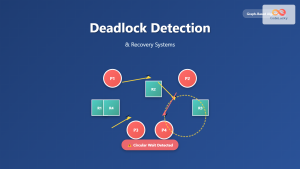
Deadlock Detection and Recovery: Graph-based Algorithms for Operating Systems
Introduction to Deadlock Detection and Recovery Deadlock is one of the most critical challenges in operating systems where multiple processes...
Thread Synchronization: Mutexes, Semaphores and Deadlocks in Operating Systems
Introduction to Thread Synchronization Thread synchronization is a fundamental concept in operating systems that ensures multiple threads can safely access...
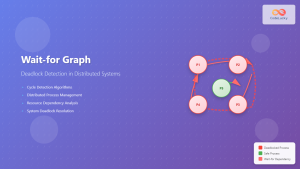
Wait-for Graph: Comprehensive Guide to Deadlock Detection in Distributed Systems
Introduction to Wait-for Graphs In distributed systems, deadlock detection remains one of the most critical challenges for maintaining system reliability...
Thread in Operating System: Lightweight Processes and Multithreading Explained
What are Threads in Operating Systems? A thread is the smallest unit of execution within a process that can be...