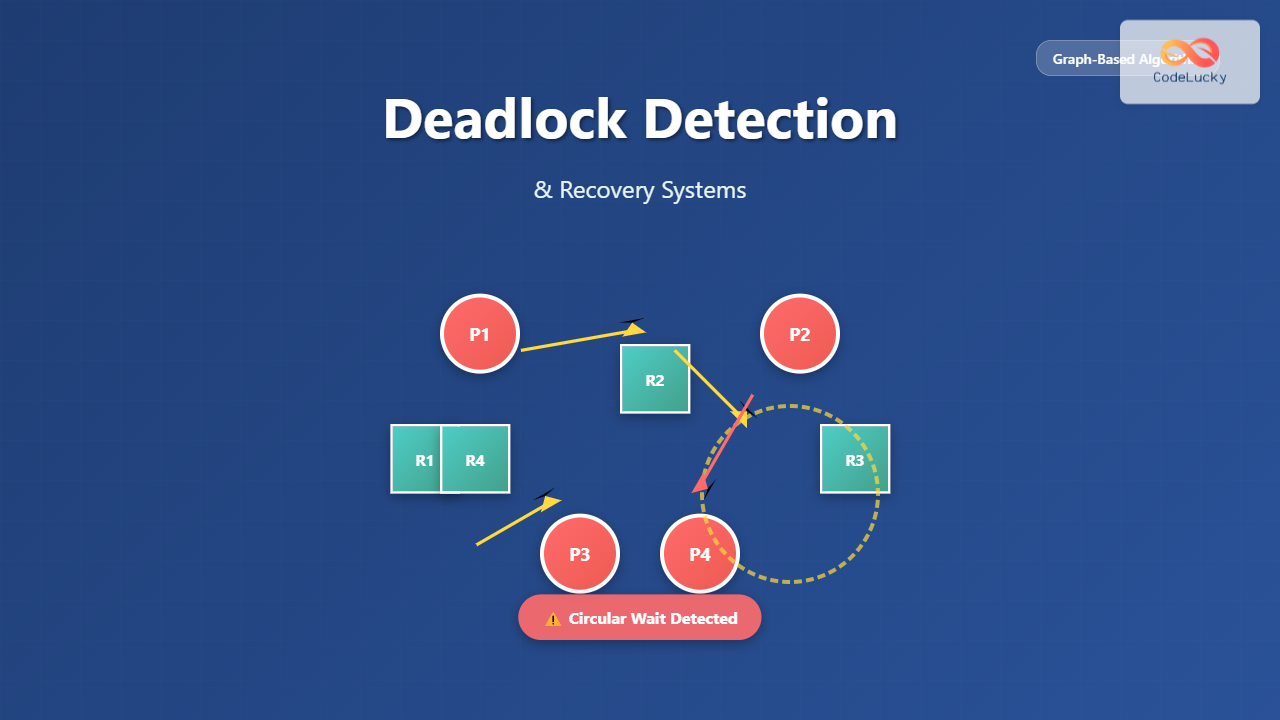
Introduction to Deadlock Detection and Recovery
Deadlock is one of the most critical challenges in operating systems where multiple processes compete for limited resources. When processes become stuck waiting for each other indefinitely, system performance degrades significantly. Graph-based algorithms provide elegant solutions for detecting and recovering from deadlocks by visualizing resource dependencies as mathematical structures.
This comprehensive guide explores advanced deadlock detection mechanisms, focusing on resource allocation graphs, wait-for graphs, and proven recovery strategies that maintain system stability while resolving conflicts efficiently.
Understanding Deadlock Fundamentals
The Four Coffman Conditions
Deadlock occurs when all four conditions exist simultaneously:
- Mutual Exclusion: Resources cannot be shared among processes
- Hold and Wait: Processes hold resources while requesting additional ones
- No Preemption: Resources cannot be forcibly removed from processes
- Circular Wait: A circular chain of processes exists where each waits for the next
Graph-based detection algorithms primarily focus on identifying circular wait conditions through mathematical graph theory principles.
Resource Allocation Graph Components
A Resource Allocation Graph (RAG) consists of:
- Process Nodes: Represented as circles (P1, P2, P3…)
- Resource Nodes: Represented as rectangles (R1, R2, R3…)
- Request Edges: Arrows from processes to resources (Pi → Rj)
- Assignment Edges: Arrows from resources to processes (Ri → Pj)

Graph-Based Detection Algorithms
Resource Allocation Graph Algorithm
The RAG algorithm detects deadlocks by identifying cycles in the resource allocation graph. Here’s the step-by-step implementation:
class ResourceAllocationGraph:
    def __init__(self):
        self.processes = set()
        self.resources = set()
        self.request_edges = {}  # process -> [resources]
        self.assignment_edges = {}  # resource -> process

    def add_request_edge(self, process, resource):
        if process not in self.request_edges:
            self.request_edges[process] = []
        self.request_edges[process].append(resource)

    def add_assignment_edge(self, resource, process):
        self.assignment_edges[resource] = process

    def detect_cycle_dfs(self, node, visited, rec_stack, path):
        visited[node] = True
        rec_stack[node] = True
        path.append(node)

        # Get adjacent nodes
        adjacent = []
        if node in self.request_edges:
            for resource in self.request_edges[node]:
                if resource in self.assignment_edges:
                    adjacent.append(self.assignment_edges[resource])

        for neighbor in adjacent:
            if not visited.get(neighbor, False):
                if self.detect_cycle_dfs(neighbor, visited, rec_stack, path):
                    return True
            elif rec_stack.get(neighbor, False):
                # Cycle detected
                cycle_start = path.index(neighbor)
                self.deadlock_cycle = path[cycle_start:]
                return True

        rec_stack[node] = False
        path.pop()
        return False

    def detect_deadlock(self):
        visited = {}
        rec_stack = {}

        for process in self.processes:
            if not visited.get(process, False):
                if self.detect_cycle_dfs(process, visited, rec_stack, []):
                    return True, self.deadlock_cycle
        return False, []
Wait-For Graph Algorithm
The Wait-For Graph simplifies detection by eliminating resource nodes, creating direct edges between processes that wait for each other:

class WaitForGraph:
    def __init__(self):
        self.graph = {}

    def add_edge(self, waiting_process, holding_process):
        if waiting_process not in self.graph:
            self.graph[waiting_process] = []
        self.graph[waiting_process].append(holding_process)

    def detect_cycle_iterative(self):
        color = {}  # 0: white, 1: gray, 2: black
        parent = {}

        for node in self.graph:
            color[node] = 0
            parent[node] = None

        def dfs_visit(u):
            color[u] = 1  # Gray

            if u in self.graph:
                for v in self.graph[u]:
                    if color.get(v, 0) == 0:
                        parent[v] = u
                        if dfs_visit(v):
                            return True
                    elif color.get(v, 0) == 1:
                        # Back edge found - cycle detected
                        return True

            color[u] = 2  # Black
            return False

        for node in self.graph:
            if color[node] == 0:
                if dfs_visit(node):
                    return True
        return False
Banker’s Algorithm for Deadlock Detection
The Banker’s Algorithm extends detection to multi-instance resources using matrix operations:
class BankersAlgorithm:
    def __init__(self, processes, resources):
        self.processes = processes
        self.resources = resources
        self.allocation = [[0] * len(resources) for _ in range(len(processes))]
        self.max_need = [[0] * len(resources) for _ in range(len(processes))]
        self.available = [0] * len(resources)

    def calculate_need(self):
        need = []
        for i in range(len(self.processes)):
            need_row = []
            for j in range(len(self.resources)):
                need_row.append(self.max_need[i][j] - self.allocation[i][j])
            need.append(need_row)
        return need

    def is_safe_state(self):
        need = self.calculate_need()
        finish = [False] * len(self.processes)
        work = self.available[:]
        safe_sequence = []

        while True:
            found = False
            for i in range(len(self.processes)):
                if not finish[i]:
                    can_allocate = True
                    for j in range(len(self.resources)):
                        if need[i][j] > work[j]:
                            can_allocate = False
                            break

                    if can_allocate:
                        # Process can complete
                        for j in range(len(self.resources)):
                            work[j] += self.allocation[i][j]
                        finish[i] = True
                        safe_sequence.append(self.processes[i])
                        found = True

            if not found:
                break

        return all(finish), safe_sequence
Deadlock Detection Implementation Examples
Example 1: Simple Resource Allocation Graph
Consider a scenario with 3 processes and 3 resources:

# Deadlock detection example
rag = ResourceAllocationGraph()
rag.processes = {'P1', 'P2', 'P3'}
rag.resources = {'R1', 'R2', 'R3'}

# Add allocation edges (resource -> process)
rag.add_assignment_edge('R1', 'P1')
rag.add_assignment_edge('R2', 'P2')
rag.add_assignment_edge('R3', 'P3')

# Add request edges (process -> resource)
rag.add_request_edge('P1', 'R2')
rag.add_request_edge('P2', 'R3')
rag.add_request_edge('P3', 'R1')

# Detect deadlock
is_deadlock, cycle = rag.detect_deadlock()
print(f"Deadlock detected: {is_deadlock}")
print(f"Deadlock cycle: {cycle}")

# Output:
# Deadlock detected: True
# Deadlock cycle: ['P1', 'P2', 'P3']
Example 2: Multi-Instance Resource Scenario
Banking system example with multiple resource instances:
# Initialize Banker's Algorithm
processes = ['P0', 'P1', 'P2', 'P3']
resources = ['R0', 'R1', 'R2']

banker = BankersAlgorithm(processes, resources)

# Current allocation matrix
banker.allocation = [
    [2, 0, 1],  # P0
    [1, 1, 0],  # P1
    [1, 0, 3],  # P2
    [0, 2, 1]   # P3
]

# Maximum need matrix
banker.max_need = [
    [3, 2, 2],  # P0
    [1, 2, 3],  # P1
    [3, 1, 4],  # P2
    [2, 2, 2]   # P3
]

# Available resources
banker.available = [1, 1, 0]

# Check for safe state
is_safe, sequence = banker.is_safe_state()
print(f"System is in safe state: {is_safe}")
print(f"Safe sequence: {sequence}")

# Output:
# System is in safe state: True
# Safe sequence: ['P1', 'P3', 'P0', 'P2']
Deadlock Recovery Strategies
Process Termination Methods
Abort All Deadlocked Processes
- Simplest approach but expensive
- Terminates all processes in the deadlock cycle
- Requires restarting processes from the beginning
Abort Processes One by One
- More efficient resource utilization
- Requires careful selection criteria
- Tests for deadlock resolution after each termination
class DeadlockRecovery:
    def __init__(self, detection_algorithm):
        self.detector = detection_algorithm

    def calculate_termination_cost(self, process):
        # Factors to consider:
        # - Process priority
        # - Computation time invested
        # - Resources currently held
        # - Number of processes that would be affected

        priority_weight = process.priority * 0.3
        time_invested = process.execution_time * 0.4
        resource_count = len(process.held_resources) * 0.2
        dependency_count = len(process.dependent_processes) * 0.1

        return priority_weight + time_invested + resource_count + dependency_count

    def abort_minimum_cost_process(self, deadlocked_processes):
        min_cost = float('inf')
        victim = None

        for process in deadlocked_processes:
            cost = self.calculate_termination_cost(process)
            if cost < min_cost:
                min_cost = cost
                victim = process

        if victim:
            self.terminate_process(victim)
            return victim
        return None

    def recover_by_termination(self):
        recovery_steps = []

        while True:
            is_deadlock, cycle = self.detector.detect_deadlock()
            if not is_deadlock:
                break

            victim = self.abort_minimum_cost_process(cycle)
            recovery_steps.append(f"Terminated process: {victim.id}")

        return recovery_steps
Resource Preemption Strategy
Resource preemption involves temporarily removing resources from processes to break deadlock cycles:

class ResourcePreemption:
    def __init__(self):
        self.rollback_points = {}

    def create_checkpoint(self, process):
        # Save process state for rollback
        checkpoint = {
            'process_id': process.id,
            'memory_state': process.memory.copy(),
            'register_state': process.registers.copy(),
            'file_descriptors': process.open_files.copy(),
            'timestamp': time.time()
        }
        self.rollback_points[process.id] = checkpoint

    def preempt_resources(self, victim_process, required_resources):
        preempted = []

        for resource in required_resources:
            if resource in victim_process.held_resources:
                # Remove resource from victim
                victim_process.held_resources.remove(resource)
                resource.holder = None
                preempted.append(resource)

        return preempted

    def rollback_process(self, process):
        if process.id in self.rollback_points:
            checkpoint = self.rollback_points[process.id]

            # Restore process state
            process.memory = checkpoint['memory_state']
            process.registers = checkpoint['register_state']
            process.open_files = checkpoint['file_descriptors']

            return True
        return False

    def recover_by_preemption(self, deadlocked_processes, required_resources):
        # Select victim based on rollback cost
        victim = min(deadlocked_processes,
                    key=lambda p: self.calculate_rollback_cost(p))

        # Create checkpoint before preemption
        self.create_checkpoint(victim)

        # Preempt resources
        preempted_resources = self.preempt_resources(victim, required_resources)

        # Rollback victim process
        self.rollback_process(victim)

        return victim, preempted_resources
Advanced Detection Optimizations
Incremental Graph Updates
Optimize detection performance by maintaining incremental graph updates instead of full reconstruction:
class IncrementalDeadlockDetector:
    def __init__(self):
        self.resource_graph = {}
        self.process_dependencies = {}
        self.last_check_timestamp = 0

    def add_resource_request(self, process, resource):
        # Update graph incrementally
        if process not in self.resource_graph:
            self.resource_graph[process] = set()
        self.resource_graph[process].add(resource)

        # Trigger detection only if potential cycle
        if self.could_create_cycle(process, resource):
            return self.detect_deadlock_incremental()
        return False

    def could_create_cycle(self, requesting_process, requested_resource):
        # Quick heuristic check
        current_holder = self.get_resource_holder(requested_resource)
        if current_holder:
            return self.has_path(current_holder, requesting_process)
        return False

    def has_path(self, start, target):
        # BFS to check if path exists
        visited = set()
        queue = [start]

        while queue:
            current = queue.pop(0)
            if current == target:
                return True

            if current in visited:
                continue
            visited.add(current)

            # Add dependent processes
            for resource in self.resource_graph.get(current, []):
                holder = self.get_resource_holder(resource)
                if holder and holder not in visited:
                    queue.append(holder)

        return False
Distributed Deadlock Detection
For distributed systems, implement edge-chasing algorithms:
class DistributedDeadlockDetector:
    def __init__(self, node_id):
        self.node_id = node_id
        self.local_wait_graph = {}
        self.probe_messages = {}

    def initiate_detection(self, blocked_process):
        # Send probe message to detect distributed deadlock
        probe = {
            'initiator': self.node_id,
            'blocked_process': blocked_process,
            'path': [self.node_id]
        }

        # Send probe to nodes where dependencies exist
        for dependency in self.get_external_dependencies(blocked_process):
            self.send_probe_message(dependency.node, probe)

    def handle_probe_message(self, probe):
        current_process = probe['blocked_process']

        # Check if probe returned to initiator
        if probe['initiator'] == self.node_id:
            # Deadlock detected
            return self.handle_deadlock_detection(probe['path'])

        # Forward probe if process is blocked
        if self.is_process_blocked(current_process):
            blocking_resource = self.get_blocking_resource(current_process)
            holder_node = self.get_resource_holder_node(blocking_resource)

            probe['path'].append(self.node_id)
            self.send_probe_message(holder_node, probe)

    def send_probe_message(self, target_node, probe):
        # Simulate network message sending
        message = {
            'type': 'DEADLOCK_PROBE',
            'probe': probe,
            'timestamp': time.time()
        }
        # Network layer would handle actual transmission
        pass
Performance Analysis and Comparison
Algorithm Complexity Comparison
| Algorithm | Time Complexity | Space Complexity | Best Use Case |
|---|---|---|---|
| Resource Allocation Graph | O(V + E) | O(V + E) | Single-instance resources |
| Wait-For Graph | O(V²) | O(V²) | Process-centric detection |
| Banker’s Algorithm | O(V × R²) | O(V × R) | Multi-instance resources |
| Edge-Chasing | O(V × E) | O(V + E) | Distributed systems |
Detection Frequency Strategies
Periodic Detection
- Fixed interval checking (e.g., every 10 seconds)
- Low overhead but potential delay in detection
- Suitable for systems with predictable workloads
Event-Driven Detection
- Triggered by resource allocation requests
- Immediate detection but higher overhead
- Optimal for interactive systems
Hybrid Approach
- Combines periodic and event-driven methods
- Adaptive frequency based on system load
- Best balance between overhead and responsiveness
Real-World Implementation Considerations
Database Deadlock Detection
Modern database systems implement sophisticated deadlock detection:
-- PostgreSQL deadlock detection example
BEGIN;
SET deadlock_timeout = '1s';

-- Transaction 1
LOCK TABLE accounts IN SHARE MODE;
UPDATE accounts SET balance = balance - 100 WHERE id = 1;

-- This may trigger deadlock detection
UPDATE accounts SET balance = balance + 100 WHERE id = 2;

COMMIT;
Operating System Integration
Integration points with OS kernel:
- Process Control Blocks (PCB): Track resource dependencies
- Resource Descriptors: Maintain allocation state
- Scheduler Integration: Coordinate with process scheduling
- Memory Management: Handle rollback and checkpointing
Best Practices and Guidelines
Design Principles
- Minimize Detection Overhead: Use incremental updates and smart triggers
- Fast Recovery: Implement efficient rollback mechanisms
- Fairness: Avoid repeatedly selecting the same victim process
- System Stability: Ensure recovery doesn’t introduce new deadlocks
Implementation Tips
- Use priority-based victim selection to minimize system impact
- Implement comprehensive logging for deadlock analysis
- Consider timeout-based detection for real-time systems
- Test recovery mechanisms under various load conditions
Conclusion
Graph-based deadlock detection and recovery algorithms provide robust solutions for maintaining system stability in multi-process environments. The choice between different approaches depends on specific system requirements including resource types, performance constraints, and recovery time objectives.
Modern implementations benefit from combining multiple techniques: using resource allocation graphs for basic detection, incremental updates for performance optimization, and intelligent victim selection for efficient recovery. Understanding these algorithms enables developers to build resilient systems that gracefully handle resource contention scenarios.
The key to successful deadlock management lies in balancing detection frequency, recovery speed, and system overhead while maintaining application correctness and user experience quality.
Related Posts
Wait-for Graph: Comprehensive Guide to Deadlock Detection in Distributed Systems
Introduction to Wait-for Graphs In distributed systems, deadlock detection remains one of the most critical challenges for maintaining system reliability...
Resource Allocation Graph: Complete Guide to Deadlock Detection and Prevention
Resource Allocation Graphs (RAG) serve as powerful visual tools in operating systems for detecting and preventing deadlocks. This comprehensive guide...
Deadlock in Operating System: Complete Guide to Necessary Conditions and Detection Methods
Deadlock is one of the most critical challenges in operating system design, where multiple processes become permanently blocked while waiting...
Critical Section Problem: Complete Guide to Mutual Exclusion Solutions in Operating Systems
What is the Critical Section Problem? The critical section problem is a fundamental challenge in operating systems where multiple processes...

Banker’s Algorithm: Complete Guide to Safe State Detection and Resource Allocation
The Banker's Algorithm is a fundamental deadlock avoidance algorithm in operating systems, designed to ensure that resource allocation maintains the...

Deadlock Prevention: Complete Guide to Avoiding Circular Wait Conditions
Understanding Deadlock and Circular Wait Deadlock is one of the most critical issues in operating systems where two or more...

Thread Synchronization: Mutexes, Semaphores and Deadlocks in Operating Systems
Introduction to Thread Synchronization Thread synchronization is a fundamental concept in operating systems that ensures multiple threads can safely access...
Process Synchronization: Critical Sections and Race Conditions in Operating Systems
Introduction to Process Synchronization Process synchronization is a fundamental concept in operating systems that ensures multiple processes can safely access...
Monitor in Operating System: High-level Synchronization for Process Coordination
What is a Monitor in Operating System? A monitor is a high-level synchronization construct in operating systems that provides a...

Peterson’s Algorithm: Complete Guide to Two-Process Mutual Exclusion in Operating Systems
What is Peterson's Algorithm? Peterson's Algorithm is a classic solution for achieving mutual exclusion between two processes or threads in...
Thread vs Process: Complete Guide to Differences and When to Use Each
Understanding the fundamental differences between threads and processes is crucial for system programming, application design, and performance optimization. While both...
C++ Atomic Operations: Lock-Free Programming
In the world of modern C++ programming, concurrency and parallelism have become increasingly important. As developers, we often need to...
- Introduction to Deadlock Detection and Recovery
- Understanding Deadlock Fundamentals
- Graph-Based Detection Algorithms
- Deadlock Detection Implementation Examples
- Deadlock Recovery Strategies
- Advanced Detection Optimizations
- Performance Analysis and Comparison
- Real-World Implementation Considerations
- Best Practices and Guidelines
- Conclusion