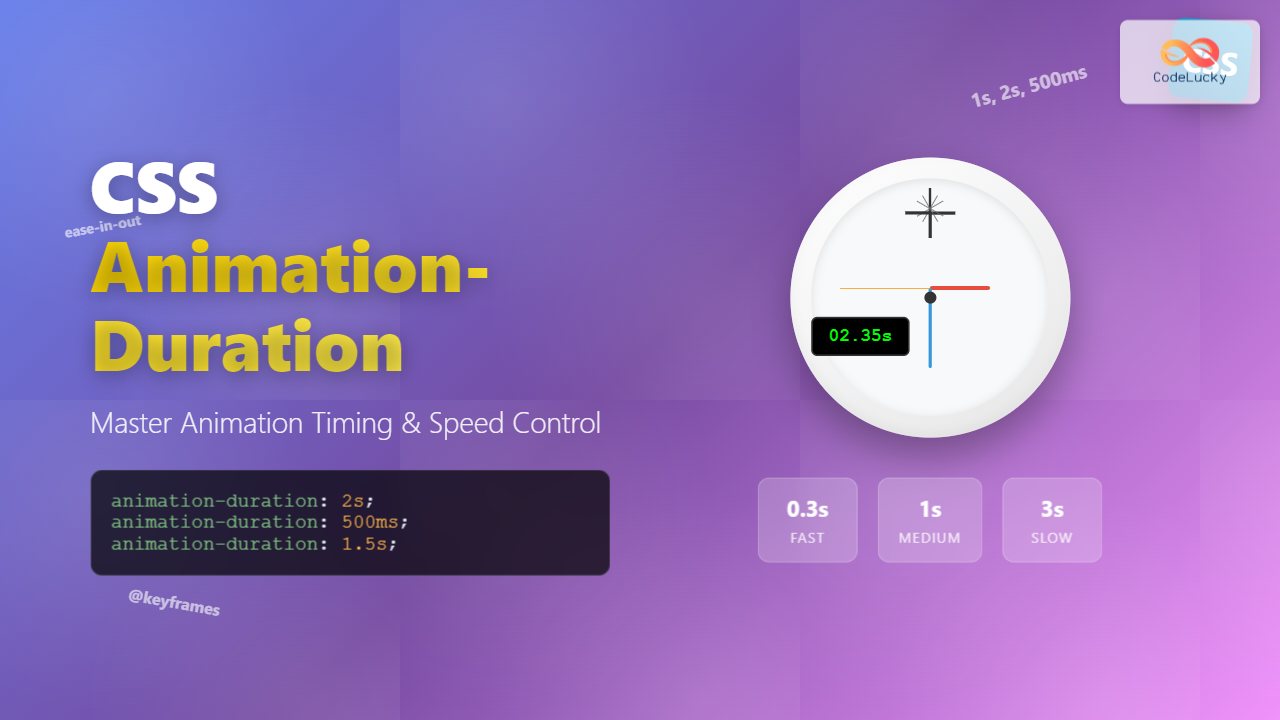
The animation-duration property is a fundamental CSS animation property that controls how long an animation takes to complete one full cycle. Whether you’re creating subtle hover effects or complex keyframe animations, understanding animation-duration is essential for crafting smooth, engaging user experiences.
What is CSS Animation-Duration?
The animation-duration property specifies the length of time an animation should take to complete one iteration. It’s measured in seconds (s) or milliseconds (ms) and determines the speed at which your animation plays from start to finish.
Syntax
animation-duration: time;

/* Examples */
animation-duration: 2s;        /* 2 seconds */
animation-duration: 500ms;     /* 500 milliseconds */
animation-duration: 0.5s;      /* 0.5 seconds */
animation-duration: 1s, 3s;    /* Multiple durations */
Animation-Duration Values
The animation-duration property accepts several types of values:
Time Values
- Seconds (s): Use decimal numbers like
1s,2.5s,0.3s - Milliseconds (ms): Use whole numbers like
1000ms,500ms,250ms - Zero (0): Instant animation completion
Multiple Values
You can specify multiple duration values for different animations applied to the same element:
.element {
  animation-name: fadeIn, slideUp;
  animation-duration: 1s, 2s;
}
Basic Animation-Duration Examples
Simple Fade Animation
@keyframes fadeIn {
  from { opacity: 0; }
  to { opacity: 1; }
}

.fade-slow {
  animation-name: fadeIn;
  animation-duration: 3s;
}

.fade-fast {
  animation-name: fadeIn;
  animation-duration: 0.5s;
}Bounce Animation with Different Durations
@keyframes bounce {
  0%, 100% { transform: translateY(0); }
  50% { transform: translateY(-20px); }
}

.bounce-1s { animation: bounce 1s infinite; }
.bounce-2s { animation: bounce 2s infinite; }
.bounce-500ms { animation: bounce 0.5s infinite; }Interactive Animation Duration Demo
Adjust Animation Duration
Duration: 1.0 seconds
Animation-Duration vs Other Timing Properties
Understanding how animation-duration works with other animation properties is crucial for creating complex animations:
Duration with Delay
.delayed-animation {
  animation-name: slideIn;
  animation-duration: 2s;        /* Animation takes 2 seconds */
  animation-delay: 1s;           /* Starts after 1 second delay */
  animation-iteration-count: 3;  /* Repeats 3 times */
}
Duration with Iteration Count
@keyframes pulse {
  0%, 100% { transform: scale(1); }
  50% { transform: scale(1.2); }
}

.pulse-finite {
  animation: pulse 1s 3; /* 3 iterations */
}

.pulse-infinite {
  animation: pulse 1s infinite;
}Advanced Animation-Duration Techniques
Staggered Animations
Create staggered effects by applying different durations to multiple elements:
.stagger-item:nth-child(1) {
  animation: slideUp 0.6s ease-out;
}
.stagger-item:nth-child(2) {
  animation: slideUp 0.8s ease-out;
}
.stagger-item:nth-child(3) {
  animation: slideUp 1s ease-out;
}
.stagger-item:nth-child(4) {
  animation: slideUp 1.2s ease-out;
}Complex Multi-Animation Example
.complex-animation {
  animation:
    colorChange 3s infinite,
    rotate 2s linear infinite,
    scale 4s ease-in-out infinite;
}

@keyframes colorChange {
  0% { background: #667eea; }
  50% { background: #764ba2; }
  100% { background: #667eea; }
}

@keyframes rotate {
  from { transform: rotate(0deg); }
  to { transform: rotate(360deg); }
}

@keyframes scale {
  0%, 100% { transform: scale(1); }
  50% { transform: scale(1.3); }
}
Color: 3s | Rotate: 2s | Scale: 4s
Performance Considerations
Choosing the right animation duration is crucial for both user experience and performance:
Optimal Duration Guidelines
Recommended Durations
- Micro-interactions: 150-300ms (button hovers, form focus)
- UI transitions: 300-500ms (modal open/close, menu slides)
- Page transitions: 500ms-1s (route changes, content swaps)
- Attention-grabbing: 1s-3s (loading animations, onboarding)
- Decorative animations: 2s+ (background effects, ambient animations)
Performance Tips
Best Practices
- Shorter durations generally provide better perceived performance
- Use CSS transforms instead of changing layout properties
- Consider reduced motion preferences with
prefers-reduced-motion - Test animations on slower devices to ensure smooth playback
- Avoid very long durations that may frustrate users
Responsive Animation Durations
Adapt animation durations for different screen sizes and devices:
/* Base duration for mobile */
.responsive-animation {
  animation-duration: 0.3s;
}

/* Longer duration for tablets */
@media (min-width: 768px) {
  .responsive-animation {
    animation-duration: 0.5s;
  }
}

/* Even longer for desktop */
@media (min-width: 1024px) {
  .responsive-animation {
    animation-duration: 0.8s;
  }
}

/* Respect user preferences */
@media (prefers-reduced-motion: reduce) {
  .responsive-animation {
    animation-duration: 0.1s;
  }
}
Common Mistakes to Avoid
Duration Too Long
Avoid: animation-duration: 10s; for UI interactions – users will lose patience
Duration Too Short
Avoid: animation-duration: 0.05s; – animation may not be visible
Ignoring Context
Avoid: Using the same duration for all animations regardless of their purpose
Browser Support and Fallbacks
CSS animations have excellent browser support, but it’s good practice to provide fallbacks:
/* Progressive enhancement approach */
.enhanced-element {
  /* Base styles without animation */
  opacity: 1;
  transform: translateX(0);
}

/* Add animation for supporting browsers */
@supports (animation-duration: 1s) {
  .enhanced-element {
    animation: slideInFade 0.6s ease-out;
  }
}
Testing Animation Durations
Use browser developer tools to test and refine your animation durations:
- Chrome DevTools: Use the Animations panel to visualize timing
- Firefox DevTools: Animations inspector shows duration and timing
- Performance testing: Check animations on different devices
- User testing: Gather feedback on animation feel and timing
Conclusion
The animation-duration property is fundamental to creating engaging web animations. By understanding how to use different duration values, combine them with other animation properties, and optimize for performance and user experience, you can create animations that enhance your web applications without overwhelming users.
Remember to always consider your users’ preferences, device capabilities, and the context of your animations when choosing duration values. Start with shorter durations and gradually increase as needed, always testing across different devices and connection speeds.
Key Takeaways
- Use appropriate durations for different types of interactions
- Test animations on various devices and connection speeds
- Respect user preferences with
prefers-reduced-motion - Combine duration with other animation properties for complex effects
- Performance matters – shorter durations often feel more responsive
Related Posts
CSS Style animationDuration Property: CSS Animation Duration
Understanding the animationDuration Property in CSS The animationDuration property in CSS specifies the length of time that an animation should...
CSS Animation Timing Function: Complete Guide to Animation Easing Functions
The animation-timing-function property in CSS controls how an animation progresses through its duration, determining the acceleration and deceleration patterns that...
CSS Transition-Duration: Complete Guide to Animation Timing Control
What is CSS Transition-Duration? The transition-duration property in CSS defines how long a transition animation should take to complete. It's...
CSS Transition-Timing-Function: Master Easing and Animation Curves for Smooth Web Animations
The transition-timing-function property in CSS is a powerful tool that controls how intermediate values are calculated during a transition. It...
CSS Style animationTimingFunction Property: CSS Animation Timing Function
CSS Style animationTimingFunction Property: A Comprehensive Guide The animation-timing-function property in CSS is a crucial component for controlling the pace...
CSS Animation-Delay: Master Timing Control for Perfect Web Animations
What is CSS Animation-Delay? The animation-delay property in CSS controls when an animation starts after it's been applied to an...
CSS Transition-Delay: Master Animation Timing and Sequencing
The transition-delay property in CSS is a powerful tool that allows you to control when a transition animation begins. Unlike...
CSS Transition-Property: Complete Guide to Controlling Animated Properties
Understanding CSS Transition-Property The CSS transition-property is a fundamental property that controls which CSS properties will animate when their values...

CSS Style animationDelay Property: CSS Animation Delay
Understanding the CSS animationDelay Property The CSS animationDelay property specifies the amount of time to wait from when the element...
CSS Animation Property: Complete Guide to Keyframe-Based Animations
CSS animations bring life to web pages by allowing elements to transition smoothly between different states over time. The animation...
CSS Style animationIterationCount Property: CSS Animation Iteration Count
CSS animation-iteration-count Property: Controlling Animation Loops The animation-iteration-count property in CSS specifies the number of times an animation should play....
CSS Transition Property: Complete Guide to Smooth Animation Effects
CSS transitions enable smooth, visually appealing animations when element properties change, transforming abrupt state changes into fluid motion. This powerful...