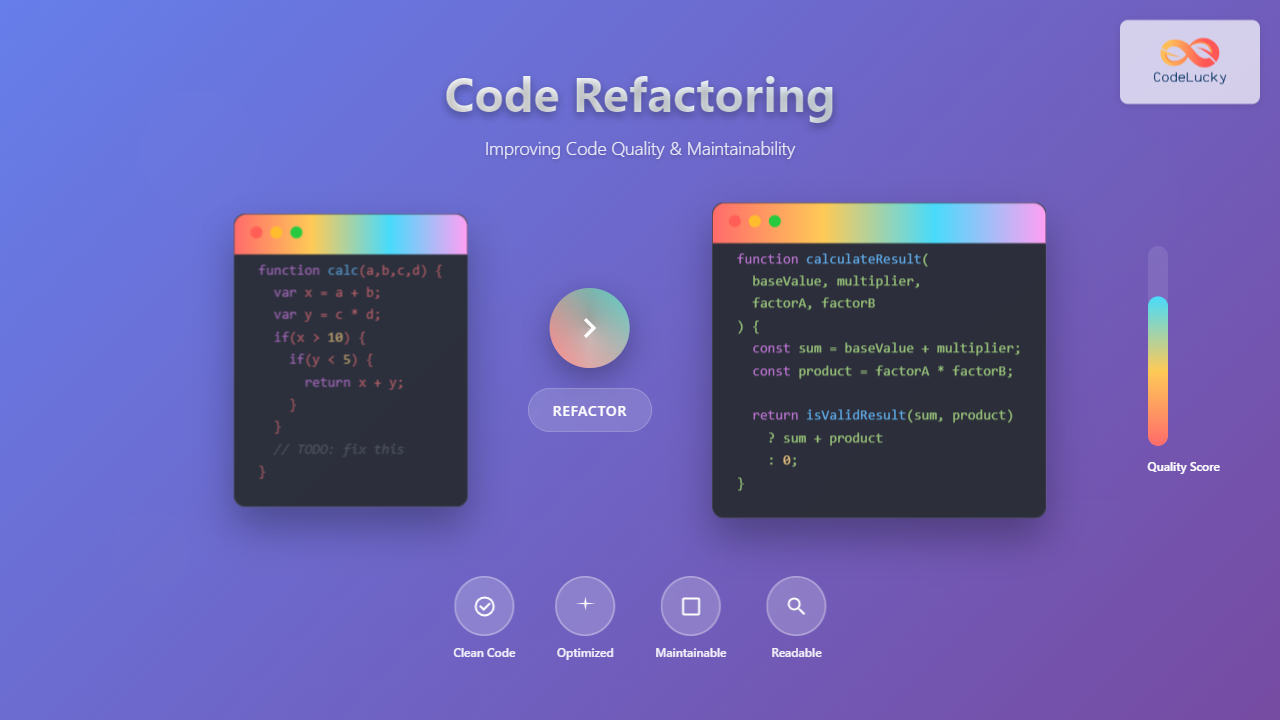
Code refactoring is the systematic process of restructuring existing code without changing its external behavior. It’s a critical practice in software development that improves code quality, enhances readability, and reduces technical debt while maintaining functionality.
What is Code Refactoring?
Code refactoring involves making incremental improvements to your codebase by reorganizing, simplifying, and optimizing the internal structure. Unlike adding new features or fixing bugs, refactoring focuses solely on improving the code’s design and architecture without altering what the software does from a user’s perspective.
The primary goal is to make code more maintainable, readable, and efficient while preserving its original functionality. This practice is essential for long-term software sustainability and team productivity.
Why is Code Refactoring Important?
Enhanced Code Readability
Refactoring transforms complex, hard-to-understand code into clear, self-documenting structures. When code is readable, developers can quickly understand its purpose, making future modifications faster and less error-prone.
Reduced Technical Debt
Technical debt accumulates when quick fixes and shortcuts are implemented without proper design consideration. Regular refactoring addresses this debt, preventing it from becoming overwhelming and expensive to resolve later.
Improved Performance
Refactoring often reveals opportunities to optimize algorithms, eliminate redundancies, and improve resource utilization, leading to better application performance.
Easier Maintenance
Well-refactored code is modular and loosely coupled, making it easier to modify, extend, and debug. This significantly reduces maintenance costs and development time for future enhancements.
Common Code Smells That Indicate Need for Refactoring
Long Methods and Classes
Methods that exceed 20-30 lines or classes with too many responsibilities are prime candidates for refactoring. These structures violate the Single Responsibility Principle and become difficult to test and maintain.
Duplicate Code
Code duplication violates the DRY (Don’t Repeat Yourself) principle and creates maintenance nightmares. When the same logic appears in multiple places, changes must be made in several locations, increasing the risk of inconsistencies.
Large Parameter Lists
Methods with numerous parameters are often doing too much or lack proper object abstraction. This makes the method signature complex and error-prone.
Feature Envy
When a class uses methods from another class excessively, it may indicate improper responsibility distribution and tight coupling between classes.
Dead Code
Unused variables, methods, or classes clutter the codebase and create confusion. Dead code should be identified and removed during refactoring sessions.
Essential Refactoring Techniques
Extract Method
This technique involves taking a portion of code from a long method and creating a separate method with a descriptive name. It improves readability and promotes code reuse.
// Before refactoring
function processOrder(order) {
    // Validate order
    if (!order.items || order.items.length === 0) {
        throw new Error('Order must have items');
    }
    if (!order.customer || !order.customer.email) {
        throw new Error('Customer email required');
    }

    // Calculate total
    let total = 0;
    for (let item of order.items) {
        total += item.price * item.quantity;
    }

    // Apply discount
    if (order.customer.isVip) {
        total *= 0.9;
    }

    return total;
}

// After refactoring
function processOrder(order) {
    validateOrder(order);
    const total = calculateTotal(order);
    return applyDiscount(total, order.customer);
}

function validateOrder(order) {
    if (!order.items || order.items.length === 0) {
        throw new Error('Order must have items');
    }
    if (!order.customer || !order.customer.email) {
        throw new Error('Customer email required');
    }
}

function calculateTotal(order) {
    return order.items.reduce((sum, item) => sum + (item.price * item.quantity), 0);
}

function applyDiscount(total, customer) {
    return customer.isVip ? total * 0.9 : total;
}
Rename Variables and Methods
Clear, descriptive names make code self-documenting. Replace vague names like data, temp, or process() with meaningful alternatives.
Replace Magic Numbers with Constants
Magic numbers are literal values that appear in code without explanation. Replace them with named constants to improve code clarity and maintainability.
// Before
if (user.age >= 18) {
    // Allow access
}

// After
const LEGAL_AGE = 18;
if (user.age >= LEGAL_AGE) {
    // Allow access
}
Consolidate Conditional Expressions
Complex conditional logic can be simplified by extracting conditions into well-named methods or combining related conditions.
Replace Nested Conditionals with Guard Clauses
Guard clauses improve readability by handling edge cases early and reducing nesting levels.
// Before
function calculateDiscount(customer, order) {
    if (customer) {
        if (customer.isVip) {
            if (order.total > 100) {
                return order.total * 0.15;
            } else {
                return order.total * 0.1;
            }
        } else {
            return order.total * 0.05;
        }
    } else {
        return 0;
    }
}

// After
function calculateDiscount(customer, order) {
    if (!customer) return 0;
    if (!customer.isVip) return order.total * 0.05;

    return order.total > 100 ? order.total * 0.15 : order.total * 0.1;
}
Best Practices for Safe Refactoring
Start with Comprehensive Tests
Before refactoring, ensure you have robust unit tests covering the code you plan to modify. Tests act as a safety net, confirming that functionality remains intact after changes.
Make Small, Incremental Changes
Avoid large-scale refactoring sessions. Instead, make small, focused changes that can be easily tested and reviewed. This approach reduces risk and makes it easier to identify issues.
Refactor One Thing at a Time
Focus on a single refactoring technique per session. Don’t mix functional changes with refactoring activities, as this makes it difficult to track what changed and why.
Use Automated Refactoring Tools
Modern IDEs provide powerful refactoring tools that can safely rename variables, extract methods, and reorganize code structures. These tools reduce human error and save time.
Review and Test Frequently
After each refactoring step, run your tests and review the changes. This practice helps catch issues early and ensures that each modification improves the code quality.
Refactoring in Agile Development
In Agile methodologies, refactoring is not a separate phase but an integral part of the development process. It supports Agile principles by enabling continuous improvement and adaptation to changing requirements.
Continuous Refactoring
Rather than dedicating entire sprints to refactoring, teams should incorporate it into daily development activities. The “Boy Scout Rule” applies here: always leave the code cleaner than you found it.
Technical Debt Management
Agile teams should track technical debt and allocate time in each sprint for addressing it through refactoring. This prevents debt from accumulating to unmanageable levels.
Refactoring User Stories
Sometimes, significant refactoring efforts warrant their own user stories. These should be prioritized based on their impact on development velocity and code quality.
Tools and Technologies for Effective Refactoring
IDE Features
Modern integrated development environments offer sophisticated refactoring capabilities:
- Automated Renaming: Safely rename variables, methods, and classes across the entire codebase
- Extract Method: Automatically create new methods from selected code blocks
- Move Operations: Relocate methods and classes between files and packages
- Inline Operations: Replace method calls with their actual implementation when appropriate
Static Analysis Tools
Static analysis tools like SonarQube, ESLint, and RuboCop identify code smells and suggest improvements. They provide objective metrics for code quality and help prioritize refactoring efforts.
Version Control Best Practices
Use version control effectively during refactoring by making frequent, small commits with descriptive messages. This creates a clear history of changes and makes it easier to revert if necessary.
Measuring Refactoring Success
Code Quality Metrics
Track improvements using measurable criteria:
- Cyclomatic Complexity: Measure the complexity of your code paths
- Code Coverage: Ensure tests cover refactored code adequately
- Maintainability Index: Use tools to calculate code maintainability scores
- Technical Debt Ratio: Monitor the percentage of code that needs refactoring
Team Productivity Indicators
Successful refactoring should lead to improved team productivity, faster feature delivery, and reduced bug rates. Monitor these metrics to validate the effectiveness of your refactoring efforts.
Common Refactoring Challenges and Solutions
Resistance to Change
Teams may resist refactoring due to time constraints or fear of introducing bugs. Address this by demonstrating the long-term benefits and starting with low-risk, high-impact improvements.
Lack of Test Coverage
Refactoring without adequate tests is risky. Invest time in creating comprehensive tests before major refactoring efforts, or consider writing tests as part of the refactoring process.
Legacy Code Constraints
Legacy systems may have architectural limitations that make refactoring challenging. Approach these situations with the Strangler Fig pattern, gradually replacing old code with new, improved implementations.
Advanced Refactoring Patterns
Strategy Pattern Implementation
Replace complex conditional logic with the Strategy pattern to improve extensibility and maintainability.
Dependency Injection
Reduce tight coupling by implementing dependency injection, making code more testable and flexible.
Observer Pattern
Implement the Observer pattern to handle event-driven scenarios more elegantly than direct method calls.
Refactoring for Different Programming Paradigms
Object-Oriented Refactoring
Focus on improving class hierarchies, encapsulation, and polymorphism. Apply SOLID principles to create more maintainable object-oriented designs.
Functional Programming Refactoring
Emphasize immutability, pure functions, and higher-order functions. Refactor imperative code to use functional approaches where appropriate.
Microservices Refactoring
In microservices architectures, refactoring may involve breaking down monolithic services, improving API designs, and optimizing service boundaries.
Building a Refactoring Culture
Team Education
Invest in training team members on refactoring techniques and tools. Regular code reviews and pair programming sessions help spread knowledge and best practices.
Establishing Guidelines
Create team guidelines for when and how to refactor. Document common code smells and preferred refactoring approaches to ensure consistency.
Time Allocation
Allocate dedicated time for refactoring in sprint planning. Consider the 20% rule: spend 20% of development time on technical improvements and refactoring.
Future of Code Refactoring
The future of refactoring is increasingly automated, with AI-powered tools emerging that can suggest and even perform complex refactoring operations. Machine learning algorithms analyze codebases to identify patterns and recommend improvements automatically.
However, human insight remains crucial for making strategic refactoring decisions that align with business goals and architectural vision. The most effective approach combines automated tools with experienced developer judgment.
Conclusion
Code refactoring is an essential practice for maintaining healthy, sustainable software systems. By systematically improving code quality through proven techniques and best practices, development teams can reduce technical debt, enhance productivity, and deliver better software products.
Remember that refactoring is not a one-time activity but an ongoing process that should be integrated into your regular development workflow. Start small, focus on the most impactful improvements, and gradually build a culture of continuous code improvement within your team.
The investment in refactoring pays dividends through reduced maintenance costs, faster feature development, and improved team morale. Make refactoring a priority in your development process, and watch your code quality and team productivity soar.
Related Posts

C Code Documentation: Best Practices and Tools
In the world of software development, writing clean, efficient code is only half the battle. The other crucial aspect is...

CSS Refactoring: Complete Guide to Modernizing Legacy Stylesheets
Legacy CSS codebases can become a significant burden on development teams, slowing down feature delivery and creating maintenance nightmares. CSS...

XP Practices: Pair Programming, TDD, and Refactoring – Complete Guide to Extreme Programming Core Techniques
Extreme Programming (XP) has transformed how development teams approach software creation through its emphasis on technical excellence and collaborative practices....

Agile Architecture: Designing for Change – Building Flexible Software Systems
In today's rapidly evolving digital landscape, traditional waterfall architecture approaches often fail to meet the dynamic needs of modern software...

Agile Documentation: Complete Guide to Living Documentation Strategies
What is Living Documentation in Agile Development? Living documentation represents a paradigm shift from traditional static documentation to dynamic, self-updating...

Waste in Software Development: Identifying and Eliminating the 8 Types of Muda for Better Agile Teams
In the fast-paced world of software development, efficiency isn't just about writing code faster—it's about eliminating activities that don't add...

Java Testing: JUnit and TestNG Frameworks
In the world of Java development, writing robust and reliable code is only half the battle. The other crucial aspect...

Java Methods: Defining and Calling Functions
Java methods are the building blocks of any Java program, serving as reusable units of code that perform specific tasks....

HTML Comments: Your Guide to Documenting and Organizing Code
Introduction Ever looked at a piece of code you wrote a few weeks ago and thought, "What was I even...

Collective Code Ownership: Building Team Responsibility and Code Quality in Agile Development
In the fast-paced world of software development, the traditional approach of individual code ownership often creates bottlenecks, knowledge silos, and...

Continuous Integration: Automating Code Integration for Modern Development Teams
Continuous Integration (CI) has revolutionized how development teams collaborate, integrate code changes, and deliver software. As a cornerstone of modern...

Quality Metrics: Defect Rates and Trends – Complete Guide for Agile Teams
Understanding Quality Metrics in Agile Development Quality metrics serve as the compass for Agile teams navigating the complex landscape of...
- What is Code Refactoring?
- Why is Code Refactoring Important?
- Common Code Smells That Indicate Need for Refactoring
- Essential Refactoring Techniques
- Best Practices for Safe Refactoring
- Refactoring in Agile Development
- Tools and Technologies for Effective Refactoring
- Measuring Refactoring Success
- Common Refactoring Challenges and Solutions
- Advanced Refactoring Patterns
- Refactoring for Different Programming Paradigms
- Building a Refactoring Culture
- Future of Code Refactoring
- Conclusion