What is a Binary Semaphore?
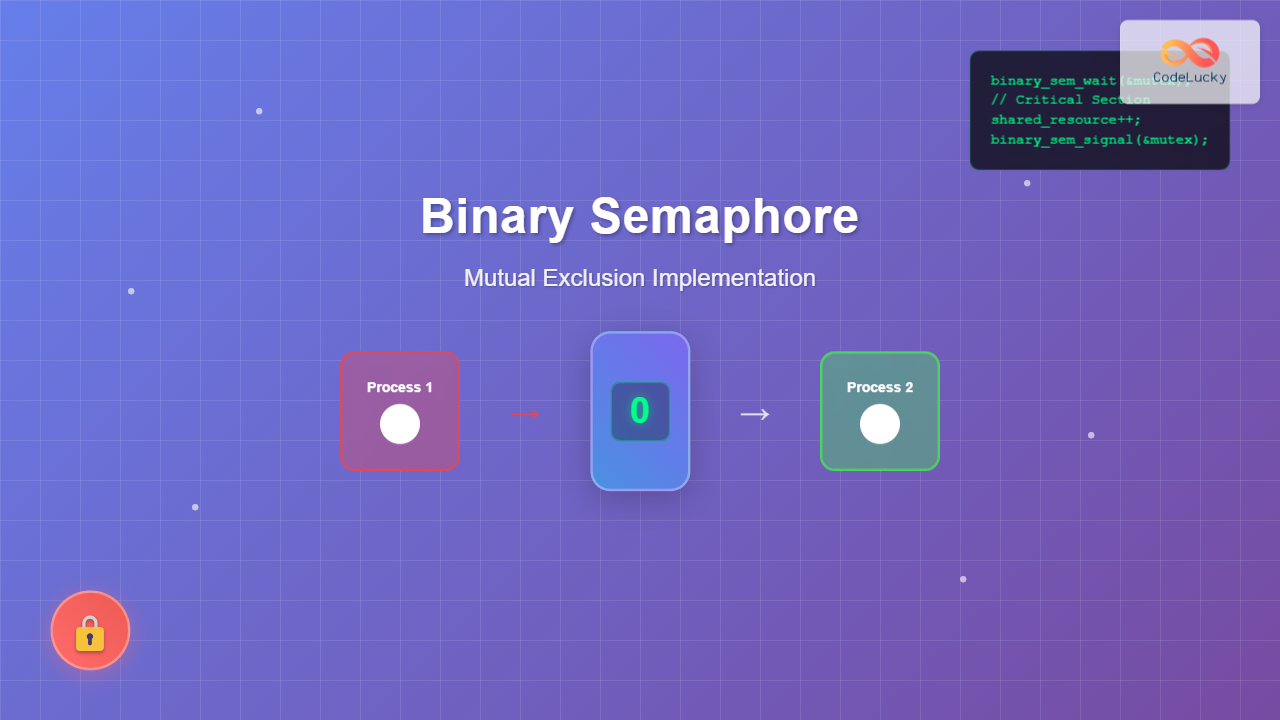
A binary semaphore is a synchronization primitive in operating systems that can hold only two values: 0 and 1. Unlike counting semaphores that can have any non-negative integer value, binary semaphores act as simple locks, making them perfect for implementing mutual exclusion (mutex) in concurrent programming.
Binary semaphores are fundamental building blocks for process synchronization, ensuring that only one process can access a critical section at any given time. They provide a simple yet powerful mechanism to prevent race conditions and maintain data consistency in multi-process or multi-threaded environments.
Core Concepts of Binary Semaphores
Basic Operations
Binary semaphores support two atomic operations:
- Wait() or P(): Decrements the semaphore value. If the value becomes negative, the process is blocked.
- Signal() or V(): Increments the semaphore value and wakes up a waiting process if any.

States and Transitions
A binary semaphore can exist in two states:
- State 1 (Available): Resource is free, one process can acquire it
- State 0 (Unavailable): Resource is occupied, other processes must wait
Implementation of Binary Semaphore
Basic Structure
Here’s a fundamental implementation of a binary semaphore in C:
#include <stdio.h>
#include <pthread.h>
#include <unistd.h>
#include <semaphore.h>

typedef struct {
    int value;
    pthread_mutex_t mutex;
    pthread_cond_t condition;
} binary_semaphore_t;

// Initialize binary semaphore
void binary_sem_init(binary_semaphore_t *sem, int initial_value) {
    sem->value = (initial_value > 0) ? 1 : 0;  // Ensure binary nature
    pthread_mutex_init(&sem->mutex, NULL);
    pthread_cond_init(&sem->condition, NULL);
}

// Wait operation (P operation)
void binary_sem_wait(binary_semaphore_t *sem) {
    pthread_mutex_lock(&sem->mutex);
    while (sem->value == 0) {
        pthread_cond_wait(&sem->condition, &sem->mutex);
    }
    sem->value = 0;  // Set to 0 (occupied)
    pthread_mutex_unlock(&sem->mutex);
}

// Signal operation (V operation)
void binary_sem_signal(binary_semaphore_t *sem) {
    pthread_mutex_lock(&sem->mutex);
    sem->value = 1;  // Set to 1 (available)
    pthread_cond_signal(&sem->condition);
    pthread_mutex_unlock(&sem->mutex);
}

// Destroy semaphore
void binary_sem_destroy(binary_semaphore_t *sem) {
    pthread_mutex_destroy(&sem->mutex);
    pthread_cond_destroy(&sem->condition);
}
Practical Example: Critical Section Protection
Let’s implement a practical example showing how binary semaphores protect critical sections:
#include <stdio.h>
#include <pthread.h>
#include <unistd.h>
#include <stdlib.h>

binary_semaphore_t mutex_sem;
int shared_resource = 0;
int thread_count = 0;

void* worker_thread(void* arg) {
    int thread_id = *(int*)arg;

    for (int i = 0; i < 5; i++) {
        printf("Thread %d: Requesting access to critical section\n", thread_id);

        // Wait for semaphore (enter critical section)
        binary_sem_wait(&mutex_sem);

        printf("Thread %d: ENTERED critical section\n", thread_id);

        // Critical section - modify shared resource
        int temp = shared_resource;
        usleep(100000);  // Simulate some work
        shared_resource = temp + 1;
        thread_count++;

        printf("Thread %d: Modified shared_resource to %d\n",
               thread_id, shared_resource);

        // Signal semaphore (exit critical section)
        binary_sem_signal(&mutex_sem);
        printf("Thread %d: EXITED critical section\n", thread_id);

        usleep(50000);  // Some work outside critical section
    }

    return NULL;
}

int main() {
    pthread_t threads[3];
    int thread_ids[3] = {1, 2, 3};

    // Initialize binary semaphore with value 1 (available)
    binary_sem_init(&mutex_sem, 1);

    printf("Starting mutual exclusion demonstration...\n\n");

    // Create worker threads
    for (int i = 0; i < 3; i++) {
        pthread_create(&threads[i], NULL, worker_thread, &thread_ids[i]);
    }

    // Wait for all threads to complete
    for (int i = 0; i < 3; i++) {
        pthread_join(threads[i], NULL);
    }

    printf("\nFinal Results:\n");
    printf("Shared Resource Value: %d\n", shared_resource);
    printf("Total Critical Section Entries: %d\n", thread_count);

    binary_sem_destroy(&mutex_sem);
    return 0;
}
Expected Output:
Starting mutual exclusion demonstration...

Thread 1: Requesting access to critical section
Thread 1: ENTERED critical section
Thread 2: Requesting access to critical section
Thread 3: Requesting access to critical section
Thread 1: Modified shared_resource to 1
Thread 1: EXITED critical section
Thread 2: ENTERED critical section
Thread 2: Modified shared_resource to 2
Thread 2: EXITED critical section
Thread 3: ENTERED critical section
Thread 3: Modified shared_resource to 3
Thread 3: EXITED critical section
...

Final Results:
Shared Resource Value: 15
Total Critical Section Entries: 15
Binary Semaphore vs Mutex: Key Differences

| Aspect | Binary Semaphore | Mutex |
|---|---|---|
| Ownership | No ownership concept | Owned by acquiring thread |
| Release | Any process can signal | Only owner can unlock |
| Purpose | Signaling, synchronization | Mutual exclusion primarily |
| Priority Inversion | Susceptible | Protected with inheritance |
Real-World Applications
Producer-Consumer Problem
Binary semaphores are extensively used in solving the classic producer-consumer problem:
#include <stdio.h>
#include <pthread.h>
#include <unistd.h>
#include <stdlib.h>

#define BUFFER_SIZE 5

binary_semaphore_t mutex_sem;      // Protects buffer access
binary_semaphore_t empty_sem;      // Signals empty slots
binary_semaphore_t full_sem;       // Signals full slots

int buffer[BUFFER_SIZE];
int in = 0, out = 0;

void* producer(void* arg) {
    int producer_id = *(int*)arg;

    for (int i = 0; i < 3; i++) {
        int item = rand() % 100;

        printf("Producer %d: Producing item %d\n", producer_id, item);

        // Wait for empty slot
        binary_sem_wait(&empty_sem);

        // Get exclusive access to buffer
        binary_sem_wait(&mutex_sem);

        // Add item to buffer
        buffer[in] = item;
        printf("Producer %d: Added item %d at position %d\n",
               producer_id, item, in);
        in = (in + 1) % BUFFER_SIZE;

        // Release buffer access
        binary_sem_signal(&mutex_sem);

        // Signal that buffer has one more item
        binary_sem_signal(&full_sem);

        sleep(1);
    }
    return NULL;
}

void* consumer(void* arg) {
    int consumer_id = *(int*)arg;

    for (int i = 0; i < 3; i++) {
        // Wait for full slot
        binary_sem_wait(&full_sem);

        // Get exclusive access to buffer
        binary_sem_wait(&mutex_sem);

        // Remove item from buffer
        int item = buffer[out];
        printf("Consumer %d: Consumed item %d from position %d\n",
               consumer_id, item, out);
        out = (out + 1) % BUFFER_SIZE;

        // Release buffer access
        binary_sem_signal(&mutex_sem);

        // Signal that buffer has one more empty slot
        binary_sem_signal(&empty_sem);

        sleep(2);
    }
    return NULL;
}
File Access Synchronization
Here’s an example of using binary semaphores for coordinating file access:
binary_semaphore_t file_access_sem;

void* file_writer(void* arg) {
    int writer_id = *(int*)arg;

    binary_sem_wait(&file_access_sem);

    printf("Writer %d: Acquired file lock\n", writer_id);

    // Simulate file writing
    FILE *file = fopen("shared_file.txt", "a");
    if (file) {
        fprintf(file, "Data from writer %d\n", writer_id);
        fclose(file);
        printf("Writer %d: Successfully wrote to file\n", writer_id);
    }

    sleep(2);  // Simulate write time

    binary_sem_signal(&file_access_sem);
    printf("Writer %d: Released file lock\n", writer_id);

    return NULL;
}
Advanced Implementation Techniques
Timeout-based Binary Semaphore
#include <time.h>

typedef struct {
    int value;
    pthread_mutex_t mutex;
    pthread_cond_t condition;
} timed_binary_semaphore_t;

// Wait with timeout
int binary_sem_wait_timeout(timed_binary_semaphore_t *sem, int timeout_ms) {
    pthread_mutex_lock(&sem->mutex);

    if (sem->value == 0) {
        struct timespec timeout;
        clock_gettime(CLOCK_REALTIME, &timeout);
        timeout.tv_nsec += timeout_ms * 1000000;

        if (timeout.tv_nsec >= 1000000000) {
            timeout.tv_sec += timeout.tv_nsec / 1000000000;
            timeout.tv_nsec %= 1000000000;
        }

        int result = pthread_cond_timedwait(&sem->condition,
                                          &sem->mutex, &timeout);
        if (result != 0) {
            pthread_mutex_unlock(&sem->mutex);
            return -1;  // Timeout occurred
        }
    }

    sem->value = 0;
    pthread_mutex_unlock(&sem->mutex);
    return 0;  // Success
}
Performance Considerations and Best Practices

Optimization Guidelines
- Minimize Critical Section Duration: Keep the code within critical sections as short as possible
- Avoid Nested Semaphores: Prevent potential deadlocks by avoiding nested semaphore acquisitions
- Use Appropriate Granularity: Balance between too many fine-grained locks and coarse-grained locks
- Error Handling: Always check return values and handle timeout scenarios
Common Pitfalls to Avoid
// BAD: Forgetting to signal
void bad_example() {
    binary_sem_wait(&semaphore);

    if (some_error_condition) {
        return;  // BAD: semaphore never signaled!
    }

    // do work
    binary_sem_signal(&semaphore);
}

// GOOD: Always signal in all paths
void good_example() {
    binary_sem_wait(&semaphore);

    if (some_error_condition) {
        binary_sem_signal(&semaphore);  // GOOD: always signal
        return;
    }

    // do work
    binary_sem_signal(&semaphore);
}
Testing and Debugging Binary Semaphores
Comprehensive Test Suite
void test_binary_semaphore_basic() {
    binary_semaphore_t test_sem;
    binary_sem_init(&test_sem, 1);

    // Test initial state
    assert(test_sem.value == 1);

    // Test wait operation
    binary_sem_wait(&test_sem);
    assert(test_sem.value == 0);

    // Test signal operation
    binary_sem_signal(&test_sem);
    assert(test_sem.value == 1);

    binary_sem_destroy(&test_sem);
    printf("Basic binary semaphore test: PASSED\n");
}

void test_mutual_exclusion() {
    binary_semaphore_t mutex;
    binary_sem_init(&mutex, 1);

    int shared_counter = 0;
    pthread_t threads[10];

    // Create multiple threads to test mutual exclusion
    for (int i = 0; i < 10; i++) {
        pthread_create(&threads[i], NULL, increment_counter, &mutex);
    }

    // Wait for completion
    for (int i = 0; i < 10; i++) {
        pthread_join(threads[i], NULL);
    }

    // Verify no race condition occurred
    assert(shared_counter == expected_value);

    binary_sem_destroy(&mutex);
    printf("Mutual exclusion test: PASSED\n");
}
Integration with Modern Systems
POSIX Semaphores Integration
#include <semaphore.h>

// Using POSIX binary semaphore
sem_t binary_sem;

void posix_binary_semaphore_example() {
    // Initialize as binary semaphore
    sem_init(&binary_sem, 0, 1);

    // Wait operation
    sem_wait(&binary_sem);

    // Critical section
    printf("In critical section\n");

    // Signal operation
    sem_post(&binary_sem);

    // Cleanup
    sem_destroy(&binary_sem);
}
Cross-Platform Considerations
When implementing binary semaphores across different platforms:
- Windows: Use CreateSemaphore() with maximum count of 1
- Linux/Unix: Use POSIX semaphores or implement with pthread primitives
- Real-time Systems: Consider priority inheritance mechanisms
Conclusion
Binary semaphores are essential synchronization primitives that provide elegant solutions for mutual exclusion problems in operating systems. Their simplicity and effectiveness make them invaluable tools for preventing race conditions and ensuring data consistency in concurrent environments.
Key takeaways for implementing binary semaphores:
- Always ensure proper initialization and cleanup
- Handle error conditions and timeouts appropriately
- Keep critical sections minimal to reduce contention
- Test thoroughly with multiple threads to verify correctness
- Consider using established libraries like POSIX semaphores for production code
Understanding binary semaphores and their proper implementation is crucial for system programmers and anyone working with concurrent systems. They form the foundation for more complex synchronization mechanisms and are fundamental to building reliable multi-threaded applications.
Related Posts

Mutex vs Semaphore: Complete Guide to Synchronization Primitives in Operating Systems
In the world of concurrent programming and operating systems, synchronization primitives are essential tools that prevent race conditions and ensure...

Thread Synchronization: Mutexes, Semaphores and Deadlocks in Operating Systems
Introduction to Thread Synchronization Thread synchronization is a fundamental concept in operating systems that ensures multiple threads can safely access...
Counting Semaphore: Resource Counting Mechanism in Operating Systems
Counting semaphores are fundamental synchronization primitives in operating systems that manage access to a finite number of identical resources. Unlike...
Monitor in Operating System: High-level Synchronization for Process Coordination
What is a Monitor in Operating System? A monitor is a high-level synchronization construct in operating systems that provides a...
Test and Set Lock: Complete Guide to Atomic Hardware Instructions for Process Synchronization
The Test and Set Lock is a fundamental atomic hardware instruction that plays a crucial role in process synchronization and...

Peterson’s Algorithm: Complete Guide to Two-Process Mutual Exclusion in Operating Systems
What is Peterson's Algorithm? Peterson's Algorithm is a classic solution for achieving mutual exclusion between two processes or threads in...

Critical Section Problem: Complete Guide to Mutual Exclusion Solutions in Operating Systems
What is the Critical Section Problem? The critical section problem is a fundamental challenge in operating systems where multiple processes...
C++ Atomic Operations: Lock-Free Programming
In the world of modern C++ programming, concurrency and parallelism have become increasingly important. As developers, we often need to...

Process Synchronization: Critical Sections and Race Conditions in Operating Systems
Introduction to Process Synchronization Process synchronization is a fundamental concept in operating systems that ensures multiple processes can safely access...
Lamport’s Bakery Algorithm: Complete Guide to N-Process Mutual Exclusion
Lamport's Bakery Algorithm stands as one of the most elegant solutions to the N-process mutual exclusion problem in concurrent programming....
Thread in Operating System: Lightweight Processes and Multithreading Explained
What are Threads in Operating Systems? A thread is the smallest unit of execution within a process that can be...

Readers Writers Problem: Complete Guide to Database Synchronization
The Readers Writers Problem is one of the most fundamental synchronization challenges in operating systems and database management. This classic...