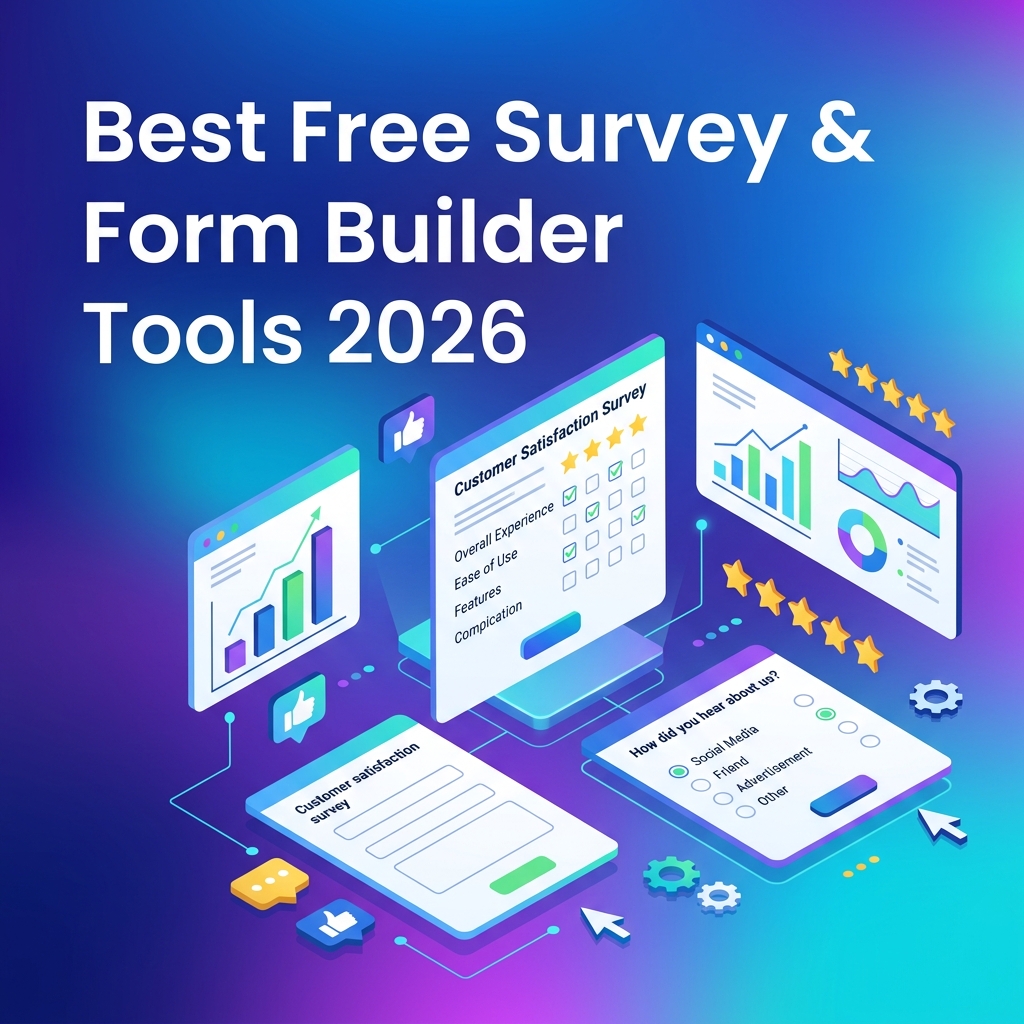
You opened Google Forms to whip up a quick customer feedback survey, and ten minutes later you were fighting with limited question types, bland themes, and zero conditional logic. Sound familiar? Google Forms is fine for the basics, but the moment you need branching questions, payment collection, advanced analytics, or simply a form that doesn’t look like it was built in 2012, you start hunting for something better.
The good news: the market for free survey and form builder tools in 2026 is genuinely impressive. You can collect responses, automate workflows, embed forms on your site, and analyze data without paying a cent — if you pick the right tool for the job. This guide walks you through the strongest Google Forms alternatives available today, what they actually do for free, where their limits kick in, and how to choose one that fits your use case.
What Makes a Great Free Survey and Form Builder Tool?
A great free survey and form builder tool is software that lets you design, distribute, and analyze online forms without a paid subscription, while still offering enough question types, logic, integrations, and response capacity to support real-world work. The best free tiers in 2026 include conditional branching, mobile-friendly templates, basic analytics, and exports to CSV or Google Sheets.
Before picking a platform, it helps to know what separates a hobby-grade builder from a workhorse. Look for these features:
- Unlimited or generous response limits — many free plans cap monthly submissions at 100 or fewer.
- Conditional logic and branching — show or hide questions based on prior answers.
- Multiple question types — beyond multiple choice and short text: matrix, ranking, file upload, signature, NPS.
- Integrations — Google Sheets, Notion, Slack, Zapier, Make, webhooks.
- Embedding and sharing options — links, QR codes, iframe embeds, popups.
- Data export and ownership — CSV, Excel, JSON exports without watermarks.
- GDPR and privacy compliance — increasingly important if you collect EU data.
Why Look Beyond Google Forms in 2026?
Google Forms still wins on speed and zero learning curve. But for anything more sophisticated than a yes/no poll, you’ll bump into its ceiling fast. There’s no native conditional logic worth using, the styling options are anemic, and analytics stop at pie charts. Integrations beyond Google Sheets require Apps Script or third-party connectors.
Newer online form builders close every one of those gaps. They offer drag-and-drop editors, modern themes, robust logic, payment fields, and AI-assisted question writing. If you’re collecting leads, running user research, or building anything resembling a workflow, a dedicated form tool will save you hours per month.
The right form is the one your respondent actually finishes. Tools with better UX consistently see 20–40% higher completion rates than plain Google Forms in user research benchmarks.
The Best Free Survey and Form Builder Tools in 2026
Below is a curated shortlist. Each tool earned its spot by offering a genuinely usable free plan, not a 14-day trial in disguise.
1. Tally — Unlimited Forms and Responses
Tally has become the unofficial darling of indie hackers and small teams. Its free plan offers unlimited forms, unlimited responses, and unlimited questions — a near-miracle in a market obsessed with usage caps. The editor feels like Notion: type a slash, pick a block, keep going.
It supports conditional logic, calculations, hidden fields, payment collection (via Stripe), file uploads, and integrations with Notion, Google Sheets, Airtable, Slack, and Zapier. The free tier is so generous that paid upgrades only matter if you need custom domains, removing Tally branding, or advanced answer piping.
2. Jotform — Powerhouse Templates and Widgets
Jotform’s free plan gives you 5 forms, 100 monthly submissions, and 100 MB of storage. The trade-off is access to over 10,000 templates and a widget library that includes signatures, geolocation, captchas, and embedded maps. If you’re collecting applications, RSVPs, or order forms, Jotform’s pre-built layouts can save a full afternoon of work.
It also offers solid HIPAA-ready options on paid tiers, mobile apps for offline data collection, and direct integrations with payment processors. Read the official Jotform documentation for limits on file types and submission storage.
3. Typeform — Conversational, One-Question-at-a-Time
Typeform pioneered the conversational form. Each question appears one at a time, fullscreen, with smooth transitions — perfect for surveys where engagement matters more than speed. The free plan caps you at 10 questions per form and 10 monthly responses, which is genuinely tight, but the polish is unmatched.
Use Typeform when you want the form itself to feel like part of your brand. For lead magnets, customer feedback, or quizzes embedded in a landing page, the conversion uplift often justifies upgrading. For internal surveys with hundreds of responses, look elsewhere.
4. Microsoft Forms — Best for Microsoft 365 Users
If your organization already lives in Microsoft 365, Microsoft Forms is the obvious Google Forms swap. It’s free with any Microsoft account, integrates natively with Excel, Teams, and Power Automate, and supports branching logic, quizzes with automatic scoring, and basic analytics.
Microsoft Forms shines in education and corporate environments where SSO and data residency matter. It’s not the prettiest tool, but it’s fast, reliable, and free at every reasonable scale.
5. Formspark and Formspree — Forms for Developers
If you build your own HTML and just need a backend to receive submissions, services like Formspark and Formspree let you point your form’s action attribute at their endpoint and start collecting data. No frontend code required.
<form action="https://submit-form.com/your-form-id" method="POST">
  <label for="email">Email</label>
  <input type="email" id="email" name="email" required>

  <label for="message">Message</label>
  <textarea id="message" name="message" required></textarea>

  <!-- Honeypot field to catch bots -->
  <input type="text" name="_honey" style="display:none">

  <button type="submit">Send</button>
</form>
That snippet is a complete contact form. Submissions land in your dashboard or email inbox, and most providers offer free tiers for 50–250 submissions per month. Perfect for static sites built with Astro, Next.js, or Eleventy where you don’t want to spin up a backend.
6. SurveyMonkey — Classic Research Tool
SurveyMonkey remains the default for academic and market research. Its free plan limits you to 10 questions and 25 responses per survey, but you get access to question banks vetted by behavioral scientists and benchmarking data. For one-off research projects, it’s still worth knowing.
7. Fillout — Multi-Page Logic Made Simple
Fillout is a newer entrant that competes head-on with Tally. It offers unlimited forms and a generous response cap on its free tier, plus deep integrations with Airtable, Notion databases, and Salesforce. Its multi-page flow editor is one of the cleanest on the market for complex workflows like applications and onboarding.
Comparison Table: Free Plan Limits at a Glance
| Tool | Forms | Monthly Responses | Conditional Logic | Removes Branding |
|---|---|---|---|---|
| Tally | Unlimited | Unlimited | Yes | No |
| Jotform | 5 | 100 | Yes | No |
| Typeform | Unlimited | 10 | Limited | No |
| Microsoft Forms | Unlimited | Unlimited | Yes | N/A |
| Formspark | 1 endpoint | 50 | Your HTML | Yes |
| SurveyMonkey | Unlimited | 25 per survey | Paid only | No |
| Fillout | Unlimited | 1,000 | Yes | No |
Numbers change as vendors revise their plans, so always confirm limits on the provider’s pricing page before committing.
How to Choose the Right Tool for Your Use Case
Picking the right form builder isn’t about the longest feature list — it’s about matching the tool to the job. Here’s a quick decision framework.
- Internal team surveys: Microsoft Forms or Google Forms. Free, familiar, integrated.
- Public-facing lead capture: Tally or Fillout. Modern UX, no submission caps, embeddable.
- Brand-critical, high-conversion forms: Typeform. Pay for what you need, skip the free tier.
- Customer research with logic: Jotform or Fillout. Strong templates and branching.
- Developer-built static sites: Formspark, Formspree, or Web3Forms. Pure HTML backends.
- Long-form academic research: SurveyMonkey or LimeSurvey (self-hosted, open source).
Connecting Your Forms to Other Tools
The real value of a modern form builder is what happens after someone clicks Submit. Most tools support direct integrations with spreadsheets and CRMs, plus a webhook for everything else. Here’s a minimal example of receiving a form submission via webhook in Node.js using Express:
import express from "express";

const app = express();
app.use(express.json());

app.post("/webhook/form", (req, res) => {
  const { email, message, submittedAt } = req.body;

  // Validate before trusting input
  if (!email || !message) {
    return res.status(400).json({ error: "Missing fields" });
  }

  console.log(`New submission from ${email} at ${submittedAt}`);
  // Push to your DB, Slack, CRM, etc.

  res.status(200).json({ received: true });
});

app.listen(3000, () => console.log("Listening on :3000"));
Configure your form tool to POST submissions to this endpoint, and you can route data anywhere — Postgres, Notion, an internal dashboard, or a Slack channel. For no-code routing, services like Zapier and Make handle the same job through a visual interface.
Common Pitfalls to Avoid
Even with great tools, it’s easy to ship a form that quietly underperforms. Watch out for these mistakes:
- Too many required fields. Every required field drops completion rates. If you don’t truly need it, make it optional.
- Ignoring mobile. More than 60% of form submissions happen on phones. Test every form on a small screen before publishing.
- No spam protection. Public forms attract bots within hours. Use honeypot fields, hCaptcha, or built-in spam filters.
- Skipping a thank-you page. A redirect or confirmation message reassures users and lets you fire analytics events.
- Forgetting GDPR consent. If you collect any personal data from EU users, you need an explicit consent checkbox and a privacy policy link. The GDPR checklist is a solid starting point.
- Storing data forever. Set retention policies. Old submissions are liability, not asset.
Security and Privacy Considerations
Forms are often the soft underbelly of an otherwise secure site. A few defensive habits go a long way:
- Serve every form over HTTPS — no exceptions.
- Validate input both client-side (for UX) and server-side (for safety).
- Sanitize any data displayed back to users to prevent cross-site scripting attacks. Reference the OWASP Top 10 when building custom backends.
- Rate-limit submissions per IP to slow down credential stuffing and spam bots.
- If your tool supports it, enable encryption at rest and audit who has access to the response dashboard.
Frequently Asked Questions
Are free survey and form builder tools really free, or is it a free trial?
Genuine free plans exist — Tally, Microsoft Forms, and Google Forms are free indefinitely with no card required. Others, like Typeform or Jotform, offer a perpetually free tier with usage caps. Always check whether you’re signing up for a free plan or a free trial; the latter expires after 7–30 days.
Which Google Forms alternative is best for conditional logic?
Tally and Fillout offer the most generous conditional logic on their free plans. You can show, hide, skip, or re-route questions based on any prior answer, including calculated fields. Jotform supports it too, but submission caps tighten faster.
Can I collect payments through a free form builder?
Yes. Tally, Jotform, and Fillout all support Stripe or PayPal integration on their free plans, though they typically take a small platform fee on top of payment processor fees. For zero-fee payments, you’ll usually need a paid tier.
How do I export form responses to Google Sheets?
Most modern form builders include a native Google Sheets integration. In Tally or Fillout, connect your Google account in the integrations panel and pick a destination sheet. New submissions append as rows automatically. For tools without native support, route through Zapier or a webhook.
Is Microsoft Forms or Google Forms more powerful?
They’re roughly tied for basic surveys. Microsoft Forms wins on branching logic and quiz scoring; Google Forms wins on collaboration and ease of sharing with non-Microsoft accounts. Choose based on which ecosystem your team already uses.
Can I self-host a form builder for full data control?
Yes. LimeSurvey, Formbricks, and OhMyForm are open-source projects you can deploy on your own server. This gives you complete data ownership and unlimited responses, with the trade-off of handling hosting, updates, and security yourself.
Conclusion
The best free survey and form builder tools in 2026 have closed the gap with paid platforms to a remarkable degree. Tally and Fillout offer near-unlimited usage for general work, Typeform delivers premium UX for brand-critical forms, Microsoft Forms quietly dominates inside the Microsoft ecosystem, and developer-focused services like Formspark turn any static HTML page into a working data collection endpoint.
The decision rarely comes down to the tool with the most features. It comes down to matching response volume, design polish, logic depth, and integration needs to the job in front of you. Start with the free tier of whichever option fits your use case best, ship something this week, and only upgrade when a real limit blocks real work. That’s how you avoid paying for tools you don’t need — and how you end up with forms people actually finish.