Ever tried downloading a 4 GB ISO over a flaky Wi-Fi connection, only to watch your browser’s progress bar reset to zero at 87%? That single moment of digital heartbreak is why download managers still matter in 2026 — even as browsers, cloud storage, and gigabit fiber have made downloading faster than ever. The best free download managers for Windows give you resumable transfers, multi-threaded acceleration, smart scheduling, and queue management that the built-in download tools in Chrome, Edge, and Firefox simply can’t match.
Whether you’re a developer pulling large container images, a video editor archiving raw footage, or a student grabbing course material on metered internet, the right tool can cut your wait time in half and save you from corrupted files. This guide walks through the top free download managers for Windows in 2026, what makes each one worth installing, and how to pick the one that fits how you actually work.
What Is a Download Manager and Why Use One in 2026?
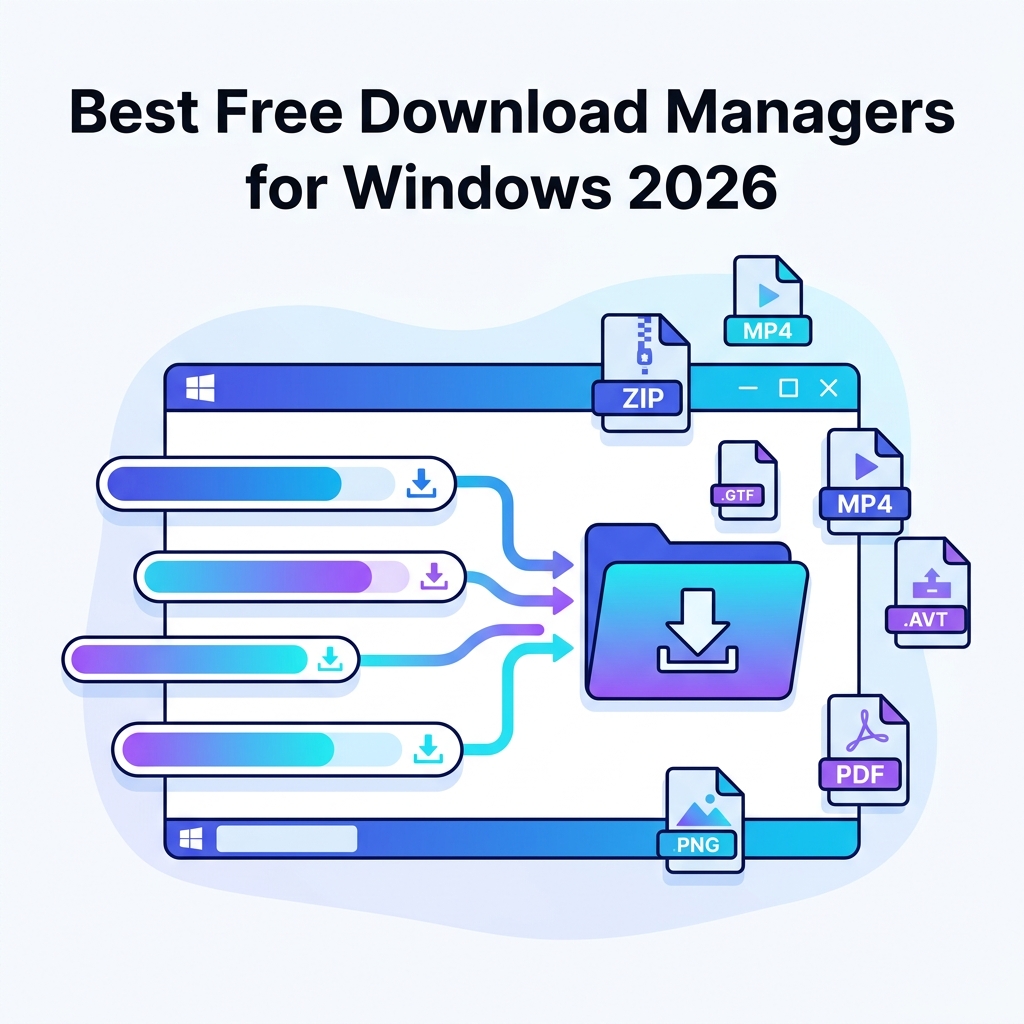
A download manager is a dedicated application that handles file transfers from the internet to your computer with more control and reliability than a web browser. It splits files into multiple segments, downloads them in parallel, automatically resumes interrupted transfers, schedules large downloads for off-peak hours, and organizes finished files into folders based on type or source.
You might wonder if you still need one when browsers handle most downloads fine. The honest answer is: for a 5 MB PDF, no. But the moment you start working with large files, batches of dozens of items, unstable connections, or sites that throttle single-stream downloads, a dedicated manager pays for itself within a single use.
Key Benefits Over Browser Downloads
- Resume support — pick up exactly where a broken transfer stopped, even after a reboot
- Multi-threaded acceleration — split files into 8, 16, or 32 segments to saturate your bandwidth
- Scheduling — queue downloads for 2 a.m. when your ISP isn’t throttling
- Browser integration — capture links from Chrome, Firefox, Edge, and Brave automatically
- Protocol breadth — handle HTTP, HTTPS, FTP, SFTP, BitTorrent, and Metalink from one app
- Checksum verification — confirm files match published hashes before you trust them
How We Evaluated the Best Free Download Managers for Windows
The market is crowded with abandoned projects, ad-laden shareware disguised as free, and tools that haven’t seen an update since Windows 7. To filter the noise, every tool on this list meets four criteria.
- Genuinely free — no trial limits, no paywalled features that cripple core functionality, no subscription pressure
- Actively maintained — at least one meaningful release within the past 18 months
- Windows 11 compatible — runs cleanly on current Windows builds with no compatibility-mode hacks
- Clean installer — no bundled toolbars, search hijackers, or unexpected telemetry
Tools were tested on a Windows 11 machine with a 500 Mbps connection, downloading files ranging from 50 MB to 10 GB across HTTP, HTTPS, FTP, and torrent sources.
1. Free Download Manager (FDM) — The All-Rounder
Free Download Manager remains the most polished free option in 2026 and the one most people should install first. It’s a cross-platform app from a Russian developer team that has steadily improved for over a decade, and the current release supports HTTP, HTTPS, FTP, BitTorrent, and Magnet links from a single interface.
FDM uses dynamic file segmentation to maximize throughput, lets you preview video and audio files before they finish, integrates with every mainstream browser through a lightweight extension, and includes a built-in scheduler with bandwidth caps for different times of day. The UI is dark-mode friendly and finally feels native on Windows 11.
Why It Stands Out
- Handles torrents and direct downloads in one queue
- Streams partial video files while still downloading
- Per-site speed limits — useful when one server is saturating your bandwidth
- Available in over 30 languages
Free Download Manager is the closest thing to a free alternative to Internet Download Manager (IDM), with similar segmentation logic and browser hooks but without the licensing fee.
You can grab it from the official Free Download Manager site. Avoid third-party mirrors — there have been historical incidents of compromised installers distributed through unofficial channels.
2. JDownloader 2 — Best for Bulk and One-Click Hosters
If your workflow involves pulling files from one-click hosters, mirror lists, or long batches of links, JDownloader 2 is the tool of choice. It’s open source, written in Java, and has plugin support for thousands of file hosts including Mega, MediaFire, and dozens of regional services that other managers ignore.
Paste a list of URLs and JDownloader’s link grabber parses each one, resolves redirects, handles captchas with optional services, and queues everything automatically. It also supports archive extraction on completion, so a batch of split RAR files can unpack themselves the moment the last segment lands.
Trade-offs to Know
- Java runtime adds memory overhead (~300 MB resident)
- UI feels dated compared to FDM
- Updates are frequent — which is good for site compatibility but occasionally noisy
The installer historically bundled optional adware, so during setup choose the custom installation path and decline every checkbox that isn’t the core app itself.
3. aria2 — The Command-Line Power Tool
aria2 isn’t a graphical app — it’s a lightweight command-line download utility, and it’s the favorite of developers, sysadmins, and anyone who scripts their downloads. It supports HTTP, HTTPS, FTP, SFTP, BitTorrent, and Metalink, runs as a service, and accepts a JSON-RPC interface so you can drive it from any language.
Here’s a typical aria2 command that downloads a file using 16 parallel connections:
# Download a file with 16 connections and 4 split segments
aria2c -x 16 -s 16 -k 1M "https://releases.example.com/ubuntu-24.04.iso"

# Resume a stopped download
aria2c -c "https://releases.example.com/ubuntu-24.04.iso"

# Download from a list of URLs in a text file
aria2c -i downloads.txt -j 5
The flags do the work: -x 16 opens up to 16 connections per server, -s 16 splits the file into 16 segments, -k 1M sets the minimum segment size, and -c tells aria2 to continue a partial file. The -j 5 flag in the last example downloads five files in parallel from the input list.
For a GUI on top of aria2, install AriaNg, a browser-based dashboard that talks to aria2 over its RPC interface. The combination gives you a polished interface backed by a battle-tested engine.
4. qBittorrent — The Best Free Torrent Client
BitTorrent is still the most efficient way to distribute large open-source releases, Linux distributions, and game patches in 2026, and qBittorrent is the cleanest free client available. It’s open source, ad-free, cross-platform, and feature-complete: sequential downloading, RSS feed auto-download, IP filtering, and an integrated search across major public trackers.
Unlike some popular alternatives, qBittorrent has never bundled cryptominers, ads, or sponsored content. The interface is approachable for beginners but exposes deep controls — DHT, PEX, encryption modes, and per-torrent bandwidth limits — for power users.
Useful Defaults to Enable
- Sequential download for media files you want to preview before completion
- Speed scheduler to cap upload during work hours
- Anonymous mode for privacy-conscious peering
- Auto-add watch folder to drop
.torrentfiles for automatic queuing
Visit the official qBittorrent project page for the latest installer. Stick to the official site — copycat domains hosting trojaned installers are a recurring problem.
5. Xtreme Download Manager (XDM) — IDM Look, Zero Cost
Xtreme Download Manager is the closest visual and functional clone of Internet Download Manager, the popular paid app. XDM uses an aggressive segmentation algorithm that claims up to 500% speed improvements on multi-connection servers, integrates with all major browsers, and can grab streaming video from sites that don’t expose direct download links.
It’s open source, completely free, and gets regular updates. The UI is utilitarian rather than beautiful, but for users migrating from IDM, the muscle memory transfers almost perfectly.
Where XDM Shines
- Video grabbing from embedded players
- Automatic browser link capture
- Built-in queue and scheduler with bandwidth caps
- Cross-platform: Windows, macOS, Linux from the same codebase
Comparison Table: Best Free Download Managers for Windows in 2026
| Tool | Best For | Torrent Support | Video Grab | Open Source | Footprint |
|---|---|---|---|---|---|
| Free Download Manager | All-purpose use | Yes | Yes | No | Light |
| JDownloader 2 | Bulk and hosters | No | Limited | Yes | Heavy (Java) |
| aria2 | Scripting and automation | Yes | No | Yes | Minimal |
| qBittorrent | Torrents only | Yes | No | Yes | Light |
| Xtreme Download Manager | IDM replacement | Limited | Yes | Yes | Light |
How to Pick the Right Download Manager for Your Workflow
There is no single best tool — the right choice depends on what you actually download. Use this quick decision flow.
- You want one app that does almost everything well → Free Download Manager
- You constantly paste lists of links from file hosters → JDownloader 2
- You script downloads or run them on a headless box → aria2
- You only download torrents → qBittorrent
- You miss the IDM interface but refuse to pay → Xtreme Download Manager
Many power users run two side by side — for example, FDM for everyday browser-captured downloads plus qBittorrent for torrents, or aria2 in the background for scripted jobs plus a GUI client for ad-hoc files.
Setting Up Browser Integration the Right Way
Most download managers ship a companion browser extension that intercepts links and routes them through the app. Setup is usually a one-click affair, but a few details are worth knowing.
In Chrome and Edge, you’ll need to enable the extension from the Chrome Web Store or Edge Add-ons store after installing the desktop app. In Firefox, the extension comes from Mozilla Add-ons. Brave and other Chromium-based browsers reuse the Chrome extension.
If link capture stops working after a browser update, the extension is almost always the culprit — check the extensions page, ensure it’s enabled, and reinstall if needed. Some extensions also need native messaging host permissions, which the download manager’s installer registers but a Windows Defender quarantine can occasionally strip.
Common Pitfalls to Avoid
A few mistakes show up repeatedly in user reports, and they’re all preventable.
Downloading From Unofficial Mirrors
The most popular free download managers are also frequent targets for impersonation. Type the URL directly or use the project’s GitHub link rather than the first search result. In 2017, the official Free Download Manager site itself was briefly compromised — fortunately a rare event, but a reminder that even reputable sources deserve a checksum verification step.
Ignoring Custom Install Options
Always pick custom or advanced installation paths. The default “express” option occasionally opts you into telemetry, browser extension changes, or in older versions of some tools, third-party software. Five extra clicks save you an afternoon of cleanup.
Running Too Many Connections Per File
More connections is not always faster. Many servers cap concurrent connections per IP, and pushing 64 threads at a server that allows 4 simply triggers rate limiting or temporary blocks. Start with 8–16 segments and tune from there.
Forgetting Checksum Verification
For ISOs, installers, and signed binaries, the publisher almost always provides a SHA-256 hash. A two-second verification with PowerShell catches corrupted or tampered files before you run them:
# Verify a downloaded file's SHA-256 hash on Windows PowerShell
Get-FileHash -Algorithm SHA256 .\ubuntu-24.04.iso

# Compare the output to the hash published on the official site
This single habit prevents most malware-via-download incidents. The hash on the official page is the ground truth — if it doesn’t match, delete the file and download from a different mirror.
Performance Tips That Actually Move the Needle
Once you’ve picked a tool, a few tweaks meaningfully improve speed and reliability.
- Match thread count to your link — on a 100 Mbps line, 8 segments is often enough; on gigabit, push to 16–32
- Use HTTPS where available — modern HTTP/2 and HTTP/3 multiplexing often outpaces multi-segment HTTP/1.1
- Schedule large transfers for off-peak hours if your ISP applies congestion management
- Park downloads on an SSD — segmented downloads write randomly, and HDDs become the bottleneck on fast lines
- Disable Windows Defender real-time scanning on the download folder only if you have a separate scan-on-completion workflow, and never for system folders
Frequently Asked Questions
Are free download managers safe to use on Windows?
The tools recommended here — Free Download Manager, JDownloader 2, aria2, qBittorrent, and Xtreme Download Manager — are safe when downloaded from their official sites or verified GitHub releases. Risk comes almost entirely from impersonator sites, bundled installers from shady mirrors, and outdated unmaintained projects. Stick to the canonical sources and run a checksum check when available.
Do I still need a download manager if I have gigabit internet?
Yes, for three reasons. First, server-side throttling often caps single-connection downloads far below your link speed, and segmentation works around that. Second, resume support saves you from re-downloading multi-gigabyte files after any interruption. Third, scheduling and queue management remain valuable even when individual transfers are fast.
What’s the best free alternative to Internet Download Manager?
For users specifically seeking an IDM replacement, Xtreme Download Manager offers the most similar interface and feature set, while Free Download Manager provides a more modern UI with comparable acceleration. Both are completely free with no licensing pressure or trial limits.
Can I use a download manager and a browser at the same time?
Absolutely. Browser extensions for download managers are designed for exactly this — they sit silently in the background and only activate when you click a download link or right-click a media file. Routine page browsing and small downloads continue to use the browser; large or important files get routed to the manager.
Why does Windows Defender sometimes flag download managers?
A handful of download managers use techniques like browser process injection or registering native messaging hosts that trigger heuristic detection. False positives are common with niche tools and are typically resolved within a release or two. If a flagged file came from an official source and the published hash matches, it’s almost always a false positive — but verify before whitelisting.
Are torrent clients legal to use?
The BitTorrent protocol itself is fully legal and widely used to distribute Linux distributions, game patches, scientific datasets, and open-source software. What’s transferred matters, not the protocol. qBittorrent and similar clients are legitimate tools, and you can read more about the protocol on its Wikipedia overview.
Conclusion
The best free download managers for Windows in 2026 turn a frustrating, fragile part of computing into something fast and forgettable. For most people, Free Download Manager handles everyday needs with the least friction. JDownloader 2 dominates bulk and host-site workflows. aria2 wins for anyone who scripts. qBittorrent remains the cleanest free torrent client. And Xtreme Download Manager delivers the IDM experience without the price tag.
Pick the one that matches the files you actually move, stick to official downloads, verify checksums when they matter, and you’ll never sit through a failed transfer again. Your bandwidth, your patience, and your file integrity will all thank you.