Introduction to Automotive Operating Systems
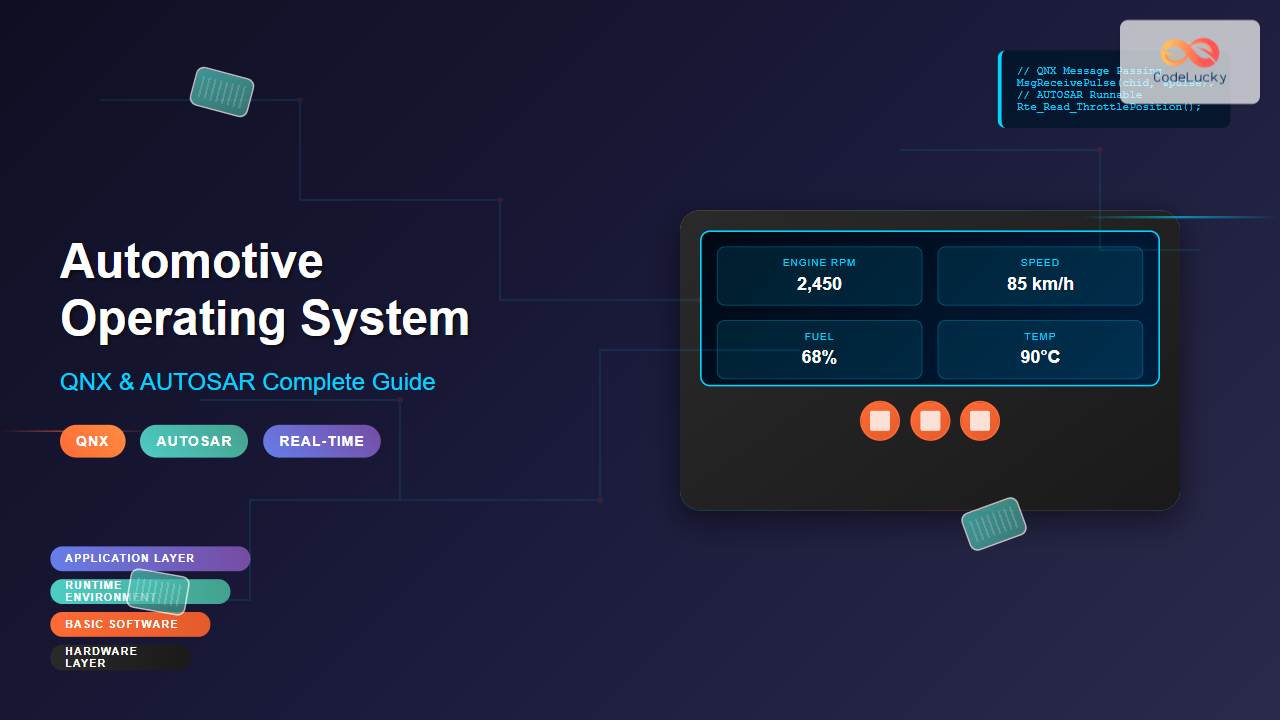
Modern vehicles are essentially computers on wheels, containing dozens of Electronic Control Units (ECUs) that manage everything from engine performance to infotainment systems. At the heart of these sophisticated systems lie specialized operating systems designed specifically for automotive applications. Two dominant players in this space are QNX and AUTOSAR, each serving different but complementary roles in the automotive ecosystem.
The automotive industry’s digital transformation has created unprecedented demand for reliable, real-time operating systems that can handle safety-critical functions while providing the flexibility needed for modern connected vehicles. Understanding these systems is crucial for developers entering the automotive software domain.
What is QNX?
QNX is a real-time operating system (RTOS) developed by BlackBerry that has become a cornerstone in automotive computing. Originally created in 1982, QNX has evolved into a microkernel-based system that excels in safety-critical applications requiring deterministic behavior and high reliability.
QNX Architecture and Key Features
The QNX microkernel architecture provides several advantages:
- Fault Isolation: Individual processes run in separate memory spaces, preventing one faulty component from crashing the entire system
- Real-time Performance: Guaranteed response times for critical operations
- Scalability: Modular design allows systems to include only necessary components
- POSIX Compliance: Standard API compatibility for easier development
QNX in Automotive Applications
QNX powers various automotive systems including:
- Infotainment Systems: Ford SYNC, Audi MMI, BMW iDrive
- Digital Instrument Clusters: High-resolution displays with real-time data
- Advanced Driver Assistance Systems (ADAS): Camera processing, sensor fusion
- Telematics Units: Connectivity and fleet management systems
Here’s a simple example of QNX message passing, a core communication mechanism:
// QNX Message Passing Example
#include <sys/neutrino.h>
#include <sys/iofunc.h>

// Server process receiving messages
int server_process() {
    int chid, rcvid;
    struct _pulse pulse;

    // Create a channel
    chid = ChannelCreate(0);
    if (chid == -1) {
        perror("ChannelCreate");
        return -1;
    }

    while (1) {
        rcvid = MsgReceivePulse(chid, &pulse, sizeof(pulse), NULL);
        if (rcvid == 0) {
            printf("Received pulse: code=%d, value=%d\n",
                   pulse.code, pulse.value.sival_int);
        }
    }

    return 0;
}
Understanding AUTOSAR
AUTOSAR (AUTomotive Open System ARchitecture) is not an operating system itself, but rather a standardized software architecture framework that defines how automotive software should be structured. Established in 2003 by major automotive manufacturers and suppliers, AUTOSAR aims to standardize ECU software architecture across the industry.
AUTOSAR Architecture Layers

AUTOSAR Components Explained
Application Layer: Contains the actual automotive functions (engine control, transmission control, etc.)
Runtime Environment (RTE): Provides communication infrastructure between software components
Basic Software (BSW): Platform-specific code including:
- Operating System services
- Communication stacks (CAN, LIN, FlexRay, Ethernet)
- Memory management
- Diagnostic services
AUTOSAR Software Component Example
// AUTOSAR Runnable Entity Example
#include "Rte_EngineControl.h"

// Runnable entity for engine control
FUNC(void, EngineControl_CODE) EngineControl_MainFunction(void) {
    // Read sensor data through RTE
    uint16 throttlePosition;
    uint16 engineRPM;

    // Read inputs via RTE interfaces
    Rte_Read_ThrottlePosition_Value(&throttlePosition);
    Rte_Read_EngineRPM_Value(&engineRPM);

    // Engine control logic
    uint16 fuelInjectionTime = CalculateFuelInjection(throttlePosition, engineRPM);

    // Write outputs via RTE interfaces
    Rte_Write_FuelInjection_Time(fuelInjectionTime);
}

// Supporting function
static uint16 CalculateFuelInjection(uint16 throttle, uint16 rpm) {
    // Simplified fuel calculation
    return (throttle * rpm) / 1000;
}
QNX vs AUTOSAR: Key Differences
| Aspect | QNX | AUTOSAR |
|---|---|---|
| Nature | Complete operating system | Software architecture standard |
| Target Applications | High-performance computing, infotainment | Traditional ECU functions |
| Real-time Capabilities | Hard real-time with guaranteed response times | Soft real-time, depends on underlying OS |
| Memory Footprint | Larger (MB range) | Smaller (KB range) |
| Development Complexity | Moderate, POSIX-based | High, requires specific toolchains |
| Safety Certification | ISO 26262 ASIL D certified | Framework supports various safety levels |
Integration Scenarios: QNX and AUTOSAR Working Together
Modern vehicles often employ both systems in different ECUs, creating a heterogeneous environment where they must communicate effectively.

Communication Protocols
The integration relies on several communication protocols:
- CAN (Controller Area Network): Traditional automotive bus for real-time communication
- Ethernet: High-bandwidth communication for multimedia and advanced features
- SOME/IP: Service-oriented communication for modern automotive applications
Development Tools and Environments
QNX Development Tools
QNX Momentics IDE: Eclipse-based integrated development environment featuring:
- Cross-compilation support
- Remote debugging capabilities
- System profiling tools
- Memory analysis utilities
QNX System Builder: Tool for creating custom QNX images with only required components.
AUTOSAR Development Tools
Configuration Tools:
- Vector DaVinci Configurator
- EB tresos Studio
- ETAS ASCET
Code Generation: Automatic generation of RTE and BSW configuration code from ARXML files.
Real-World Implementation Examples
Ford SYNC System Architecture
Ford’s SYNC system demonstrates QNX’s capabilities in automotive infotainment:
// Simplified SYNC audio management
#include <audio/audio.h>
#include <sys/asoundlib.h>

typedef struct {
    snd_pcm_t *playback_handle;
    snd_pcm_t *capture_handle;
    pthread_t audio_thread;
} sync_audio_manager_t;

int sync_audio_init(sync_audio_manager_t *manager) {
    int err;

    // Initialize playback device
    err = snd_pcm_open(&manager->playback_handle, "default",
                       SND_PCM_STREAM_PLAYBACK, SND_PCM_NONBLOCK);
    if (err < 0) {
        printf("Playback open error: %s\n", snd_strerror(err));
        return err;
    }

    // Configure audio parameters
    snd_pcm_set_params(manager->playback_handle,
                      SND_PCM_FORMAT_S16_LE,
                      SND_PCM_ACCESS_RW_INTERLEAVED,
                      2,  // channels
                      44100,  // sample rate
                      1,  // allow resampling
                      500000); // latency in microseconds

    return 0;
}
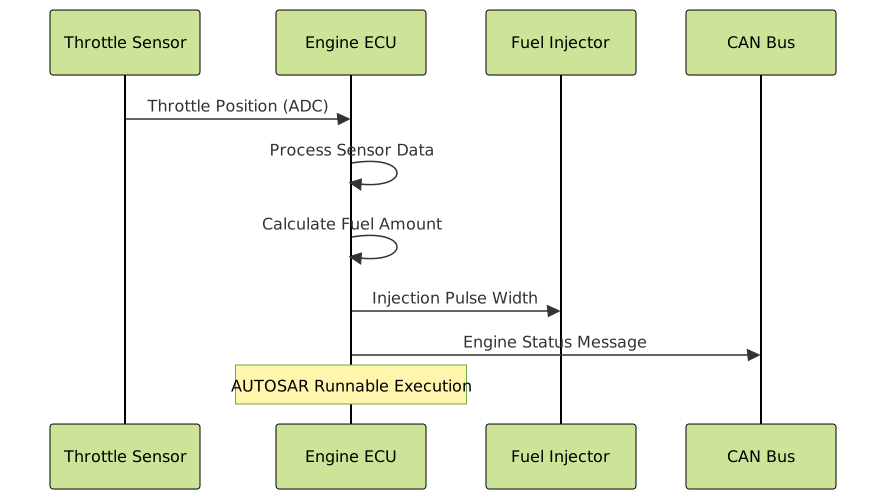
AUTOSAR-based Engine Management System
Security Considerations
Both QNX and AUTOSAR systems must address automotive cybersecurity challenges:
QNX Security Features
- Hypervisor Technology: Isolates critical and non-critical functions
- Encrypted Boot: Ensures system integrity from startup
- Sandboxing: Limits application access to system resources
- Certificate Management: Secure communication with external systems
AUTOSAR Security
- Crypto Service Manager: Centralized cryptographic operations
- Secure Communication: Authentication and encryption for CAN/Ethernet
- Intrusion Detection: Monitoring for abnormal behavior
- Secure Boot: Verified boot process for ECUs
Performance Optimization Strategies
QNX Optimization Techniques
// QNX thread priority and scheduling optimization
#include <pthread.h>
#include <sched.h>
int optimize_qnx_thread() {
pthread_t thread;
pthread_attr_t attr;
struct sched_param param;
// Initialize thread attributes
pthread_attr_init(&attr);
// Set scheduling policy to FIFO for real-time behavior
pthread_attr_setschedpolicy(&attr, SCHED_FIFO);
// Set high priority for critical tasks
param.sched_priority = 30;
pthread_attr_setschedparam(&attr, ¶m);
// Set appropriate stack size
pthread_attr_setstacksize(&attr, 64 * 1024);
// Create thread with optimized attributes
return pthread_create(&thread, &attr, critical_task_function, NULL);
}
AUTOSAR Optimization
- Task Configuration: Optimize task periods and priorities
- Memory Allocation: Static memory allocation for predictable performance
- Communication Optimization: Minimize RTE overhead through efficient interfaces
- Code Generation Tuning: Optimize generated code for target hardware
Future Trends and Evolution
The automotive operating system landscape is rapidly evolving with several key trends:
AUTOSAR Adaptive Platform
AUTOSAR Adaptive represents a shift toward service-oriented architecture, designed for high-performance computing ECUs running on POSIX-compliant operating systems like QNX.
Hypervisor Technology
Mixed-criticality systems running both safety-critical AUTOSAR Classic applications and high-performance QNX applications on the same hardware through hypervisor technology.
Over-the-Air Updates
Both platforms are evolving to support secure OTA updates, enabling continuous improvement of vehicle software throughout the vehicle lifecycle.
AI and Machine Learning Integration
Enhanced support for AI/ML workloads in automotive applications, particularly for ADAS and autonomous driving functions.
Best Practices for Automotive OS Development
Design Principles
- Safety First: Always prioritize safety-critical functions
- Deterministic Behavior: Ensure predictable system response times
- Fault Tolerance: Design for graceful degradation
- Modularity: Maintain clear separation between components
- Testability: Design systems that can be thoroughly tested
Development Guidelines
- Follow automotive coding standards (MISRA C/C++)
- Implement comprehensive error handling
- Use static analysis tools for code quality
- Perform thorough integration testing
- Document system architecture and interfaces
Conclusion
QNX and AUTOSAR serve complementary roles in the modern automotive ecosystem. QNX excels in high-performance computing applications requiring rich user interfaces and complex processing, while AUTOSAR provides a standardized framework for traditional ECU development with strong emphasis on interoperability and cost reduction.
The future of automotive operating systems lies in the intelligent combination of these technologies, leveraging QNX’s performance capabilities for advanced features while maintaining AUTOSAR’s standardization benefits for traditional control functions. As vehicles become increasingly connected and autonomous, understanding both platforms becomes essential for automotive software developers.
Success in automotive OS development requires not just technical knowledge, but also understanding of automotive industry requirements including functional safety, security, and the unique challenges of developing software for safety-critical applications. Both QNX and AUTOSAR continue to evolve to meet these challenges, making them indispensable tools in the modern automotive developer’s toolkit.
- Introduction to Automotive Operating Systems
- What is QNX?
- Understanding AUTOSAR
- QNX vs AUTOSAR: Key Differences
- Integration Scenarios: QNX and AUTOSAR Working Together
- Development Tools and Environments
- Real-World Implementation Examples
- Security Considerations
- Performance Optimization Strategies
- Future Trends and Evolution
- Best Practices for Automotive OS Development
- Conclusion