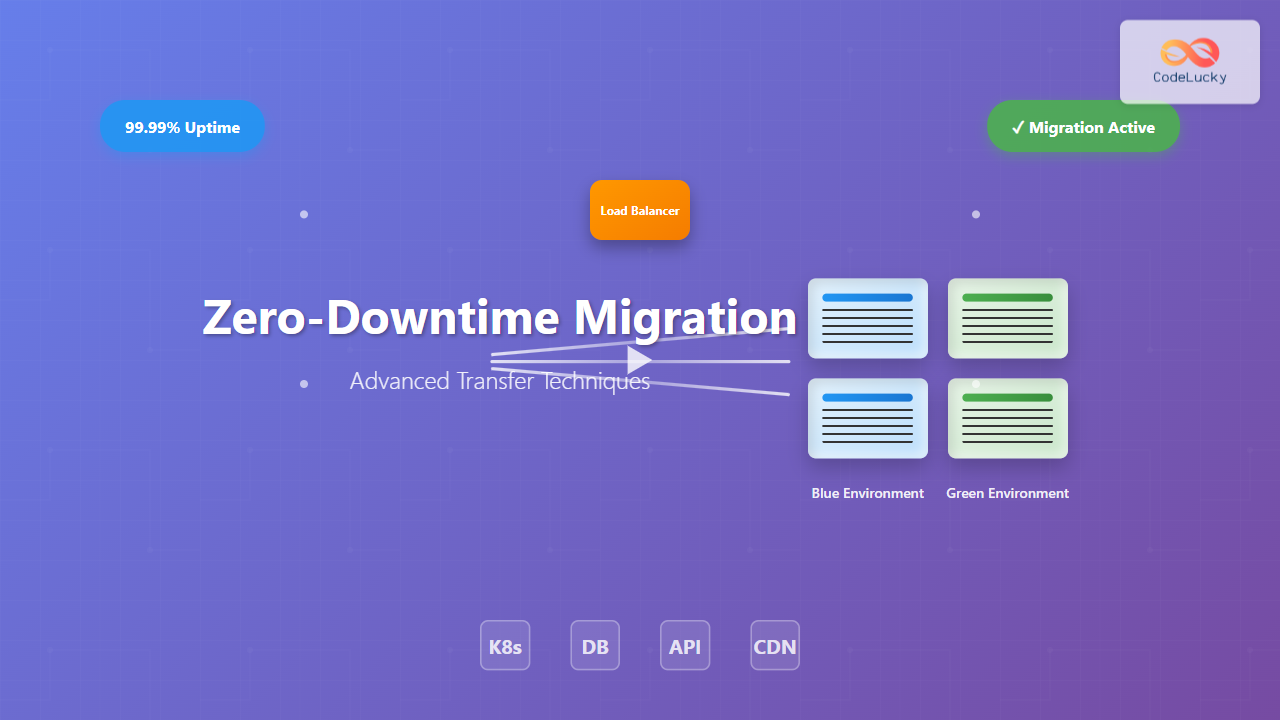
Zero-downtime migration has become a critical requirement for modern applications where even seconds of unavailability can result in significant business losses. This comprehensive guide explores advanced techniques that enable seamless transitions between systems, databases, and infrastructures without interrupting user services.
Understanding Zero-Downtime Migration
Zero-downtime migration refers to the process of moving applications, databases, or entire systems from one environment to another while maintaining continuous service availability. Unlike traditional maintenance windows that require scheduled downtime, these techniques ensure uninterrupted operation throughout the migration process.
Key Principles
- Redundancy: Maintaining parallel systems during transition
- Graceful Degradation: Ensuring fallback mechanisms are in place
- Data Consistency: Preserving data integrity throughout the process
- Traffic Management: Controlled routing of user requests
- Monitoring: Real-time visibility into migration progress
Blue-Green Deployment Strategy
Blue-green deployment is one of the most effective zero-downtime migration techniques, utilizing two identical production environments.

Implementation Steps
1. Environment Preparation
# Create green environment configuration
docker-compose -f docker-compose.green.yml up -d

# Verify green environment health
curl -f http://green-env.example.com/health || exit 1

# Sync database to green environment
pg_dump production_db | psql green_production_db
2. Traffic Switching
# Nginx configuration for gradual traffic shift
upstream backend {
    server blue-env.internal:8080 weight=90;
    server green-env.internal:8080 weight=10;
}

server {
    listen 80;
    location / {
        proxy_pass http://backend;
        proxy_set_header Host $host;
    }
}
3. Complete Switchover
# Update load balancer to point to green environment
kubectl patch service app-service -p '{"spec":{"selector":{"version":"green"}}}'

# Verify traffic is flowing to green environment
kubectl get endpoints app-service
Database Migration Techniques
Database migrations present unique challenges due to data consistency requirements and potential schema changes.
Master-Slave Replication Migration
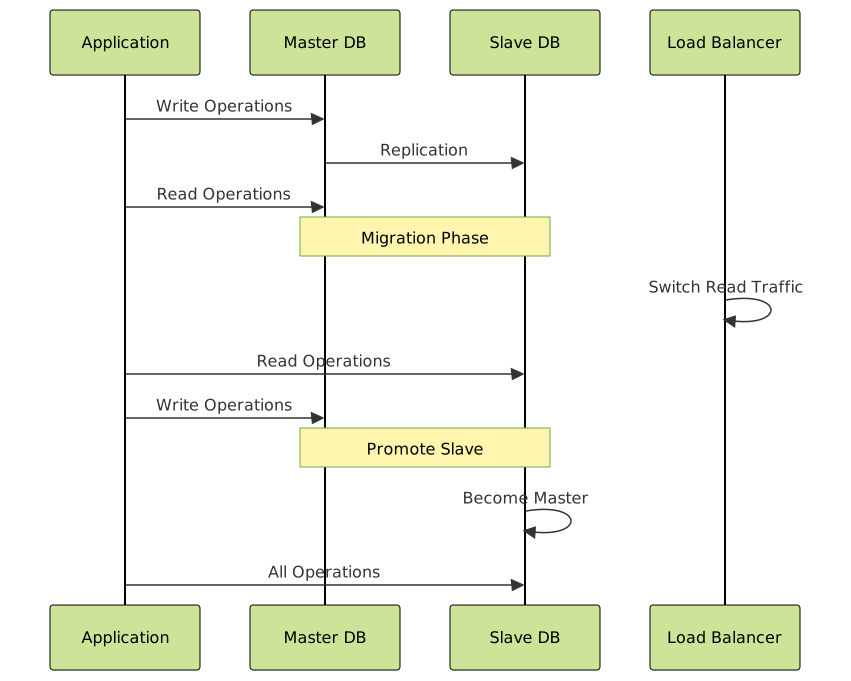
PostgreSQL Streaming Replication Setup
-- On master database
CREATE USER replicator REPLICATION LOGIN CONNECTION LIMIT 1 ENCRYPTED PASSWORD 'secure_password';

-- Configure postgresql.conf
wal_level = replica
max_wal_senders = 3
checkpoint_segments = 8
wal_keep_segments = 8
# On slave server
pg_basebackup -h master_host -D /var/lib/postgresql/data -U replicator -W -v -P

# Configure recovery.conf
standby_mode = 'on'
primary_conninfo = 'host=master_host port=5432 user=replicator'
Schema Evolution Strategy
Managing schema changes during zero-downtime migrations requires careful planning:
-- Phase 1: Add new column (nullable)
ALTER TABLE users ADD COLUMN email_verified BOOLEAN DEFAULT FALSE;

-- Phase 2: Populate data gradually
UPDATE users SET email_verified = TRUE
WHERE email IS NOT NULL AND created_at < NOW() - INTERVAL '30 days';

-- Phase 3: Make column non-nullable (after full population)
ALTER TABLE users ALTER COLUMN email_verified SET NOT NULL;
Rolling Updates for Containerized Applications
Rolling updates allow gradual replacement of application instances without service interruption.

Kubernetes Rolling Update Configuration
apiVersion: apps/v1
kind: Deployment
metadata:
  name: app-deployment
spec:
  replicas: 3
  strategy:
    type: RollingUpdate
    rollingUpdate:
      maxUnavailable: 1
      maxSurge: 1
  template:
    spec:
      containers:
      - name: app
        image: myapp:v2.0
        readinessProbe:
          httpGet:
            path: /health
            port: 8080
          initialDelaySeconds: 10
          periodSeconds: 5
Health Checks and Readiness Probes
// Express.js health check endpoint
app.get('/health', (req, res) => {
  // Check database connectivity
  db.ping()
    .then(() => {
      // Check external dependencies
      return Promise.all([
        checkRedisConnection(),
        checkS3Connectivity(),
        validateConfiguration()
      ]);
    })
    .then(() => {
      res.status(200).json({
        status: 'healthy',
        timestamp: new Date().toISOString(),
        version: process.env.APP_VERSION
      });
    })
    .catch(error => {
      res.status(503).json({
        status: 'unhealthy',
        error: error.message,
        timestamp: new Date().toISOString()
      });
    });
});
Advanced Traffic Management
Canary Deployments
Canary deployments gradually shift traffic to new versions, allowing for risk mitigation:
# Istio VirtualService for canary deployment
apiVersion: networking.istio.io/v1alpha3
kind: VirtualService
metadata:
  name: app-canary
spec:
  http:
  - match:
    - headers:
        canary:
          exact: "true"
    route:
    - destination:
        host: app-service
        subset: v2
  - route:
    - destination:
        host: app-service
        subset: v1
      weight: 90
    - destination:
        host: app-service
        subset: v2
      weight: 10
Feature Flags Integration
// Feature flag implementation for gradual rollout
class FeatureManager {
  constructor() {
    this.flags = new Map();
  }

  async evaluateFlag(flagKey, userId, defaultValue = false) {
    const flag = this.flags.get(flagKey);
    if (!flag) return defaultValue;

    // Percentage-based rollout
    if (flag.rolloutPercentage) {
      const userHash = this.hashUserId(userId);
      return (userHash % 100) < flag.rolloutPercentage;
    }

    // User-specific targeting
    if (flag.targetUsers && flag.targetUsers.includes(userId)) {
      return true;
    }

    return flag.enabled || defaultValue;
  }

  hashUserId(userId) {
    let hash = 0;
    for (let i = 0; i < userId.length; i++) {
      const char = userId.charCodeAt(i);
      hash = ((hash << 5) - hash) + char;
      hash = hash & hash; // Convert to 32-bit integer
    }
    return Math.abs(hash);
  }
}
Data Migration Strategies
Event Sourcing for Migration

// Event-driven migration service
class MigrationService {
  constructor(eventStore, targetSystem) {
    this.eventStore = eventStore;
    this.targetSystem = targetSystem;
    this.checkpoint = new Map();
  }

  async migrateData(entityType, batchSize = 1000) {
    let lastProcessedId = this.checkpoint.get(entityType) || 0;

    while (true) {
      const events = await this.eventStore.getEvents({
        entityType,
        fromId: lastProcessedId,
        limit: batchSize
      });

      if (events.length === 0) break;

      // Process events in batches
      await this.processBatch(events);

      // Update checkpoint
      lastProcessedId = events[events.length - 1].id;
      await this.updateCheckpoint(entityType, lastProcessedId);

      // Add delay to avoid overwhelming target system
      await this.sleep(100);
    }
  }

  async processBatch(events) {
    const transformedData = events.map(event =>
      this.transformEvent(event)
    );

    await this.targetSystem.batchInsert(transformedData);
  }
}
Dual-Write Strategy
// Dual-write implementation with eventual consistency
class DualWriteService {
  constructor(primaryDB, secondaryDB, eventBus) {
    this.primaryDB = primaryDB;
    this.secondaryDB = secondaryDB;
    this.eventBus = eventBus;
  }

  async writeData(data) {
    try {
      // Primary write (synchronous)
      const result = await this.primaryDB.insert(data);

      // Secondary write (asynchronous)
      this.eventBus.emit('secondary-write', {
        operation: 'insert',
        data: data,
        primaryId: result.id
      });

      return result;
    } catch (error) {
      // Log error and handle gracefully
      console.error('Primary write failed:', error);
      throw error;
    }
  }

  setupSecondaryWriteHandler() {
    this.eventBus.on('secondary-write', async (event) => {
      try {
        await this.secondaryDB.insert(event.data);
        await this.logSuccessfulSync(event.primaryId);
      } catch (error) {
        await this.scheduleRetry(event);
      }
    });
  }
}
Monitoring and Validation
Real-time Migration Monitoring
// Migration monitoring dashboard
class MigrationMonitor {
  constructor(metricsCollector) {
    this.metrics = metricsCollector;
    this.alerts = [];
  }

  async validateMigration() {
    const checks = await Promise.all([
      this.validateDataIntegrity(),
      this.checkPerformanceMetrics(),
      this.verifyApplicationHealth(),
      this.validateUserExperience()
    ]);

    return {
      overall: checks.every(check => check.success),
      details: checks,
      timestamp: new Date().toISOString()
    };
  }

  async validateDataIntegrity() {
    const sourceCount = await this.getSourceRecordCount();
    const targetCount = await this.getTargetRecordCount();

    return {
      name: 'Data Integrity',
      success: sourceCount === targetCount,
      details: { sourceCount, targetCount },
      variance: Math.abs(sourceCount - targetCount)
    };
  }

  async checkPerformanceMetrics() {
    const metrics = await this.metrics.getLatestMetrics();

    return {
      name: 'Performance',
      success: metrics.responseTime < 500 && metrics.errorRate < 0.01,
      details: metrics
    };
  }
}
Automated Rollback Mechanisms
#!/bin/bash
# Automated rollback script

ROLLBACK_THRESHOLD_ERROR_RATE=0.05
ROLLBACK_THRESHOLD_RESPONSE_TIME=1000

# Monitor key metrics
ERROR_RATE=$(curl -s "http://monitoring/api/error-rate" | jq -r '.value')
RESPONSE_TIME=$(curl -s "http://monitoring/api/response-time" | jq -r '.p95')

# Check thresholds
if (( $(echo "$ERROR_RATE > $ROLLBACK_THRESHOLD_ERROR_RATE" | bc -l) )); then
  echo "Error rate exceeded threshold: $ERROR_RATE"
  trigger_rollback "high_error_rate"
fi

if (( $(echo "$RESPONSE_TIME > $ROLLBACK_THRESHOLD_RESPONSE_TIME" | bc -l) )); then
  echo "Response time exceeded threshold: ${RESPONSE_TIME}ms"
  trigger_rollback "high_response_time"
fi

trigger_rollback() {
  REASON=$1
  echo "Initiating rollback due to: $REASON"

  # Switch load balancer back to blue environment
  kubectl patch service app-service -p '{"spec":{"selector":{"version":"blue"}}}'

  # Wait for traffic to stabilize
  sleep 30

  # Verify rollback success
  curl -f http://app.example.com/health || exit 1

  echo "Rollback completed successfully"

  # Send alert to operations team
  curl -X POST "http://alerts/api/notify" \
    -H "Content-Type: application/json" \
    -d "{\"message\":\"Automatic rollback triggered: $REASON\",\"severity\":\"critical\"}"
}
Best Practices and Common Pitfalls
Planning and Preparation
- Comprehensive Testing: Test migration procedures in staging environments that mirror production
- Backup Strategies: Ensure robust backup and recovery mechanisms are in place
- Dependency Mapping: Understand all system dependencies and integration points
- Communication Plans: Establish clear communication channels for stakeholders
Common Pitfalls to Avoid
- Insufficient Testing: Skipping thorough testing in production-like environments
- Database Lock Contention: Long-running migrations blocking critical operations
- Resource Underestimation: Not accounting for increased resource usage during migration
- Incomplete Rollback Plans: Lack of tested rollback procedures
- Monitoring Gaps: Insufficient visibility into migration progress and system health
Performance Optimization
// Optimized batch processing with backpressure
class OptimizedMigrator {
  constructor(options = {}) {
    this.batchSize = options.batchSize || 1000;
    this.maxConcurrency = options.maxConcurrency || 5;
    this.delayBetweenBatches = options.delay || 100;
  }

  async migrateWithBackpressure(dataSource, processor) {
    const semaphore = new Semaphore(this.maxConcurrency);
    let processedCount = 0;

    while (true) {
      const batch = await dataSource.getNextBatch(this.batchSize);
      if (batch.length === 0) break;

      await semaphore.acquire();

      processor(batch)
        .then(() => {
          processedCount += batch.length;
          console.log(`Processed ${processedCount} records`);
        })
        .catch(error => {
          console.error('Batch processing failed:', error);
        })
        .finally(() => {
          semaphore.release();
        });

      // Implement backpressure
      if (semaphore.availablePermits === 0) {
        await new Promise(resolve => setTimeout(resolve, this.delayBetweenBatches));
      }
    }
  }
}
Zero-downtime migration represents a critical capability for modern applications where continuous availability is essential. By implementing these advanced techniques – from blue-green deployments and rolling updates to sophisticated data migration strategies – organizations can achieve seamless transitions while maintaining service quality and user experience. Success requires careful planning, comprehensive testing, robust monitoring, and well-defined rollback procedures. As systems grow in complexity, mastering these migration techniques becomes increasingly important for maintaining competitive advantage and operational excellence.