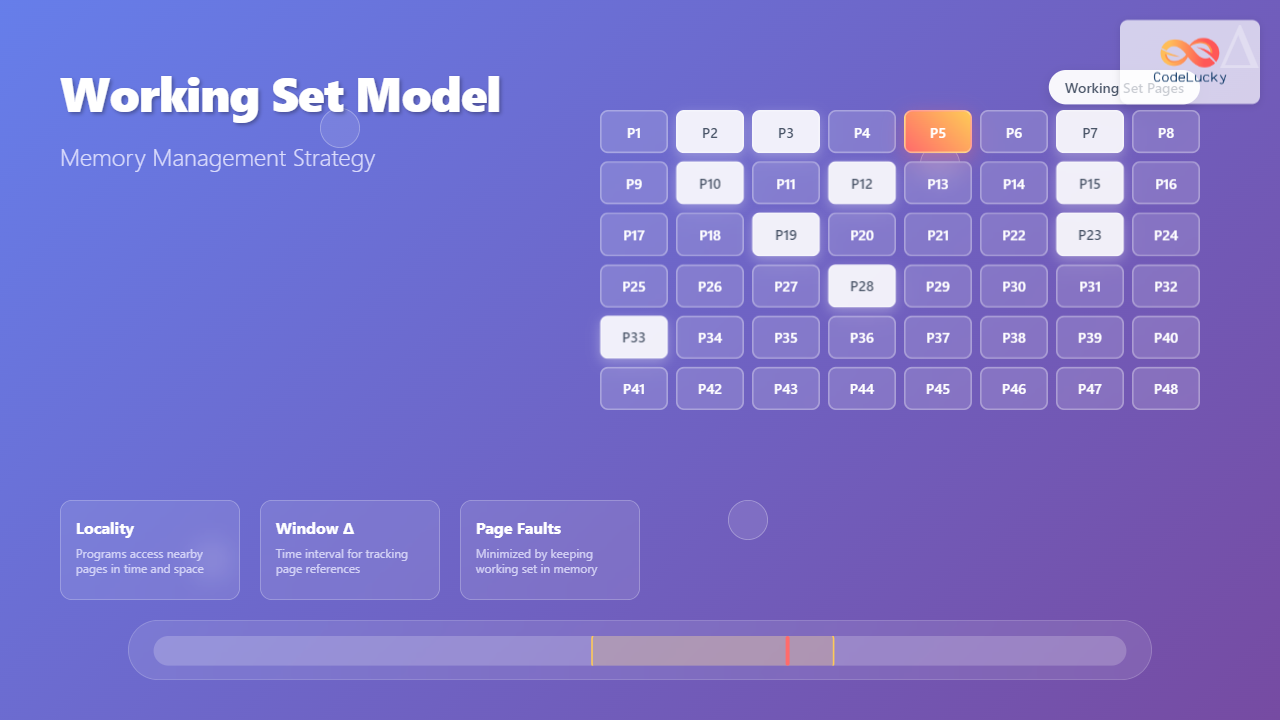
The Working Set Model is a fundamental memory management strategy that revolutionized how operating systems handle virtual memory allocation and page replacement. Developed by Peter Denning in 1968, this model addresses the critical challenge of determining which pages should remain in physical memory to minimize page faults and optimize system performance.
Understanding the Working Set Concept
A working set represents the collection of pages that a process has referenced within a specific time window, called the working set window (Δ). This model is based on the principle of locality of reference, which observes that programs tend to access a relatively small portion of their address space during any given time interval.
Key Components
- Working Set Window (Δ): The time interval used to determine which pages belong to the working set
- Working Set Size: The number of distinct pages referenced within the window
- Reference String: The sequence of page references made by a process
- Locality of Reference: The tendency of programs to access nearby memory locations
Mathematical Foundation
The working set at time t with window size Δ is formally defined as:
WS(t, Δ) = {p | page p was referenced in the interval (t-Δ, t]}
This mathematical definition ensures that only recently accessed pages are considered part of the active working set, providing a dynamic view of memory requirements.
Working Set Size Calculation Example
Reference String: 1, 2, 3, 4, 1, 2, 5, 1, 2, 3, 4, 5
Window Size (Δ): 4

Time t=6: Pages referenced in interval (2,6] = {3, 4, 1, 2}
Working Set WS(6,4) = {1, 2, 3, 4}, Size = 4

Time t=8: Pages referenced in interval (4,8] = {1, 2, 5, 1}
Working Set WS(8,4) = {1, 2, 5}, Size = 3
Locality of Reference Principles
The Working Set Model leverages two fundamental types of locality that characterize program behavior:
Temporal Locality
Recently accessed pages are likely to be accessed again soon. This occurs due to:
- Loop iterations accessing the same instructions repeatedly
- Frequently called functions and their local variables
- Recursive function calls maintaining stack frames
Spatial Locality
Pages near recently accessed pages are likely to be accessed soon. This happens because:
- Sequential instruction execution
- Array traversals and data structure operations
- Related data often stored in adjacent memory locations

Working Set Implementation Strategies
Hardware-Based Tracking
Modern processors provide hardware support for working set tracking through:
- Reference Bits: Hardware sets a bit when a page is accessed
- Access Timestamps: Recording the time of last page access
- TLB Monitoring: Translation Lookaside Buffer miss patterns
Software-Based Approximation
Operating systems implement approximation algorithms when precise hardware support is unavailable:
// Simplified Working Set Tracking Algorithm
struct page {
    int page_number;
    long last_reference_time;
    bool in_working_set;
};

void update_working_set(int current_time, int window_size) {
    for (each page in page_table) {
        if (current_time - page.last_reference_time <= window_size) {
            page.in_working_set = true;
        } else {
            page.in_working_set = false;
        }
    }
}
Memory Allocation Using Working Set Model
The Working Set Model guides memory allocation decisions through several key mechanisms:
Resident Set Management
The operating system maintains each process’s resident set (pages currently in physical memory) based on its working set requirements:
- Allocate sufficient frames to contain the working set
- Prevent thrashing by ensuring working set fits in memory
- Dynamically adjust allocation based on working set changes

Degree of Multiprogramming Control
The Working Set Model helps determine the optimal number of processes that can run simultaneously:
Total Available Frames = Sum of all Working Set Sizes

If (Total Working Set Demand > Available Physical Memory) {
    Suspend some processes to prevent thrashing
} else {
    Allow new process admission
}
Page Replacement Algorithms
Working Set Page Replacement
This algorithm removes pages that are not in the current working set:
- Examine each page’s last reference time
- If (current_time – last_reference_time > Δ), mark for replacement
- Replace the page with the oldest reference time outside the working set
- If no such page exists, replace the oldest page in the working set
Working Set Clock Algorithm
An efficient approximation that combines working set principles with clock algorithm efficiency:
// Working Set Clock Algorithm Implementation
void ws_clock_replacement() {
    while (true) {
        if (current_page.reference_bit == 1) {
            current_page.reference_bit = 0;
            current_page.last_reference_time = current_time;
        } else {
            int age = current_time - current_page.last_reference_time;
            if (age > working_set_window) {
                replace_page(current_page);
                return;
            }
        }
        advance_clock_hand();
    }
}
Practical Working Set Example
Consider a program that processes a large array with nested loops:
// Example: Matrix multiplication program
for (int i = 0; i < 1000; i++) {
    for (int j = 0; j < 1000; j++) {
        for (int k = 0; k < 1000; k++) {
            C[i][j] += A[i][k] * B[k][j];
        }
    }
}

// Working Set Analysis:
// Phase 1 (i=0, j=0-999): Pages containing A[0][*], B[*][*], C[0][*]
// Phase 2 (i=1, j=0-999): Pages shift to A[1][*], B[*][*], C[1][*]
// Working Set Size: Relatively stable, containing current row segments
Working Set Evolution
| Time Period | Active Data | Working Set Size | Locality Type |
|---|---|---|---|
| Outer loop iteration | Current row of matrices | 20-50 pages | Spatial + Temporal |
| Inner loop execution | Specific elements | 10-20 pages | Strong temporal |
| Loop transition | New row initialization | 15-30 pages | Spatial shift |
Performance Benefits and Trade-offs
Advantages
- Reduced Page Faults: Keeping working set in memory minimizes page fault frequency
- Thrashing Prevention: Ensures sufficient memory allocation per process
- Dynamic Adaptation: Working set size changes with program behavior
- Optimal Resource Utilization: Prevents over-allocation and under-allocation
Challenges
- Overhead: Tracking reference times and working set calculations
- Window Size Selection: Choosing optimal Δ value for different applications
- Implementation Complexity: Requires sophisticated memory management mechanisms
- Hardware Requirements: May need specialized hardware support for efficiency

Modern Applications and Extensions
Virtual Memory Systems
Contemporary operating systems implement working set concepts through:
- Adaptive Replacement Algorithms: ARC (Adaptive Replacement Cache) uses working set principles
- Memory Balancing: Linux’s kswapd daemon considers working set information
- Container Memory Limits: Docker and Kubernetes use working set metrics for resource allocation
Database Buffer Management
Database systems apply working set concepts for buffer pool management:
// Database Buffer Pool with Working Set Concepts
class BufferPool {
    void access_page(PageID pid) {
        if (is_in_buffer(pid)) {
            update_reference_time(pid);
        } else {
            if (buffer_full()) {
                evict_non_working_set_pages();
            }
            load_page_to_buffer(pid);
        }
    }
}
Comparison with Other Memory Management Strategies
| Strategy | Approach | Advantages | Disadvantages |
|---|---|---|---|
| Working Set Model | Time-based locality | Dynamic adaptation, thrashing prevention | Implementation complexity, overhead |
| LRU | Recency-based | Simple implementation | No time window concept |
| FIFO | Order-based | Very simple | Ignores usage patterns |
| Clock Algorithm | Approximated LRU | Efficient implementation | Less precise than working set |
Optimization Techniques
Window Size Optimization
Selecting the optimal working set window size requires balancing several factors:
- Too Small: Misses important pages, increases page faults
- Too Large: Includes irrelevant pages, wastes memory
- Adaptive Sizing: Dynamically adjust based on page fault patterns
Implementation Optimizations
// Efficient Working Set Tracking with Bit Vectors
class WorkingSetTracker {
private:
    BitVector reference_history[MAX_TIME_SLOTS];
    int current_time_slot;
    int window_size;

public:
    void record_reference(PageID page) {
        reference_history[current_time_slot].set(page);
    }

    bool in_working_set(PageID page) {
        for (int i = 0; i < window_size; i++) {
            int slot = (current_time_slot - i) % MAX_TIME_SLOTS;
            if (reference_history[slot].is_set(page)) {
                return true;
            }
        }
        return false;
    }
};
Real-World Performance Analysis
Studies have shown that Working Set Model implementations can achieve:
- Page Fault Reduction: 30-60% fewer page faults compared to simple LRU
- Throughput Improvement: 15-25% better system throughput in multiprogramming environments
- Memory Utilization: 10-20% more efficient memory allocation
- Response Time: Significantly reduced response time variance
The Working Set Model remains a cornerstone of modern memory management, providing the theoretical foundation for understanding and optimizing virtual memory systems. Its principles continue to influence contemporary memory management algorithms and system design decisions, making it essential knowledge for system developers and performance engineers.
By implementing working set concepts, operating systems can achieve optimal balance between memory utilization and system performance, ensuring that applications receive adequate memory resources while preventing the devastating effects of thrashing in multiprogramming environments.
Related Posts

Page Replacement Algorithms: FIFO, LRU, Optimal – Complete Guide
Introduction to Page Replacement Algorithms Page replacement algorithms are fundamental components of virtual memory systems in modern operating systems. When...

Demand Paging: Loading Pages on Demand for Efficiency
Introduction to Demand Paging Demand paging is a sophisticated memory management technique used by modern operating systems to optimize memory...

Garbage Collection in Operating System: Complete Guide to Automatic Memory Management
What is Garbage Collection in Operating Systems? Garbage collection is an automatic memory management technique used by operating systems and...
Paging in Operating System: Complete Guide to Memory Management and Page Tables
What is Paging in Operating Systems? Paging is a memory management scheme that allows the operating system to store and...

Memory Allocation Techniques: Contiguous vs Non-contiguous Management Strategies
Memory allocation is a fundamental aspect of operating system design that determines how programs and data are stored and accessed...

Virtual Memory in OS: Complete Guide to Paging, Segmentation and Address Translation
Virtual memory is one of the most fundamental concepts in modern operating systems, enabling efficient memory management and providing crucial...
Memory Management in Operating System: Virtual and Physical Memory Fundamentals
Introduction to Memory Management Memory management is one of the most critical functions of an operating system, responsible for efficiently...

Process in Operating System: Complete Guide to Definition, States and Lifecycle
What is a Process in Operating System? A process is a program in execution that consists of the program code...

Thrashing in Operating System: Complete Guide to Causes, Effects and Prevention Techniques
What is Thrashing in Operating System? Thrashing is a critical performance degradation condition in operating systems where the system spends...

Windows Memory Management: Virtual Memory Implementation and Optimization Guide
Introduction to Windows Virtual Memory Windows virtual memory is a sophisticated memory management system that allows programs to use more...

Memory Protection: Hardware and Software Mechanisms for Secure Computing
Understanding Memory Protection in Modern Computing Memory protection is a fundamental security mechanism that prevents programs from accessing memory regions...
Segmentation in OS: Memory Management Through Logical Address Space Division
Introduction to Segmentation in Operating Systems Segmentation is a fundamental memory management technique in operating systems that divides the logical...
- Understanding the Working Set Concept
- Mathematical Foundation
- Locality of Reference Principles
- Working Set Implementation Strategies
- Memory Allocation Using Working Set Model
- Page Replacement Algorithms
- Practical Working Set Example
- Performance Benefits and Trade-offs
- Modern Applications and Extensions
- Comparison with Other Memory Management Strategies
- Optimization Techniques
- Real-World Performance Analysis