Introduction to Windows NT Kernel
The Windows NT Kernel forms the foundation of all modern Windows operating systems, from Windows NT 3.1 to the latest Windows 11. Unlike its predecessors, the NT kernel was designed from the ground up to be a robust, secure, and portable operating system kernel that could support multiple hardware architectures and provide enterprise-grade reliability.
The NT (New Technology) kernel represents a significant departure from the MS-DOS-based Windows systems, introducing advanced features like preemptive multitasking, memory protection, and symmetric multiprocessing (SMP) support.
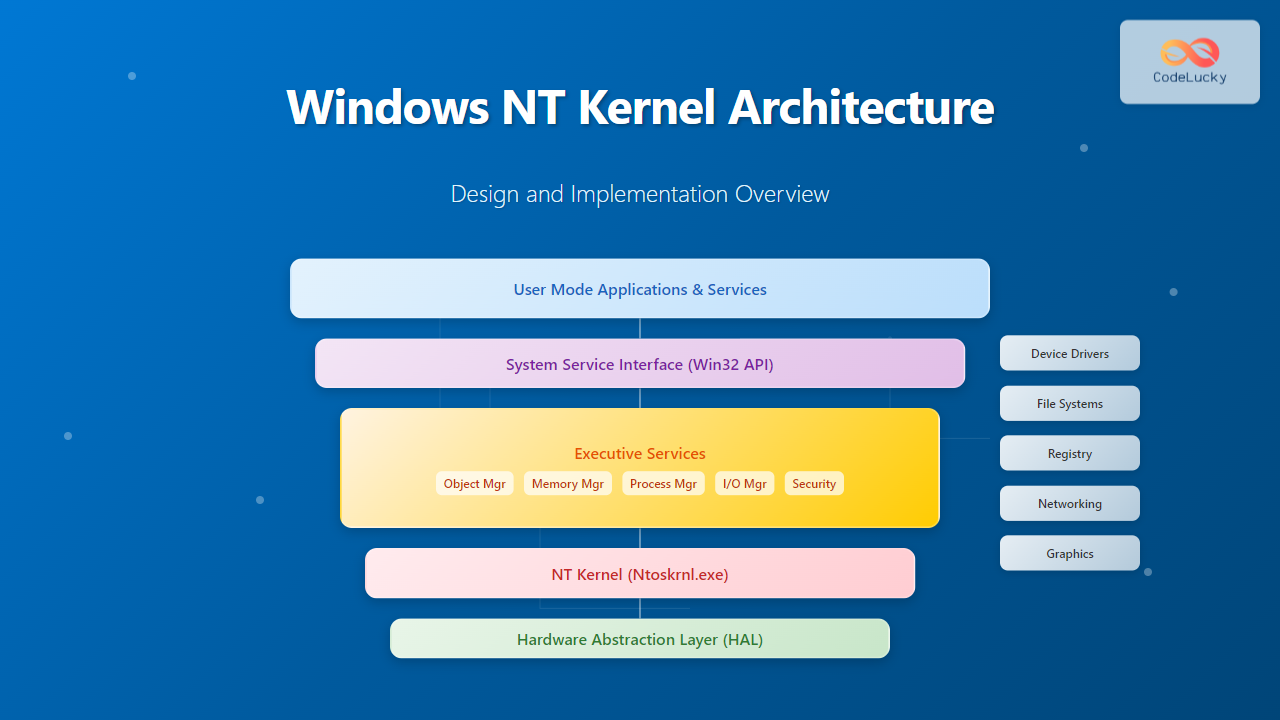
NT Kernel Architecture Overview
The Windows NT kernel follows a hybrid microkernel architecture, combining elements of both monolithic and microkernel designs. This approach provides the performance benefits of a monolithic kernel while maintaining the modularity and reliability of a microkernel.

Key Architectural Components
1. Hardware Abstraction Layer (HAL)
The HAL provides a consistent interface between the kernel and the underlying hardware. It abstracts hardware-specific details, enabling the same kernel to run on different hardware platforms.
Key Functions:
- Interrupt handling and routing
- DMA (Direct Memory Access) operations
- Timer and clock management
- System bus interface
- Power management interface
2. NT Kernel (Ntoskrnl.exe)
The core kernel provides fundamental operating system services including:
- Thread scheduling and dispatching
- Interrupt and exception handling
- Synchronization primitives
- Low-level memory management
3. Executive Services
The Executive layer implements higher-level operating system services:
- Object Manager: Manages kernel objects and namespaces
- Memory Manager: Virtual memory management and paging
- Process Manager: Process and thread management
- I/O Manager: Device drivers and file system interface
- Security Reference Monitor: Access control and auditing
Memory Management Architecture
The NT kernel implements a sophisticated virtual memory system that provides each process with its own 4GB virtual address space (on 32-bit systems) or much larger on 64-bit systems.

Memory Management Components
Virtual Memory Manager (VMM)
The VMM handles:
- Page fault handling
- Working set management
- Page file operations
- Memory-mapped files
Memory Pools
The kernel maintains two primary memory pools:
- Paged Pool: Can be swapped to disk, used for less critical data
- Non-Paged Pool: Always remains in physical memory, used for critical kernel structures
Page Table Management
The NT kernel uses a two-level page table structure on x86 systems:
// Example: Virtual address translation
// Virtual Address: 0x12345678
//
// Bits 31-22: Page Directory Index = 0x048 (72 decimal)
// Bits 21-12: Page Table Index = 0x345 (837 decimal)
// Bits 11-0:  Offset = 0x678 (1656 decimal)

typedef struct _PTE {
    ULONG Valid : 1;
    ULONG Write : 1;
    ULONG Owner : 1;
    ULONG WriteThrough : 1;
    ULONG CacheDisable : 1;
    ULONG Accessed : 1;
    ULONG Dirty : 1;
    ULONG LargePage : 1;
    ULONG Global : 1;
    ULONG CopyOnWrite : 1;
    ULONG Prototype : 1;
    ULONG reserved : 1;
    ULONG PageFrameNumber : 20;
} PTE, *PPTE;
Process and Thread Management
The NT kernel implements a sophisticated process and thread model that supports preemptive multitasking and symmetric multiprocessing.
Process Structure
Each process in the NT kernel is represented by several key data structures:
- EPROCESS: Executive process block (kernel-mode representation)
- PEB (Process Environment Block): User-mode process information
- KPROCESS: Kernel process block
// Simplified EPROCESS structure
typedef struct _EPROCESS {
    KPROCESS Pcb;                    // Kernel process block
    PVOID ProcessLock;               // Process synchronization
    LARGE_INTEGER CreateTime;        // Process creation time
    LARGE_INTEGER ExitTime;          // Process exit time
    HANDLE UniqueProcessId;          // Process ID
    LIST_ENTRY ActiveProcessLinks;   // Link in active process list
    PVOID VadRoot;                   // Virtual address descriptor tree
    PVOID ObjectTable;               // Handle table
    PVOID Token;                     // Security token
    // ... many more fields
} EPROCESS, *PEPROCESS;
Thread Scheduling
The NT kernel uses a priority-based, preemptive scheduling algorithm with 32 priority levels (0-31):

Quantum-based Scheduling
Each thread receives a time quantum (typically 10-120ms) during which it can execute before being preempted:
// Thread quantum calculation example
ULONG CalculateQuantum(UCHAR Priority, BOOLEAN IsServer) {
    ULONG BaseQuantum = IsServer ? 120 : 60; // milliseconds

    if (Priority >= 16) {
        // Real-time threads get longer quantum
        return BaseQuantum * 2;
    } else {
        // Variable priority threads
        return BaseQuantum + (Priority * 5);
    }
}
I/O System Architecture
The NT kernel’s I/O system is built around a layered driver model that provides flexibility and extensibility.
I/O Request Packets (IRPs)
All I/O operations in the NT kernel are handled through I/O Request Packets (IRPs):
// Simplified IRP structure
typedef struct _IRP {
    CSHORT Type;                     // IRP type
    USHORT Size;                     // Size of IRP
    PMDL MdlAddress;                // Memory descriptor list
    ULONG Flags;                     // IRP flags
    NTSTATUS IoStatus;               // I/O status
    KPROCESSOR_MODE RequestorMode;   // Requestor mode
    BOOLEAN PendingReturned;         // Pending flag
    CHAR StackCount;                 // Number of stack locations
    PIO_STACK_LOCATION CurrentLocation; // Current stack location
    // ... additional fields
} IRP, *PIRP;

// I/O Stack Location
typedef struct _IO_STACK_LOCATION {
    UCHAR MajorFunction;             // IRP_MJ_xxx
    UCHAR MinorFunction;             // IRP_MN_xxx
    UCHAR Flags;                     // Stack flags
    UCHAR Control;                   // Stack control
    PDEVICE_OBJECT DeviceObject;     // Target device
    PFILE_OBJECT FileObject;         // File object
    union {
        // Different parameter structures for different operations
        struct {
            ULONG Length;
            LARGE_INTEGER ByteOffset;
        } Read;
        struct {
            ULONG Length;
            LARGE_INTEGER ByteOffset;
        } Write;
        // ... other operation types
    } Parameters;
} IO_STACK_LOCATION, *PIO_STACK_LOCATION;

Driver Types and Hierarchy
The NT kernel supports several types of drivers:
- Highest Level Drivers: File system drivers (NTFS, FAT32)
- Intermediate Drivers: Volume managers, filter drivers
- Lowest Level Drivers: Hardware device drivers
Object Management System
The NT kernel implements a unified object model where all system resources are represented as objects.
Object Types
Common object types include:
- Process and Thread objects
- File and Directory objects
- Event and Semaphore objects
- Registry Key objects
- Device objects
Object Manager Functions
// Object creation example
NTSTATUS CreateObjectExample() {
    OBJECT_ATTRIBUTES ObjectAttributes;
    UNICODE_STRING ObjectName;
    HANDLE EventHandle;
    NTSTATUS Status;

    RtlInitUnicodeString(&ObjectName, L"\\BaseNamedObjects\\MyEvent");

    InitializeObjectAttributes(&ObjectAttributes,
                              &ObjectName,
                              OBJ_CASE_INSENSITIVE,
                              NULL,
                              NULL);

    Status = ZwCreateEvent(&EventHandle,
                          EVENT_ALL_ACCESS,
                          &ObjectAttributes,
                          SynchronizationEvent,
                          FALSE);

    return Status;
}
Object Namespace
The NT kernel maintains a hierarchical namespace for all objects:
Security Architecture
The NT kernel implements comprehensive security through the Security Reference Monitor (SRM).
Access Control Model
Security in NT is based on:
- Security Identifiers (SIDs): Unique identifiers for users and groups
- Access Tokens: Contain security information for processes/threads
- Security Descriptors: Define permissions for objects
- Access Control Lists (ACLs): List of access control entries
// Access token structure (simplified)
typedef struct _TOKEN {
    LUID TokenId;                    // Token identifier
    LUID AuthenticationId;           // Logon session identifier
    LARGE_INTEGER ExpirationTime;    // Token expiration
    TOKEN_TYPE TokenType;            // Primary or impersonation
    SECURITY_IMPERSONATION_LEVEL ImpersonationLevel;
    TOKEN_SOURCE TokenSource;        // Token source
    PSID_AND_ATTRIBUTES UserAndGroups; // User and group SIDs
    PLUID_AND_ATTRIBUTES Privileges;   // Privileges
    // ... additional fields
} TOKEN, *PTOKEN;

// Security descriptor structure
typedef struct _SECURITY_DESCRIPTOR {
    UCHAR Revision;                  // Descriptor revision
    UCHAR Sbz1;                     // Reserved
    SECURITY_DESCRIPTOR_CONTROL Control; // Control flags
    PSID Owner;                     // Owner SID
    PSID Group;                     // Primary group SID
    PACL Sacl;                      // System ACL
    PACL Dacl;                      // Discretionary ACL
} SECURITY_DESCRIPTOR, *PSECURITY_DESCRIPTOR;
Privilege System
The NT kernel implements a fine-grained privilege system with privileges like:
- SeDebugPrivilege: Debug other processes
- SeBackupPrivilege: Bypass file security for backup
- SeLoadDriverPrivilege: Load device drivers
- SeShutdownPrivilege: Shut down the system
Synchronization Mechanisms
The NT kernel provides various synchronization primitives for coordinating access to shared resources.
Kernel Synchronization Objects
- Mutexes: Mutual exclusion with ownership
- Semaphores: Counting synchronization
- Events: Signaling mechanisms
- Critical Sections: Fast user-mode synchronization
- Spin Locks: High-performance kernel synchronization
// Spin lock example
KSPIN_LOCK MySpinLock;
KIRQL OldIrql;

// Initialize spin lock
KeInitializeSpinLock(&MySpinLock);

// Acquire spin lock
KeAcquireSpinLock(&MySpinLock, &OldIrql);

// Critical section code here
// Access shared resource

// Release spin lock
KeReleaseSpinLock(&MySpinLock, OldIrql);

// Fast mutex example for better performance
FAST_MUTEX MyFastMutex;

ExInitializeFastMutex(&MyFastMutex);

// Acquire fast mutex
ExAcquireFastMutex(&MyFastMutex);

// Critical section
// Modify shared data structure

// Release fast mutex
ExReleaseFastMutex(&MyFastMutex);
Performance and Scalability Features
Symmetric Multiprocessing (SMP)
The NT kernel was designed from the ground up to support multiple processors:
- Per-processor data structures
- Processor affinity control
- Load balancing algorithms
- NUMA (Non-Uniform Memory Access) support
Kernel Optimizations
- Lazy evaluation: Defer expensive operations when possible
- Copy-on-write: Optimize memory usage for process creation
- Lookaside lists: Fast allocation of frequently used objects
- Working set optimization: Intelligent memory management
// Lookaside list example
NPAGED_LOOKASIDE_LIST MyLookasideList;

// Initialize lookaside list
ExInitializeNPagedLookasideList(&MyLookasideList,
                                NULL,                // Allocate function
                                NULL,                // Free function
                                0,                   // Flags
                                sizeof(MY_STRUCTURE), // Size
                                'Tag1',              // Pool tag
                                0);                  // Depth

// Allocate from lookaside list
PMY_STRUCTURE pStruct = ExAllocateFromNPagedLookasideList(&MyLookasideList);

// Use the structure
if (pStruct != NULL) {
    // Initialize and use structure
    // ...

    // Free back to lookaside list
    ExFreeToNPagedLookasideList(&MyLookasideList, pStruct);
}
Debugging and Diagnostic Features
Kernel Debugging Support
The NT kernel provides extensive debugging capabilities:
- Blue Screen of Death (BSOD): System crash information
- Kernel debugger integration
- Event Tracing for Windows (ETW)
- System call tracing
- Memory pool tracking
Crash Dump Analysis
// Crash dump header structure
typedef struct _DUMP_HEADER {
    ULONG Signature;                 // 'DUMP' or 'PAGE'
    ULONG ValidDump;                // 'DUMP'
    ULONG MajorVersion;             // Major version
    ULONG MinorVersion;             // Minor version
    ULONG DirectoryTableBase;       // Page directory
    PULONG PfnDataBase;             // Page frame database
    PLIST_ENTRY PsLoadedModuleList; // Loaded modules
    PLIST_ENTRY PsActiveProcessHead; // Active processes
    ULONG MachineImageType;         // Machine type
    ULONG NumberProcessors;         // Processor count
    ULONG BugCheckCode;             // Bug check code
    // ... additional crash information
} DUMP_HEADER, *PDUMP_HEADER;
Evolution and Modern Enhancements
Windows 10/11 Kernel Improvements
Recent versions of the NT kernel include:
- Kernel Control Flow Guard (kCFG): Enhanced security against ROP attacks
- Hypervisor Code Integrity (HVCI): Hardware-enforced code integrity
- Kernel Address Space Layout Randomization (kASLR)
- Memory compression: Improved memory utilization
- Container support: Windows containers and Hyper-V isolation
Performance Monitoring
Modern NT kernel includes advanced performance monitoring:
// ETW (Event Tracing for Windows) example
REGHANDLE RegistrationHandle;
EVENT_DESCRIPTOR EventDescriptor;

// Register ETW provider
EventRegister(&MyProviderGuid,
              NULL,                    // Enable callback
              NULL,                    // Context
              &RegistrationHandle);

// Define event
EventDescCreate(&EventDescriptor,
                1,                     // Event ID
                0,                     // Version
                0,                     // Channel
                TRACE_LEVEL_INFORMATION, // Level
                0,                     // Task
                0,                     // OpCode
                0);                    // Keyword

// Write event
EventWrite(RegistrationHandle,
           &EventDescriptor,
           0,                          // User data count
           NULL);                      // User data

// Unregister
EventUnregister(RegistrationHandle);
Best Practices for Kernel Development
Driver Development Guidelines
- Use appropriate IRQL levels: Understand when code runs at different interrupt levels
- Minimize time in critical sections: Avoid long-running operations while holding locks
- Handle all error conditions: Always check return values and handle failures gracefully
- Use proper memory management: Match allocations with deallocations
- Follow coding standards: Use consistent naming and documentation
Common Pitfalls
- IRQL violations: Calling pageable code at elevated IRQL
- Memory leaks: Not freeing allocated memory
- Deadlocks: Improper lock ordering
- Buffer overruns: Not validating input parameters
- Resource leaks: Not releasing handles and objects
Conclusion
The Windows NT kernel represents a sophisticated and well-engineered operating system foundation that has evolved over three decades. Its hybrid architecture combines the best aspects of different kernel designs, providing excellent performance while maintaining reliability and security.
Key strengths of the NT kernel include:
- Robust architecture: Clean separation between user and kernel modes
- Scalability: Excellent SMP and NUMA support
- Security: Comprehensive access control and privilege system
- Extensibility: Layered driver model and object-oriented design
- Portability: HAL abstraction enables multi-platform support
Understanding the NT kernel’s design and implementation is crucial for system developers, security professionals, and anyone working with Windows at a low level. The kernel’s continued evolution demonstrates Microsoft’s commitment to maintaining a modern, secure, and high-performance operating system foundation.
As Windows continues to evolve with cloud computing, containers, and modern security requirements, the NT kernel remains the stable foundation that enables these advanced features while maintaining backward compatibility with decades of existing software.
Related Posts
Operating System Architecture: Monolithic vs Microkernel Design Patterns
Introduction to Operating System Architecture Operating system architecture defines how the core components of an OS are organized and interact...
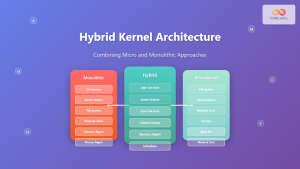
Hybrid Kernel: Complete Guide to Combining Micro and Monolithic Kernel Architectures
A hybrid kernel represents an evolutionary approach in operating system design that strategically combines elements from both microkernel and monolithic...
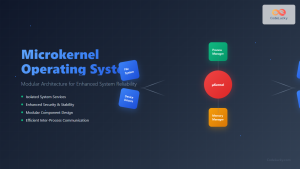
Microkernel Operating System: Modular Architecture for Enhanced System Reliability
What is a Microkernel Operating System? A microkernel operating system represents a minimalist approach to kernel design where only the...
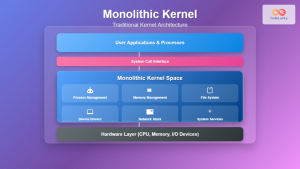
Monolithic Kernel: Complete Guide to Traditional Kernel Architecture
What is a Monolithic Kernel? A monolithic kernel is a traditional kernel architecture where the entire operating system runs in...
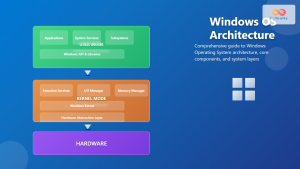
Windows Operating System: Complete Guide to Architecture and Core Components
The Windows Operating System stands as one of the most widely used operating systems globally, powering billions of devices from...
Kernel in Operating System: Core Functions and Memory Management
The kernel stands as the fundamental cornerstone of any operating system, serving as the critical bridge between hardware components and...
Embedded Operating System: Complete Guide to Resource-Constrained Environments
Embedded operating systems form the backbone of countless devices we interact with daily, from smart home appliances to automotive control...
Exokernel: Application-level Resource Management Architecture in Operating Systems
Introduction to Exokernel Architecture The exokernel represents a revolutionary approach to operating system design that fundamentally challenges traditional kernel architectures....
Trusted Computing Base: Security Kernel Design Fundamentals and Implementation
In the realm of operating system security, the Trusted Computing Base (TCB) represents the foundation upon which all system security...
Multithreading in Operating Systems: Benefits, Challenges, and Implementation Guide
What is Multithreading in Operating Systems? Multithreading is a fundamental concept in modern operating systems that allows a single process...
Garbage Collection in Operating System: Complete Guide to Automatic Memory Management
What is Garbage Collection in Operating Systems? Garbage collection is an automatic memory management technique used by operating systems and...
Memory Protection: Hardware and Software Mechanisms for Secure Computing
Understanding Memory Protection in Modern Computing Memory protection is a fundamental security mechanism that prevents programs from accessing memory regions...
- Introduction to Windows NT Kernel
- NT Kernel Architecture Overview
- Memory Management Architecture
- Process and Thread Management
- I/O System Architecture
- Object Management System
- Security Architecture
- Synchronization Mechanisms
- Performance and Scalability Features
- Debugging and Diagnostic Features
- Evolution and Modern Enhancements
- Best Practices for Kernel Development
- Conclusion