Introduction to User Account Management
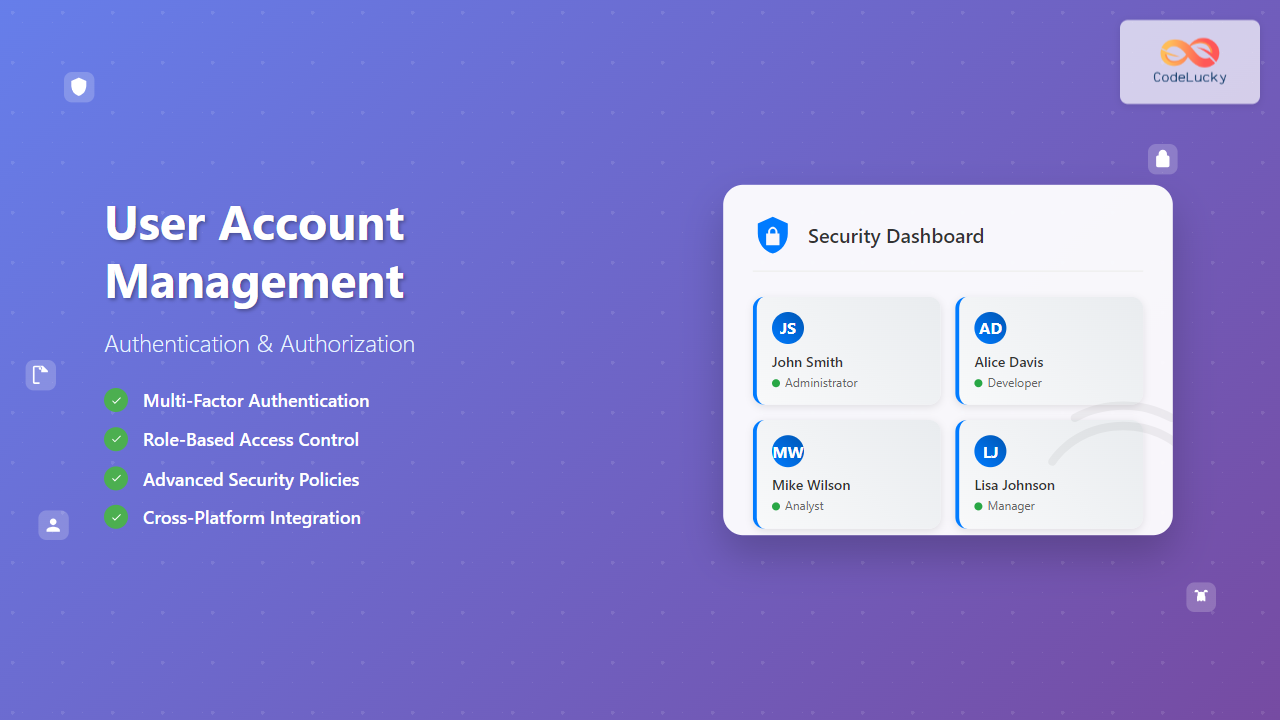
User account management forms the cornerstone of operating system security, establishing the foundation for authentication (verifying user identity) and authorization (controlling access to resources). Modern operating systems implement sophisticated mechanisms to ensure only legitimate users access appropriate system resources while maintaining security boundaries between different user contexts.
This comprehensive guide explores the intricate relationship between authentication and authorization, examining implementation strategies, security models, and practical examples across major operating systems including Windows, Linux, and macOS.
Understanding Authentication Fundamentals
Authentication represents the process of verifying a user’s claimed identity through various credential verification methods. Operating systems employ multiple authentication factors to establish trust before granting system access.
Authentication Factors
Something you know (Knowledge factors):
- Passwords and passphrases
- Personal identification numbers (PINs)
- Security questions and answers
Something you have (Possession factors):
- Smart cards and hardware tokens
- Mobile devices for SMS/app-based verification
- USB security keys
Something you are (Inherence factors):
- Fingerprint recognition
- Facial recognition
- Voice pattern analysis
- Iris scanning

Windows Authentication Example
Windows implements multiple authentication protocols, with NTLM and Kerberos being predominant in domain environments.
# View current authentication information
whoami /all

# Output example:
USER INFORMATION
----------------
User Name           SID
=================== ================================================
DOMAIN\johnsmith    S-1-5-21-123456789-987654321-111111111-1001

GROUP INFORMATION
-----------------
Group Name                             Type             SID
====================================== ================ ================================================
Everyone                               Well-known group S-1-1-0
DOMAIN\Domain Users                    Group            S-1-5-21-123456789-987654321-111111111-513
BUILTIN\Users                          Alias            S-1-5-32-545
Linux Authentication Process
Linux systems utilize the Pluggable Authentication Modules (PAM) framework, providing flexible authentication configuration.
# Check current user authentication status
id

# Output:
uid=1000(johnsmith) gid=1000(johnsmith) groups=1000(johnsmith),4(adm),24(cdrom),27(sudo),30(dip)

# View authentication logs
sudo tail -f /var/log/auth.log

# Example output:
Aug 28 21:45:32 server sshd[1234]: Accepted password for johnsmith from 192.168.1.100 port 22 ssh2
Aug 28 21:45:32 server systemd-logind[567]: New session 2 of user johnsmith.
Authorization Models and Implementation
Authorization determines what authenticated users can access and perform within the system. Operating systems implement various authorization models to enforce security policies effectively.

Access Control Lists (ACLs)
Discretionary Access Control (DAC) allows resource owners to control access permissions. This model forms the foundation of most modern operating system security implementations.
Windows ACL Example
# View file permissions using PowerShell
Get-Acl "C:\Important\Document.txt" | Format-List

# Output:
Path   : Microsoft.PowerShell.Core\FileSystem::C:\Important\Document.txt
Owner  : DOMAIN\johnsmith
Group  : DOMAIN\Domain Users
Access : NT AUTHORITY\SYSTEM Allow  FullControl
         DOMAIN\johnsmith Allow  FullControl
         BUILTIN\Administrators Allow  FullControl
         DOMAIN\ProjectTeam Allow  ReadAndExecute, Write

# Modify permissions
$acl = Get-Acl "C:\Important\Document.txt"
$accessRule = New-Object System.Security.AccessControl.FileSystemAccessRule("DOMAIN\newuser","ReadAndExecute","Allow")
$acl.SetAccessRule($accessRule)
$acl | Set-Acl "C:\Important\Document.txt"
Linux Permission System
# Display detailed file permissions
ls -la /home/johnsmith/project/

# Output:
drwxr-xr-x  3 johnsmith johnsmith 4096 Aug 28 21:30 documents/
-rw-r--r--  1 johnsmith johnsmith 1024 Aug 28 21:25 readme.txt
-rwxr-x---  1 johnsmith developers 2048 Aug 28 21:20 script.sh

# Modify permissions using chmod
chmod 750 script.sh
chmod g+w documents/

# Set ACL for advanced permissions
setfacl -m u:alice:rw readme.txt
getfacl readme.txt

# Output:
# file: readme.txt
# owner: johnsmith
# group: johnsmith
user::rw-
user:alice:rw-
group::r--
mask::rw-
other::r--
Role-Based Access Control (RBAC)
RBAC assigns permissions to roles rather than individual users, simplifying permission management in complex environments.

Windows Server Role Implementation
# Create custom role in Active Directory
New-ADGroup -Name "DatabaseAdministrators" -GroupScope Global -GroupCategory Security
New-ADGroup -Name "WebDevelopers" -GroupScope Global -GroupCategory Security

# Assign users to roles
Add-ADGroupMember -Identity "DatabaseAdministrators" -Members "johnsmith", "mikewilson"
Add-ADGroupMember -Identity "WebDevelopers" -Members "janedoe"

# Configure folder permissions for role
$acl = Get-Acl "C:\Database"
$accessRule = New-Object System.Security.AccessControl.FileSystemAccessRule("DOMAIN\DatabaseAdministrators","FullControl","ContainerInherit,ObjectInherit","None","Allow")
$acl.SetAccessRule($accessRule)
$acl | Set-Acl "C:\Database"
Multi-Factor Authentication Implementation
Multi-factor authentication (MFA) significantly enhances security by requiring multiple verification methods. Modern operating systems integrate various MFA technologies to strengthen authentication processes.
Windows Hello Implementation
# Check Windows Hello status
Get-WindowsOptionalFeature -Online -FeatureName "HelloFace"

# Configure Windows Hello for Business
# Registry configuration example
$regPath = "HKLM:\SOFTWARE\Policies\Microsoft\PassportForWork"
New-ItemProperty -Path $regPath -Name "Enabled" -Value 1 -PropertyType DWORD -Force
New-ItemProperty -Path $regPath -Name "RequireSecurityDevice" -Value 1 -PropertyType DWORD -Force
Linux PAM MFA Configuration
# Install Google Authenticator PAM module
sudo apt-get install libpam-google-authenticator

# Configure PAM for SSH MFA
sudo nano /etc/pam.d/sshd

# Add this line:
auth required pam_google_authenticator.so

# Update SSH configuration
sudo nano /etc/ssh/sshd_config

# Modify these settings:
ChallengeResponseAuthentication yes
AuthenticationMethods publickey,keyboard-interactive

# Restart SSH service
sudo systemctl restart sshd

# Setup MFA for user
google-authenticator

# Output:
Do you want authentication tokens to be time-based (y/n) y
Your new secret key is: ABCDEFGHIJKLMNOP
Your verification code is 123456
Your emergency scratch codes are:
  98765432
  87654321
  76543210
Advanced Authorization Mechanisms
Attribute-Based Access Control (ABAC)
ABAC provides fine-grained access control based on attributes of users, resources, actions, and environmental conditions.

Linux Capabilities System
Linux capabilities provide granular privilege control, allowing processes to operate with specific privileges without full root access.
# View process capabilities
sudo getpcaps $(pgrep nginx)

# Output:
Capabilities for `1234': = cap_net_bind_service+ep

# Set file capabilities
sudo setcap 'cap_net_bind_service=+ep' /usr/sbin/nginx

# View file capabilities
getcap /usr/sbin/nginx

# Output:
/usr/sbin/nginx = cap_net_bind_service+ep

# List available capabilities
capsh --print

# Output shows available capabilities:
Current: = cap_chown,cap_dac_override,cap_dac_read_search,cap_fowner...
Bounding set: =cap_chown,cap_dac_override,cap_dac_read_search,cap_fowner...
Security Considerations and Best Practices
Password Policy Implementation
# Linux password policy configuration
sudo nano /etc/security/pwquality.conf

# Example configuration:
minlen = 12
minclass = 3
maxrepeat = 2
maxclasschg = 0
difok = 4
gecoscheck = 1
dcredit = -1
ucredit = -1
lcredit = -1
ocredit = -1

# Check password strength
echo "TestPassword123!" | pwscore

# Output: 90

# Configure account lockout policy
sudo nano /etc/security/faillock.conf

# Configuration:
deny = 5
unlock_time = 900
fail_interval = 900
Audit and Monitoring

# Linux audit system configuration
sudo auditctl -w /etc/passwd -p wa -k password_changes
sudo auditctl -w /etc/shadow -p wa -k shadow_changes
sudo auditctl -w /etc/group -p wa -k group_changes

# Search audit logs
sudo ausearch -k password_changes -ts recent

# Windows event monitoring
Get-WinEvent -FilterHashtable @{LogName='Security'; ID=4624,4625,4648} | Select-Object -First 10

# Output shows login events:
TimeCreated         Id LevelDisplayName Message
-----------         -- ---------------- -------
8/28/2025 9:45:32 PM 4624 Information   An account was successfully logged on...
8/28/2025 9:44:15 PM 4625 Information   An account failed to log on...
Cross-Platform User Management
Integration Strategies
Modern environments often require integration between different operating systems and authentication providers.
# SSSD configuration for Active Directory integration
sudo nano /etc/sssd/sssd.conf

# Configuration:
[sssd]
domains = company.local
config_file_version = 2
services = nss, pam

[domain/company.local]
ad_domain = company.local
krb5_realm = COMPANY.LOCAL
realmd_tags = manages-system joined-with-adcli
cache_credentials = True
id_provider = ad
krb5_store_password_if_offline = True
default_shell = /bin/bash
ldap_id_mapping = True
fallback_homedir = /home/%u@%d
access_provider = ad

# Start SSSD service
sudo systemctl enable sssd
sudo systemctl start sssd

# Test domain authentication
su - [email protected]
Performance Optimization
Caching Strategies
# Configure SSSD caching
sudo nano /etc/sssd/sssd.conf

# Add caching parameters:
[domain/company.local]
cache_credentials = true
entry_cache_timeout = 1200
account_cache_expiration = 1
enum_cache_timeout = 120

# Clear authentication cache when needed
sudo sss_cache -E

# Monitor authentication performance
sudo journalctl -u sssd -f

# Windows credential caching
klist

# Output:
Current LogonId is 0:0x1a2b3c4d

Cached Tickets: (2)

#0>     Client: [email protected]
        Server: krbtgt/[email protected]
        Ticket Flags 0x40e10000
        Start Time: 8/28/2025 21:45:32
        End Time:   8/29/2025 07:45:32
Troubleshooting Common Issues
Authentication Failures
# Debug PAM authentication
sudo tail -f /var/log/auth.log | grep pam

# Common failure patterns:
# Failed password for user
# Authentication failure for user
# Account locked due to failed logins

# Windows authentication debugging
Get-EventLog -LogName Security -InstanceId 4625 -Newest 10 | Format-Table TimeGenerated, Message -AutoSize

# Reset account lockout
net user johnsmith /active:yes
Permission Troubleshooting
# Linux permission debugging
# Check effective permissions
sudo -u testuser ls -la /restricted/directory/

# Windows permission analysis
icacls "C:\Important\Document.txt" /verify

# Output:
C:\Important\Document.txt: Verification completed successfully.

# Fix common permission issues
sudo chmod -R u+rwX,g+rX,o+rX /shared/directory/
sudo chown -R www-data:www-data /var/www/html/
Future Trends and Considerations
User account management continues evolving with passwordless authentication, zero-trust architectures, and artificial intelligence-driven security systems. Organizations should prepare for:
- Biometric integration becoming standard across all platforms
- Behavioral analytics for continuous authentication
- Quantum-resistant cryptography implementation
- Decentralized identity management systems
- AI-powered threat detection and response
Understanding these fundamental concepts and implementation strategies enables system administrators to design robust, scalable user account management systems that balance security requirements with operational efficiency. Regular monitoring, policy updates, and staying current with security best practices ensure continued protection against evolving threats while maintaining user productivity and system reliability.