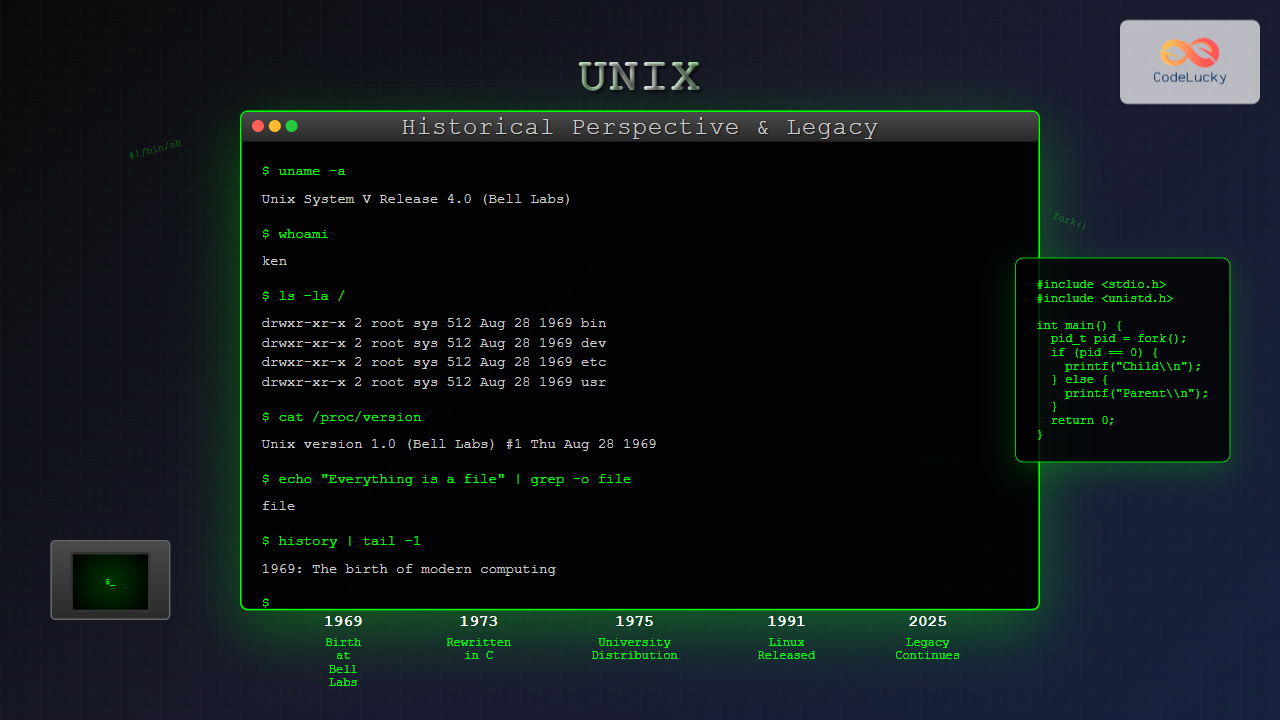
The Unix operating system stands as one of the most influential and enduring achievements in computer science history. Born in the late 1960s at Bell Labs, Unix revolutionized how we think about operating systems, establishing principles and philosophies that continue to shape modern computing today. From powering the earliest internet servers to forming the foundation of contemporary systems like Linux and macOS, Unix’s legacy permeates virtually every aspect of modern technology.
The Genesis of Unix: Bell Labs Innovation (1969-1971)
The story of Unix begins with frustration and innovation at Bell Labs. In 1969, Ken Thompson, working alongside Dennis Ritchie and others, began developing what would become Unix after Bell Labs withdrew from the ambitious but troubled Multics project. Thompson’s initial motivation was surprisingly simple: he wanted to play a game called “Space Travel” on a PDP-7 minicomputer.
What started as a personal project quickly evolved into something revolutionary. Thompson wrote the first version of Unix in assembly language for the PDP-7, creating a simple but elegant operating system that embodied principles of simplicity and modularity. The name “Unix” itself was a play on “Multics,” suggesting a simpler, more unified approach to operating system design.
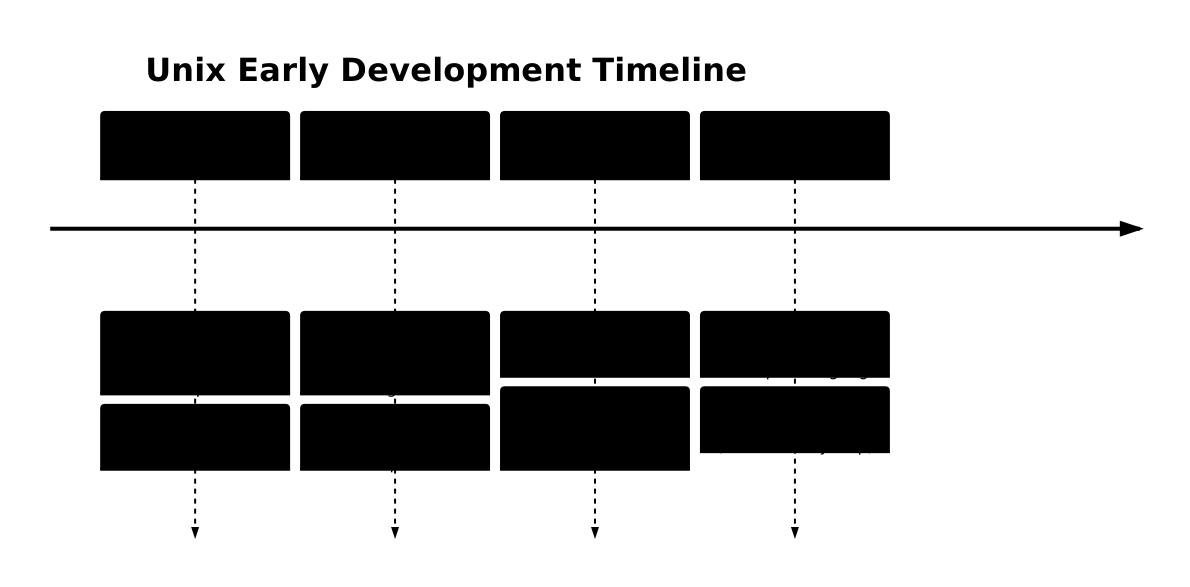
Key Innovations of Early Unix
Several groundbreaking concepts emerged from these early Unix versions:
- Hierarchical File System: Unix introduced the tree-like directory structure we take for granted today, with the root directory (/) at the top and subdirectories branching below.
- Everything is a File: This fundamental philosophy treated devices, processes, and system resources as files, creating a unified interface for system interaction.
- Simple, Composable Tools: Unix programs were designed to do one thing well and work together through pipes and redirection.
- Multi-user, Multi-tasking: Unlike many contemporary systems, Unix was designed from the ground up to support multiple users and concurrent processes.
The C Language Revolution and Portability (1972-1973)
Perhaps the most significant milestone in Unix history came when Dennis Ritchie developed the C programming language specifically to rewrite Unix. This decision, completed by 1973, was revolutionary for several reasons:
Prior to C, operating systems were written in assembly language, making them tied to specific hardware architectures. By rewriting Unix in C, Thompson and Ritchie created the first truly portable operating system. This portability would prove crucial to Unix’s widespread adoption and longevity.
Impact of C on Unix Development
The relationship between C and Unix was symbiotic:
- Portability: Unix could now run on different hardware platforms with minimal modification
- Maintainability: C code was easier to read, debug, and modify than assembly language
- Performance: C provided low-level control while maintaining high-level expressivity
- Ecosystem Growth: C became the language of choice for system programming, creating a skilled developer community

Academic Distribution and the Berkeley Connection (1975-1980)
A crucial turning point came in 1975 when AT&T began licensing Unix to universities at nominal fees. This decision, driven partly by antitrust concerns that prevented AT&T from commercializing software directly, had profound unintended consequences.
The University of California, Berkeley became particularly significant in Unix’s evolution. Students and faculty, led by Bill Joy, began enhancing Unix with new features and improvements. These modifications eventually became known as the Berkeley Software Distribution (BSD).
BSD Contributions to Unix
Berkeley’s contributions were substantial and lasting:
- Virtual Memory Management: BSD introduced sophisticated memory management techniques
- TCP/IP Networking: The networking stack that powers the internet was largely developed at Berkeley
- vi Editor: Bill Joy created the vi text editor, which remains popular today
- C Shell (csh): An alternative to the original Bourne shell with enhanced scripting capabilities
- Fast File System (FFS): Significant improvements to file system performance and reliability
Commercial Unix Wars and Fragmentation (1980s-1990s)
As Unix gained popularity, commercial vendors began creating their own versions, leading to a period of fragmentation that both helped and hindered Unix’s growth. Major variants included:
- System V (AT&T): The “official” commercial Unix from AT&T
- SunOS/Solaris (Sun Microsystems): Popular in workstation and server markets
- AIX (IBM): IBM’s Unix for their hardware platforms
- HP-UX (Hewlett-Packard): HP’s Unix implementation
- IRIX (Silicon Graphics): Specialized for graphics workstations

The POSIX Standardization Effort
To address fragmentation, the IEEE developed the Portable Operating System Interface (POSIX) standards in the late 1980s. POSIX defined standard APIs and behaviors that Unix-like systems should implement, promoting compatibility across different Unix variants.
The Rise of Free and Open Source Unix (1990s-Present)
The 1990s brought two revolutionary developments that would reshape Unix’s legacy: the GNU Project and Linux.
GNU Project and the Free Software Movement
Richard Stallman’s GNU Project, launched in 1983, aimed to create a completely free Unix-like operating system. GNU (GNU’s Not Unix) developed many essential Unix tools and utilities, including:
- GCC (GNU Compiler Collection): A powerful, portable C compiler
- GNU Coreutils: Essential command-line utilities
- Bash Shell: An enhanced Bourne shell with advanced features
- Emacs Editor: A highly extensible text editor
Linux: The Game Changer
In 1991, Linus Torvalds, a Finnish computer science student, released the first version of Linux—a Unix-like kernel that could run GNU software. This combination of the Linux kernel with GNU tools created a complete, free Unix-like operating system that anyone could use, modify, and distribute.
Linux’s impact was immediate and profound:
- Accessibility: Free licensing made Unix technology available to everyone
- Community Development: Thousands of developers worldwide contributed to Linux
- Hardware Support: Linux rapidly supported new hardware platforms
- Commercial Adoption: Companies began using Linux for critical applications
Unix Philosophy and Design Principles
Unix’s enduring success stems from a set of design principles and philosophical approaches that remain relevant today. These principles, often called the “Unix Philosophy,” include:
Core Unix Principles
- Write programs that do one thing and do it well: Unix tools are designed to perform specific tasks efficiently rather than being monolithic applications.
- Write programs to work together: Tools should be composable, allowing complex tasks to be accomplished by combining simple programs.
- Write programs to handle text streams: Text is a universal interface that enables tool interoperability.
- Everything is a file: Devices, processes, and system resources are accessed through the file system interface.
- Store data in flat text files: Human-readable configuration and data files promote transparency and ease of manipulation.
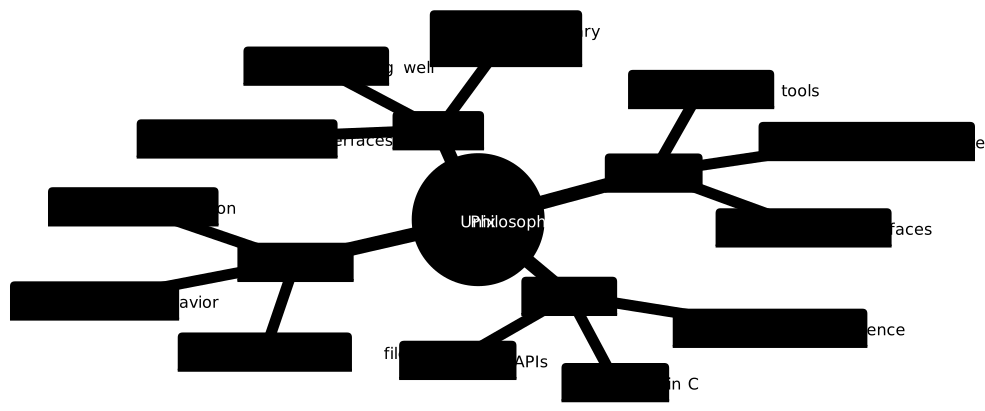
Examples of Unix Philosophy in Action
The power of Unix philosophy becomes clear through practical examples:
Command Pipeline Example
# Find the 10 most frequently used words in a text file
cat document.txt | tr ' ' '\n' | sort | uniq -c | sort -nr | head -10
This simple command demonstrates:
- cat: Outputs file contents
- tr: Translates spaces to newlines (one word per line)
- sort: Sorts words alphabetically
- uniq -c: Counts unique occurrences
- sort -nr: Sorts numerically in reverse order
- head -10: Shows only the top 10 results
File System as Universal Interface
# Reading from devices and processes as files
cat /proc/cpuinfo        # CPU information
cat /dev/urandom | head -c 10  # Random data
echo "Hello" > /dev/tty1       # Write to terminal
Unix’s Technical Innovations and Contributions
Beyond philosophy, Unix introduced numerous technical innovations that became standard in modern operating systems:
Process Management
Unix pioneered several process management concepts:
- Fork and Exec Model: The fork() system call creates process copies, while exec() replaces the process image
- Process Hierarchy: Parent-child relationships with process inheritance
- Signal Handling: Inter-process communication through signals
- Process Groups and Sessions: Logical grouping of related processes
File System Architecture
Unix file systems introduced several enduring concepts:
- Inodes: Separate metadata storage for file information
- Hard and Soft Links: Multiple references to the same file
- Mount Points: Unified namespace for multiple file systems
- Permission Model: Owner, group, and other permission categories
Shell and Command Interface
The Unix shell established patterns still used today:
- Command-line Interface: Text-based system interaction
- Shell Scripting: Automation through script files
- I/O Redirection: Flexible input/output routing
- Job Control: Background and foreground process management

Modern Unix Descendants and Their Impact
Today’s computing landscape is dominated by systems that trace their lineage directly to Unix:
Linux: The Open Source Revolution
Linux has become the most successful Unix descendant:
- Server Dominance: Linux powers the majority of web servers, cloud infrastructure, and supercomputers
- Mobile Computing: Android, based on Linux, runs on billions of mobile devices
- Embedded Systems: Linux runs everything from smart TVs to automotive systems
- Container Technology: Docker and Kubernetes have revolutionized application deployment
macOS: Unix in the Consumer Market
Apple’s macOS, built on the Darwin kernel (itself derived from BSD), brings Unix to millions of consumer devices:
- POSIX Compliance: Full Unix compatibility under a user-friendly interface
- Developer Platform: Popular among software developers and creative professionals
- Integration: Seamless integration with iOS ecosystem
BSD Variants: The Academic Legacy
The BSD family continues to thrive:
- FreeBSD: Popular for servers and appliances
- OpenBSD: Focus on security and correctness
- NetBSD: Emphasis on portability across hardware platforms
Unix in Modern Computing Infrastructure
Unix’s influence on modern computing infrastructure cannot be overstated:
Internet and Web Servers
The internet was largely built on Unix systems:
- Web Servers: Apache, Nginx, and other web servers originated on Unix
- DNS: The Domain Name System runs primarily on Unix-like systems
- Email: Most email servers use Unix-based systems
- Network Protocols: TCP/IP stack development happened on Unix
Cloud Computing and DevOps
Modern cloud computing is built on Unix foundations:
- Virtualization: Technologies like KVM and Xen run on Linux
- Containers: Docker and container orchestration systems
- Infrastructure as Code: Configuration management tools
- Continuous Integration: Most CI/CD pipelines run on Unix-like systems
Security Model and Permissions
Unix introduced a security model that remains fundamental to modern systems:
User and Group Management
The Unix security model includes:
- User Accounts: Individual user identification and authentication
- Group Membership: Logical grouping of users for permission management
- Superuser (root): Administrative account with full system access
- Process Ownership: Every process runs with specific user privileges
File Permissions
Unix file permissions use a simple but effective model:
# Example file permissions
-rwxr-xr--  1 user group 1024 Aug 28 18:30 script.sh
# -: regular file
# rwx: owner can read, write, execute
# r-x: group can read and execute
# r--: others can only read
Programming and Development Environment
Unix established the foundation for modern software development:
Development Tools
Unix pioneered many development tools still used today:
- Text Editors: vi, emacs, and their descendants
- Compilers: cc (C compiler) and later GCC
- Debuggers: dbx and later gdb
- Version Control: SCCS, RCS, and later Git
- Build Systems: make utility for automated compilation
Scripting and Automation
Unix shell scripting enables powerful automation:
#!/bin/bash
# Example backup script
DATE=$(date +%Y%m%d)
BACKUP_DIR="/backups"
SOURCE_DIR="/home/user/documents"

# Create backup with timestamp
tar -czf "$BACKUP_DIR/backup_$DATE.tar.gz" "$SOURCE_DIR"

# Remove backups older than 30 days
find "$BACKUP_DIR" -name "backup_*.tar.gz" -mtime +30 -delete

echo "Backup completed: backup_$DATE.tar.gz"
Educational Impact and Computer Science
Unix’s role in computer science education has been profound:
Academic Influence
Unix became the standard teaching platform for:
- Operating Systems Courses: Students learn OS concepts through Unix
- Systems Programming: C programming and system calls
- Network Programming: Socket programming and network protocols
- Software Engineering: Development practices and tool usage
Research Platform
Unix facilitated countless research projects:
- Networking Research: Internet protocols and applications
- Database Systems: Many database innovations originated on Unix
- Artificial Intelligence: AI research tools and languages
- Graphics and Visualization: Computer graphics development
Challenges and Criticisms
Despite its success, Unix has faced legitimate criticisms:
Complexity and Learning Curve
- Command-line Interface: Can be intimidating for new users
- Fragmentation: Multiple variants with subtle differences
- Documentation: Sometimes terse or incomplete
- Inconsistencies: Different tools may use different conventions
Security Concerns
- Legacy Code: Some older Unix systems contain security vulnerabilities
- Privilege Escalation: The root/user model can be a security risk
- Network Security: Many services were designed before security was paramount
Future Prospects and Continuing Evolution
Unix continues to evolve and adapt to new computing paradigms:
Container Technology
Unix concepts enable modern containerization:
- Namespaces: Process isolation and resource management
- Control Groups: Resource limiting and monitoring
- Union File Systems: Layered file system approaches
Cloud-Native Computing
Unix principles align well with cloud computing:
- Microservices: Small, focused services mirror Unix tool philosophy
- Immutable Infrastructure: Treating servers as replaceable components
- Configuration as Code: Text-based configuration management
Internet of Things (IoT)
Unix-like systems power IoT devices:
- Embedded Linux: Lightweight Linux distributions for IoT
- Real-time Capabilities: Enhanced real-time performance
- Security Focus: Improved security for connected devices
Conclusion: The Enduring Legacy of Unix
The Unix operating system represents one of the most successful and influential projects in computer science history. From its humble beginnings as Ken Thompson’s personal project to its current status as the foundation of most modern computing infrastructure, Unix has demonstrated remarkable longevity and adaptability.
The key to Unix’s enduring success lies not just in its technical innovations, but in its philosophical approach to system design. The Unix philosophy of simplicity, modularity, and composability has proven to be timeless, influencing everything from programming languages to software architecture patterns to modern microservices design.
Today, as we navigate an era of cloud computing, artificial intelligence, and Internet of Things devices, Unix principles continue to provide valuable guidance. The idea that complex systems should be built from simple, well-defined components that work together seamlessly remains as relevant now as it was in 1969.
Whether you’re using a Linux server, developing on macOS, or deploying containerized applications in the cloud, you’re benefiting from more than five decades of Unix innovation and evolution. The system that began as a way to play a computer game has become the invisible foundation that powers our digital world, a testament to the power of elegant design and principled engineering.
As we look to the future, Unix’s legacy will undoubtedly continue to shape how we think about operating systems, software design, and computing in general. The principles established by Thompson, Ritchie, and their colleagues at Bell Labs remain a guiding light for system designers and developers worldwide, ensuring that Unix’s influence will persist well into the future of computing.
- The Genesis of Unix: Bell Labs Innovation (1969-1971)
- The C Language Revolution and Portability (1972-1973)
- Academic Distribution and the Berkeley Connection (1975-1980)
- Commercial Unix Wars and Fragmentation (1980s-1990s)
- The Rise of Free and Open Source Unix (1990s-Present)
- Unix Philosophy and Design Principles
- Unix’s Technical Innovations and Contributions
- Modern Unix Descendants and Their Impact
- Unix in Modern Computing Infrastructure
- Security Model and Permissions
- Programming and Development Environment
- Educational Impact and Computer Science
- Challenges and Criticisms
- Future Prospects and Continuing Evolution
- Conclusion: The Enduring Legacy of Unix