Web hosting uptime refers to the amount of time a web hosting service remains fully operational and accessible to users over a given period. It is usually expressed as a percentage of total time in a month or year. For example, a 99.9% uptime guarantee means that the website is expected to be available and functioning 99.9% of the time, minimizing downtime caused by server issues, maintenance, or outages.
The uptime percentage directly impacts the reliability of your website. Downtime can mean lost visitors, lost revenue, damage to brand reputation, and poor user experience. For e-commerce, SaaS, or any business relying on its website, uptime is a critical metric.
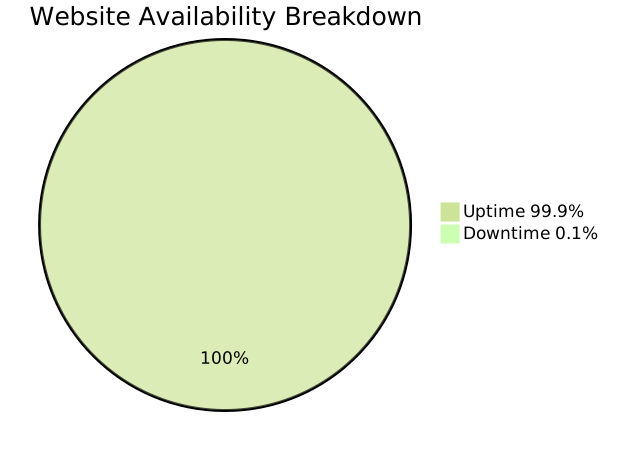
99.9% uptime is often called “three nines” uptime. While it sounds almost perfect, it still allows some amount of downtime annually or monthly. Let’s see how much downtime this translates to:

So, with 99.9% uptime:
- Maximum ~43 minutes of downtime per month
- Maximum ~8.76 hours of downtime per year
Imagine you run an online store with 99.9% uptime hosting. If the service goes offline for 30 minutes one month, you are still within the SLA (Service Level Agreement). However, if downtime exceeds 43 minutes consistently, you risk breaching the uptime guarantee.
Even though downtime seems minor, those minutes can cause significant disruption for high traffic sites, especially during peak sales or important launches.
To achieve and maintain 99.9% uptime, web hosts employ multiple strategies:
- Redundant Server Infrastructure: Multiple servers and failover systems ensure the website remains online if one server fails.
- Regular Maintenance: Scheduled updates are done during low-traffic hours to reduce impact.
- Network Security and Monitoring: 24/7 monitoring detects potential issues before they cause downtime.
- Data Backups: Prevent data loss in case of hardware failures.
Try to estimate your potential loss if your site goes down for 43 minutes in a given month:
- Assume your website gets 1,000 visitors per hour
- Average conversion rate is 2%
- Average order value is $50
Loss in those 43 minutes:
- Visitors lost: 1,000 visitors/hour × 0.717 hours = ~717 visitors
- Potential sales lost: 717 visitors × 2% = ~14 sales
- Revenue lost: 14 sales × $50 = $700
This simple calculation helps highlight why uptime matters financially.
| Uptime Percentage | Allowed Downtime per Year | Example Usage |
|---|---|---|
| 99% (“Two Nines”) | ~3.65 days | Small personal blogs, low-priority sites |
| 99.9% (“Three Nines”) | ~8.76 hours | Most business websites, small e-commerce |
| 99.99% (“Four Nines”) | ~52.56 minutes | High-availability apps, professional e-commerce |
| 99.999% (“Five Nines”) | ~5.26 minutes | Critical financial, healthcare applications |
- Uptime Does Not Guarantee Zero Downtime: It’s a statistical target, not an absolute promise.
- All Downtime Is Not Equal: Some downtime may be planned for maintenance but still counts towards uptime calculations.
- Uptime Includes Network and Server Availability: Sometimes external factors like internet outages at user’s end are not counted.

For most businesses and professional websites, 99.9% uptime is a solid baseline to ensure reliability without exorbitant hosting costs. It balances reasonable downtime allowances with strong performance guarantees. Always review your hosting provider’s uptime SLA carefully and understand the compensation terms if they fail to meet the guarantee.
Investing in quality hosting with verified uptime improves your site’s trustworthiness, user experience, and ultimately your business success.