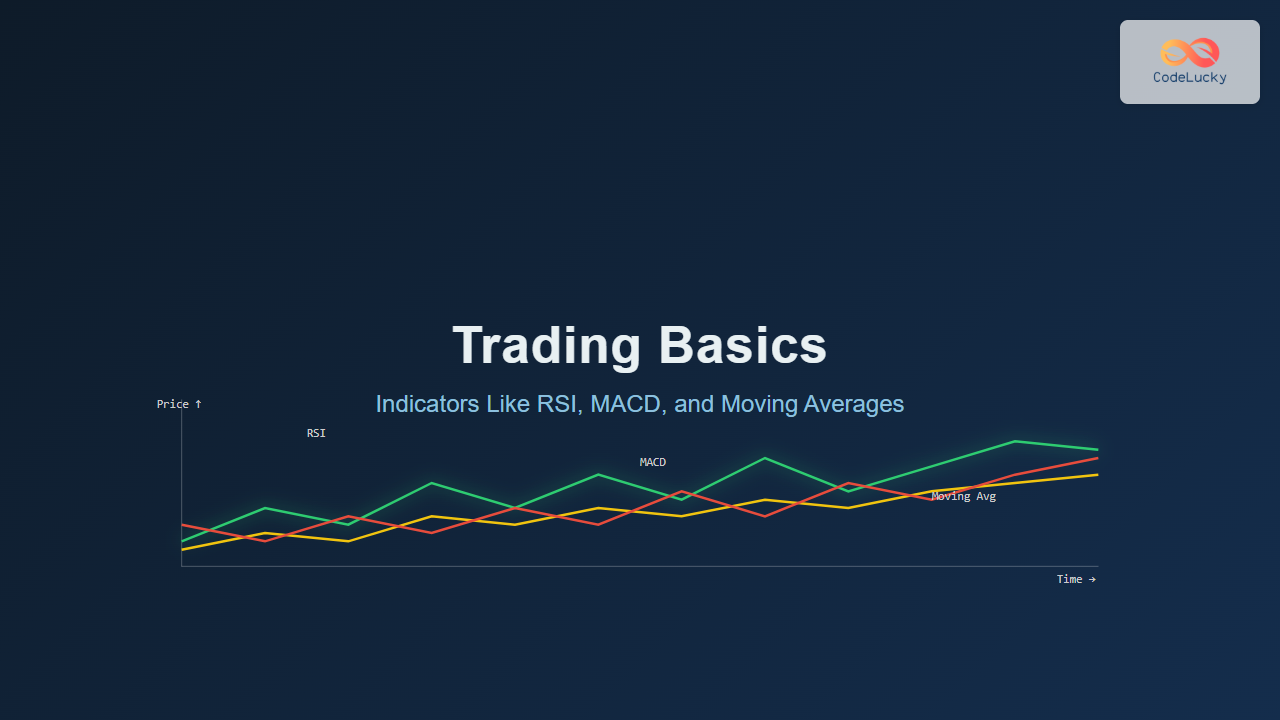
Technical indicators are essential tools for traders aiming to analyze market movements and identify profitable opportunities. In this article, we’ll explain RSI (Relative Strength Index), MACD (Moving Average Convergence Divergence), and Moving Averages—three foundational indicators in technical analysis. Each provides insight into price momentum, trend strength, and potential reversals.
Understanding Technical Indicators
Technical indicators are mathematical calculations based on asset price, volume, or open interest. Traders use them to identify entry and exit points for trading decisions. Indicators can be categorized broadly as:
- Trend indicators (like Moving Averages, MACD) – show the overall direction.
- Momentum indicators (like RSI) – measure speed and magnitude of price movements.
- Volatility indicators (like Bollinger Bands) – show market volatility.
1. Relative Strength Index (RSI)
The RSI measures how quickly and strongly prices move up or down. It oscillates between 0 and 100 and helps identify overbought or oversold conditions:
- RSI above 70 → Overbought (prices may correct down)
- RSI below 30 → Oversold (prices may bounce up)
Formula:
\(RSI = 100 – \left(\frac{100}{1 + RS}\right)\)
where \(RS = \frac{Average\ Gain}{Average\ Loss}\)
Example: If a stock has averaged a 2% gain and a 1% loss over 14 days, then RS = 2, RSI = 100 – 100/(1+2) ≈ 66.7. This signals moderate strength without being overbought.
Visual Insight: Traders often plot RSI below the price chart. When RSI crosses above 30 from below, it signals potential upward momentum; when it dips below 70, it signals loss of momentum.
Interactive Example (Conceptual)
Imagine a slider where you adjust the number of days used in RSI calculation—shorter periods make RSI more sensitive, while longer periods smoothen fluctuations. This helps traders adjust strategies for day trading vs long-term investing.
2. Moving Average (MA)
The Moving Average smooths price data to reveal trends over time. It reduces noise from short-term price fluctuations and highlights the underlying direction of the market.
Types of Moving Averages:
- Simple Moving Average (SMA): Average of closing prices over a given period.
- Exponential Moving Average (EMA): Gives more weight to recent prices, reacting faster to changes.
SMA Formula: \(SMA = \frac{P_1 + P_2 + … + P_n}{n}\)
EMA Formula: \(EMA = (Price_{today} \times K) + (EMA_{yesterday} \times (1-K))\), where \(K = \frac{2}{n+1}\)
Example: A 10-day SMA of closing prices helps identify short-term trends, while a 50 or 200-day SMA shows long-term direction.
Moving Average Crossovers
A popular trading strategy is the Golden Cross (when the 50-day MA crosses above the 200-day MA) signaling a possible uptrend, and the Death Cross (when it moves below) signaling a downtrend.

3. MACD (Moving Average Convergence Divergence)
The MACD indicator combines both trend and momentum insights. It’s derived from the difference between two EMAs:
- MACD Line = 12-period EMA – 26-period EMA
- Signal Line = 9-period EMA of MACD Line
- Histogram = MACD Line – Signal Line
Interpretation:
- When MACD crosses above the Signal Line → Bullish signal
- When MACD crosses below the Signal Line → Bearish signal
- Histogram bars visualize momentum strength.

Example: Suppose a stock’s MACD line crosses above the signal line while prices break a resistance level—this dual confirmation often strengthens the case for a buying opportunity.
Combining RSI, MACD, and MA
Skilled traders rarely rely on just one indicator. Combining RSI, MACD, and Moving Averages offers multi-dimensional analysis:
- RSI shows momentum and potential reversals.
- MACD confirms trend direction and momentum shifts.
- MA confirms the overall trend alignment.
Example Trading Setup:
- Price above 200-day MA → Trend is up.
- MACD crosses above Signal → Momentum turning bullish.
- RSI climbs from 40 to 60 → Strength building, good buy zone.

Key Takeaways
- RSI measures momentum and potential overbought/oversold levels.
- Moving Averages reveal overall trend direction and strength.
- MACD merges both concepts for trend confirmation and timing.
- Combining them reduces false signals and improves accuracy.
Practical Tip
Backtest your strategy before live trading. Set proper stop-loss levels to limit risk. Indicators provide insights, not guarantees—always consider market context and global factors.
In summary, RSI, MACD, and Moving Averages help traders go beyond guesswork to data-informed decision-making. With consistent use and disciplined interpretation, these indicators can enhance performance in any market condition.