When it comes to trading and investing, two primary schools of thought dominate the approach to market analysis — Technical Analysis and Fundamental Analysis. Both are powerful methods used by traders to make informed decisions, yet they differ significantly in how they interpret data and predict future price movements.
What Is Technical Analysis?
Technical Analysis (TA) focuses on studying market data — primarily price and volume — to forecast future movements. It assumes that all market fundamentals are already reflected in the price, and history tends to repeat itself.
Technical analysts, often called chartists, use a range of tools such as charts, indicators, and candlestick patterns to identify trends, support/resistance levels, and momentum signals.
Common Tools in Technical Analysis
- Moving Averages (MA): Helps smooth out price data to identify trend direction.
- Relative Strength Index (RSI): Measures momentum and identifies overbought or oversold conditions.
- Bollinger Bands: Indicate volatility and potential price breakouts.
- MACD (Moving Average Convergence Divergence): Detects trend changes and momentum shifts.
- Support & Resistance Lines: Show levels where price historically reversed or paused.
Visual Representation of Technical Analysis

In this simplified chart, traders derive signals from price data using indicators and chart patterns, guiding buy or sell decisions.
Example: Using Moving Averages
Imagine a stock trading between ₹950 and ₹1000. You apply a 50-day and a 200-day moving average:
- If the 50-day MA crosses above the 200-day MA (a Golden Cross), it signals a bullish trend.
- If the 50-day MA crosses below the 200-day MA (a Death Cross), it indicates a bearish trend.
This type of analysis is often used by swing and day traders who rely heavily on historical data patterns rather than company fundamentals.
What Is Fundamental Analysis?
Fundamental Analysis (FA), on the other hand, evaluates the intrinsic value of a financial asset by examining underlying economic and financial factors. It focuses on the question: “Is this asset worth its current market price?”
Analysts assess company performance, industry outlook, and macroeconomic conditions to determine whether a stock is undervalued or overvalued.
Key Components of Fundamental Analysis
- Financial Statements: Income statements, balance sheets, and cash flow reports.
- Ratios: Price-to-Earnings (P/E), Earnings Per Share (EPS), Debt-to-Equity, Return on Equity (ROE).
- Economic Indicators: GDP growth, inflation, interest rates.
- Industry Trends: Market share, competition, and regulatory impact.

This flow shows how fundamental analysis leads investors from company data to actionable investment decisions.
Example: Evaluating a Stock Fundamentally
Suppose Company ABC’s stock trades at ₹500 per share. With an EPS of ₹50, its P/E ratio equals 10. If peers average a P/E of 20, ABC may be undervalued. An investor might buy expecting the price to rise toward its fair value.
Technical vs Fundamental Analysis: Key Differences
| Aspect | Technical Analysis | Fundamental Analysis |
|---|---|---|
| Focus | Price & volume data | Company and economic data |
| Time Horizon | Short to medium term | Medium to long term |
| Tools | Charts, indicators, patterns | Financial statements, ratios |
| Purpose | Timing entry and exit | Finding intrinsic value |
| Used By | Traders | Investors |
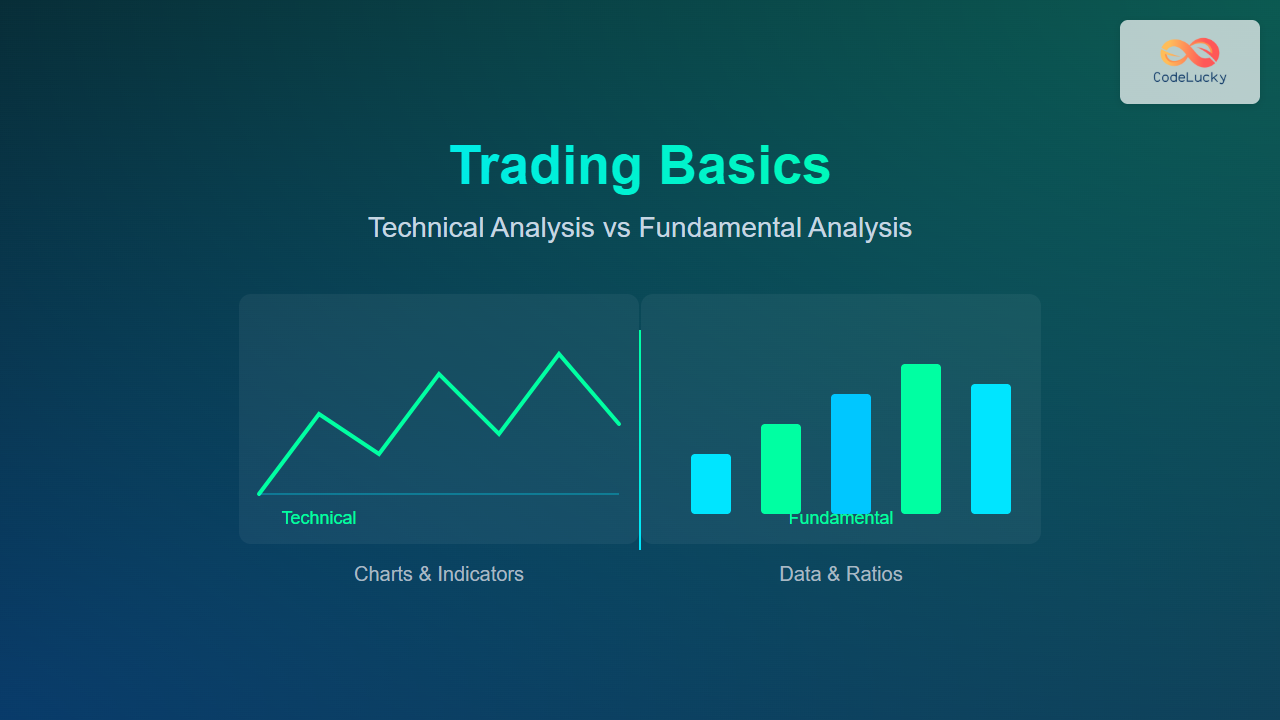
Visual Comparison

While technical analysis emphasizes market psychology and timing, fundamental analysis concentrates on company performance and economic health.
Integrating Both Approaches
Smart traders and investors often combine both methods.
- Use fundamental analysis to select which asset to buy (quality and value).
- Use technical analysis to determine when to buy or sell (timing).

For instance, an investor might identify an undervalued company but wait for a bullish technical signal before entering a position. This synergy improves precision and confidence in market decisions.
Interactive Thought Exercise
Try this quick checklist to identify your analytical leaning:
- Do you prefer studying charts and indicators? → You favor Technical Analysis.
- Do you enjoy reading financial reports? → You favor Fundamental Analysis.
- Do you want the best of both worlds? → Combine FA + TA to balance insight with timing.
Final Thoughts
Whether you choose technical or fundamental analysis depends on your trading style, goals, and patience level. Day traders lean toward short-term chart analysis, while long-term investors rely on company fundamentals. However, mastering both can give you a strategic edge, blending data-driven insights with timing precision to maximize profit potential.