Tim Sort Algorithm is one of the most efficient sorting algorithms used within modern programming languages like Python (as the default sorting method) and Java (in Arrays.sort for objects). Unlike traditional algorithms such as Merge Sort or Quick Sort, Tim Sort is a hybrid algorithm — it intelligently combines Insertion Sort and Merge Sort to take advantage of already existing order within datasets.
In this detailed guide, we’ll explore how Tim Sort works, why it was created, and how it outperforms other sorting algorithms in practice.
What is Tim Sort?
Tim Sort was designed by Tim Peters in 2002 for the Python programming language. It leverages the fact that real-world data often contains partially ordered sequences. By exploiting natural runs (sorted subsequences), Tim Sort reduces the sorting overhead dramatically compared to pure algorithms like Quick Sort.
It is a stable sorting algorithm, meaning equal elements preserve their input order. This property is extremely useful in scenarios like sorting records in databases or objects with multiple fields.
Key Idea Behind Tim Sort
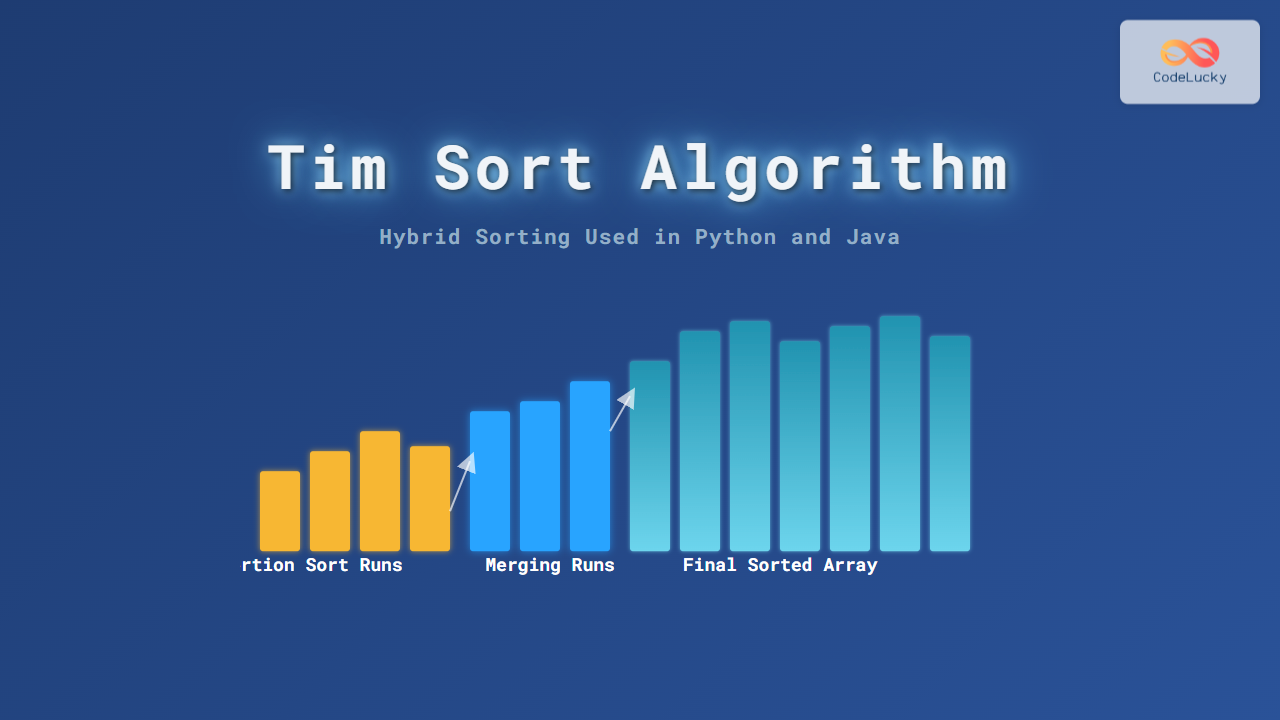
- Split the array into small segments (called runs).
- Sort each run using Insertion Sort, which is efficient for small arrays.
- Merge the sorted runs using a technique similar to Merge Sort.

Why Tim Sort is Used in Python and Java
Both Python’s sorted() function and Java’s Arrays.sort() for objects rely on Tim Sort because:
- Practical Efficiency: Makes use of existing order in datasets.
- Adaptability: Works better on real-world data compared to purely theoretical cases.
- Stability: Keeps equal items in their relative positions.
- Optimal Merge Strategy: Uses a smart approach to minimize total merging cost.
Step-by-Step Example of Tim Sort
Consider the following array: [34, 7, 23, 32, 5, 62]
- Divide into runs: The array is broken into smaller chunks (e.g., length 32 by default in Python).
- Sort runs with Insertion Sort: Each run is ordered individually.
- Merge runs: Sorted runs are merged pair by pair until the entire array is sorted.
Final Sorted Array: [5, 7, 23, 32, 34, 62]
Python Example of Tim Sort
# Python automatically uses Tim Sort in sorted() and .sort()

# Example: Sorting numbers
arr = [34, 7, 23, 32, 5, 62]
print("Original:", arr)

sorted_arr = sorted(arr)
print("Sorted (Tim Sort):", sorted_arr)

# Sorting strings (Tim Sort still applies)
words = ["banana", "apple", "orange", "apple"]
print("Original:", words)
print("Sorted (Stable):", sorted(words))
Output:
Original: [34, 7, 23, 32, 5, 62]
Sorted (Tim Sort): [5, 7, 23, 32, 34, 62]

Original: ['banana', 'apple', 'orange', 'apple']
Sorted (Stable): ['apple', 'apple', 'banana', 'orange']
Java Example of Tim Sort
import java.util.Arrays;

public class TimSortDemo {
    public static void main(String[] args) {
        int[] arr = {34, 7, 23, 32, 5, 62};
        System.out.println("Original: " + Arrays.toString(arr));

        // Tim Sort is applied internally by Arrays.sort for objects
        Arrays.sort(arr);
        System.out.println("Sorted: " + Arrays.toString(arr));

        String[] words = {"banana", "apple", "orange", "apple"};
        Arrays.sort(words);
        System.out.println("Sorted words: " + Arrays.toString(words));
    }
}
Output:
Original: [34, 7, 23, 32, 5, 62]
Sorted: [5, 7, 23, 32, 34, 62]
Sorted words: [apple, apple, banana, orange]
Complexity Analysis of Tim Sort
| Case | Time Complexity |
|---|---|
| Best Case | O(n) |
| Average Case | O(n log n) |
| Worst Case | O(n log n) |
Space Complexity: O(n)
Visualizing Merge Strategy

Advantages of Tim Sort
- Highly optimized for real-world inputs with existing sequences.
- Stable sorting ensures order consistency.
- Better than Quick Sort for many practical cases, especially in worst-case scenarios.
Limitations
- Requires extra space similar to Merge Sort.
- Not as simple to implement compared to Quick Sort or Insertion Sort.
When to Use Tim Sort
- Whenever built-in sorting is enough (Python and Java handle it internally).
- When dealing with datasets with existing partial ordering.
- When stability is essential, e.g., multi-key object sorting.
Conclusion
Tim Sort is a brilliant example of algorithm engineering where theoretical concepts are blended with practical optimizations. Its adaptive nature makes it the go-to choice for real-world applications, and that’s why both Python and Java rely on it as a default sorting strategy. Understanding Tim Sort not only helps in grasping efficient sorting but also in appreciating how real-world inputs influence algorithm design.