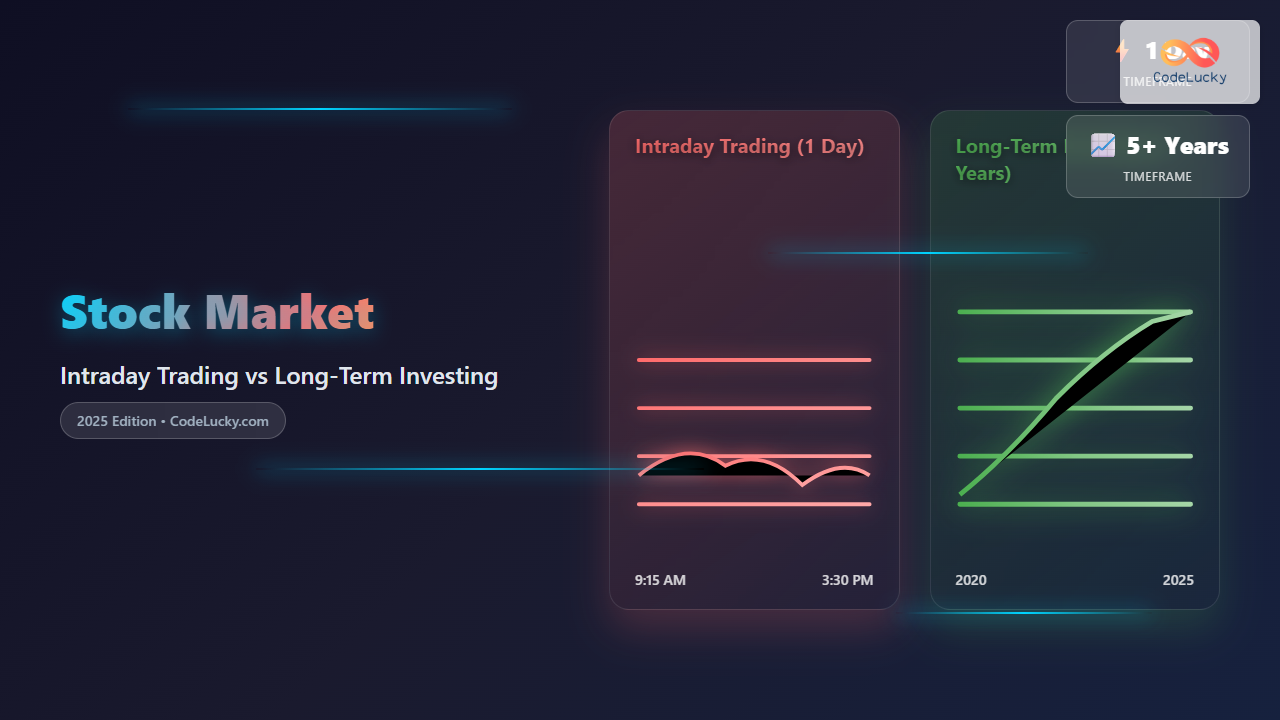
The stock market offers countless ways to build wealth, but two of the most common approaches are Intraday Trading and Long-Term Investing. While both aim to generate profits, they differ fundamentally in timeframe, strategy, psychology, and risk exposure. Understanding these differences can help you choose a trading style that fits your financial goals and personality.
What is Intraday Trading?
Intraday trading involves buying and selling stocks within the same trading day. Traders aim to profit from short-term price fluctuations caused by market sentiment, breaking news, or technical momentum. Every position is squared off before the market closes — no holdings are carried overnight.
For example, if a stock opens at ₹200 and a trader believes it will rise due to positive earnings, they may buy at ₹200 and sell at ₹210 the same day — earning ₹10 per share before the market closes.

Key Traits of Intraday Trading
- Time Horizon: Minutes to hours within the same day.
- Analysis Focus: Technical charts, volume, and momentum indicators.
- Objective: Capture short-term price movements.
- Risk: High, due to quick market reversals and volatility.
- Tools: Real-time charts, stop-loss orders, and leverage.
What is Long-Term Investing?
Long-term investing refers to holding stocks for years, often decades, to benefit from company fundamentals and overall economic growth. This approach relies on compounding and the steady appreciation of value over time.
For instance, an investor who bought Infosys shares at ₹200 in 2010 and held them until 2025 has likely seen over 10x growth — a result of consistent performance and reinvested dividends.

Key Traits of Long-Term Investing
- Time Horizon: 3 years or more.
- Analysis Focus: Company fundamentals, earnings growth, and management quality.
- Objective: Build wealth steadily through capital appreciation and dividends.
- Risk: Lower in the long run, as short-term volatility smooths out.
- Tools: Balance sheets, P/E ratios, and macroeconomic indicators.
Core Differences: Intraday vs Long-Term Investing
The table below summarizes the main differences between these two popular stock market strategies.
| Parameter | Intraday Trading | Long-Term Investing |
|---|---|---|
| Time Horizon | Within a single trading day | Years to decades |
| Goal | Short-term profit | Wealth creation and compounding |
| Analysis Type | Technical | Fundamental |
| Risk Level | High | Moderate to low |
| Effort & Monitoring | Continuous during market hours | Periodic review |
| Tax Implications (India) | Taxed as business income | Capital gains tax based on duration |
Which One Should You Choose?
The choice depends on your financial goals, available time, and risk appetite:
- If you enjoy analyzing charts, following market momentum, and can dedicate several hours daily, intraday trading might suit you.
- If you prefer building wealth passively and avoiding daily stress, long-term investing is generally safer and more rewarding.

Example: Same Stock, Two Approaches
Imagine a company, ABC Ltd., currently trading at ₹100.
- Trader’s View: Buys at ₹100 in the morning, sells at ₹104 by afternoon — ₹4 profit in hours.
- Investor’s View: Buys at ₹100 and holds for 3 years — stock grows to ₹200, earning ₹100 profit + dividends.
The difference lies in vision: traders profit from noise, investors from time.

Benefits and Drawbacks
Advantages of Intraday Trading
- Quick potential profits within hours.
- No overnight market risk.
- Opportunity to trade daily.
Disadvantages of Intraday Trading
- High stress and screen time.
- Requires strong technical analysis skills.
- Losses can multiply rapidly due to leverage.
Advantages of Long-Term Investing
- Power of compounding accelerates growth.
- Less stress from daily market volatility.
- Benefit from dividends and corporate growth.
Disadvantages of Long-Term Investing
- Patience required; no instant gratification.
- Opportunity cost if funds are locked for long periods.
- Vulnerable to long-term economic shifts if not regularly reviewed.
Interactive Visualization: Compounding Calculator
You can test how long-term investing compounds over time. Try adjusting the variables below:
<script>
function calculateCompounding(principal, rate, years) {
  let amount = principal * Math.pow(1 + rate / 100, years);
  return amount.toFixed(2);
}
console.log("Investment of ₹10,000 at 12% for 10 years = ₹" +
  calculateCompounding(10000, 12, 10));
</script>
This small script calculates how a ₹10,000 investment at 12% annual return grows to ₹31,058 over 10 years, demonstrating the true power of long-term investing.

Final Thoughts
Both intraday trading and long-term investing can coexist in a balanced portfolio. The key is to know your temperament and time availability. Traders chase momentum; investors harness patience. Your success depends not just on market timing, but on emotional discipline and continuous learning.
At CodeLucky.com, we recommend new investors begin with long-term investing to understand market fundamentals before venturing into intraday trading. Remember — in the stock market, time in the market often beats timing the market.