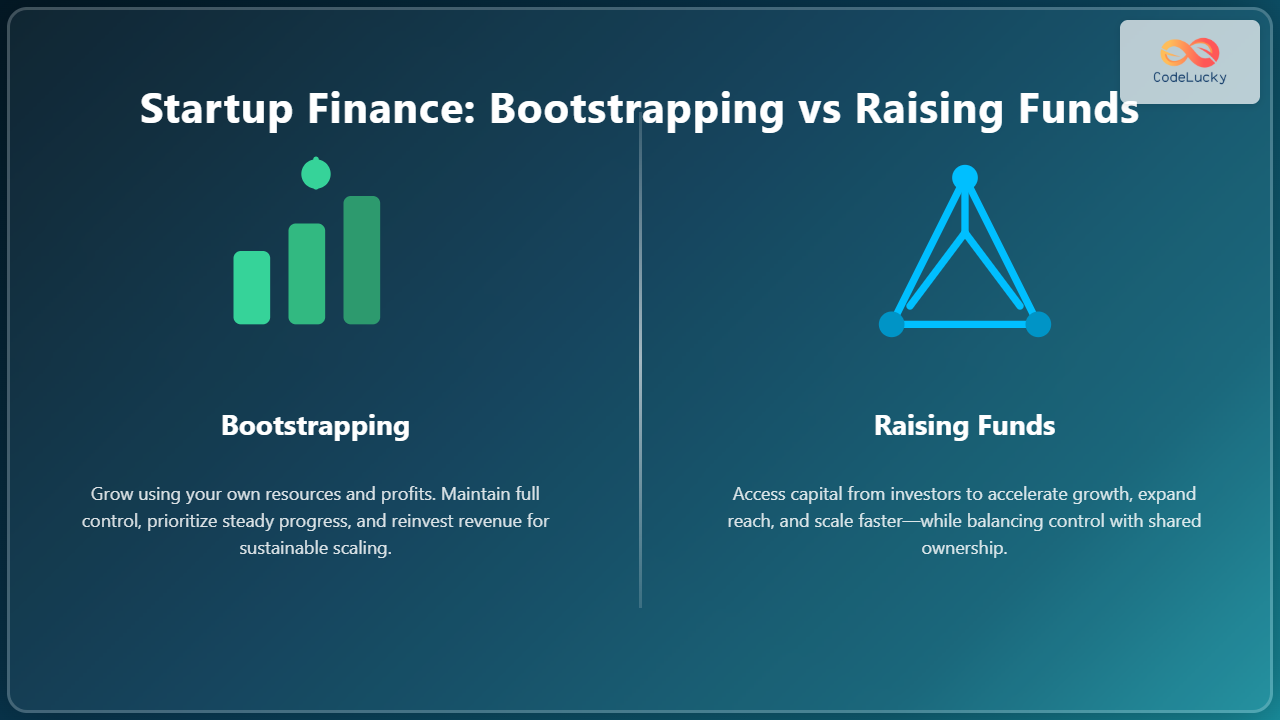
Startup Finance is one of the most crucial aspects of building a sustainable business. Whether you’re a founder starting your first venture or strategizing for your next big idea, understanding how to fund your startup can make or break your success. The two most common paths are bootstrapping—funding your startup with your own resources—and raising funds—securing outside investment from venture capitalists, angel investors, or crowdfunding platforms.
In this guide from CodeLucky.com, we’ll dive deep into these two models, explore their pros and cons, and outline how you can determine which one aligns best with your startup’s vision and stage of growth.
Understanding Startup Financing
Before comparing the two models, let’s visualize the basic flow of startup financing. From idea creation to scaling, founders make key decisions about when and how to bring in money.
This diagram shows how bootstrapping and external fundraising diverge early in a startup’s journey. Each path affects not just how money flows but also the company’s control, risk, and scalability.
What is Bootstrapping?
Bootstrapping means financing your startup using your own savings, business revenue, or minimal external resources. In this model, you grow at your pace, reinvesting profits to expand. Many famous companies, including Mailchimp and Basecamp, started as bootstrapped ventures before reaching major success.
Advantages of Bootstrapping
- Full Control: You retain 100% ownership and decision-making power.
- Profit Focused: Every rupee spent must justify its return, leading to smart financial discipline.
- Customer-Centric: Without investor pressure, the business stays closer to customer needs.
- Flexible Exit Plans: You choose when and how to exit.
Challenges of Bootstrapping
- Limited Capital: Growth is constrained by your personal or generated funds.
- Slower Scaling: Market opportunities might pass before you have resources to expand.
- Higher Founder Risk: Your personal savings are on the line if things go south.
Example: Bootstrapped Success
Zoho Corporation built enterprise-grade software without outside investment. Its strategy focused on profitability and product quality rather than rapid fundraising. This example shows that with patience and innovation, bootstrapping can lead to global success.

What is Raising Funds?
Raising funds involves attracting external money from angel investors, venture capitalists, or through crowdfunding. This route provides faster access to capital but reduces ownership share and control. Startups with strong market potential or product innovation often choose this path.
Advantages of Raising Funds
- Rapid Growth: Large investments enable aggressive marketing, hiring, and scaling.
- Mentorship and Networks: Investors often bring experience and business connections.
- Market Validation: Securing funding signals trust to customers and other stakeholders.
- Risk Distribution: Financial risk spreads across multiple investors.
Challenges of Raising Funds
- Ownership Dilution: Every funding round reduces founder equity.
- Pressure for Returns: Investors expect rapid growth and exit strategies.
- Loss of Autonomy: Founders must align with investor expectations.
Example: Fundraising Success
Flipkart, an Indian e-commerce giant, began with modest seed capital but later raised billions across multiple funding rounds, achieving rapid growth before being acquired by Walmart. The trade-off was shared control, but the capital allowed massive scaling.

Bootstrapping vs Raising Funds: A Comparison
| Aspect | Bootstrapping | Raising Funds |
|---|---|---|
| Control | Full founder control | Shared with investors |
| Growth Speed | Steady, organic growth | Rapid, capital-fueled expansion |
| Risk | Higher for founders | Shared among investors |
| Profitability Focus | High, early stage focus | Delayed, long-term goal |
| Example Company | Zoho, Basecamp | Flipkart, Swiggy |
When Should You Bootstrap?
Choose bootstrapping if:
- Your business model requires low upfront capital.
- You have sufficient savings or early revenue streams.
- You prefer steady, independent growth over speed.
- Your target market allows organic scaling.
When Should You Raise Funds?
Consider external fundraising if:
- Your product depends on rapid market capture.
- You’re entering a capital-intensive industry (like tech hardware or biotech).
- You need talent, marketing, or infrastructure quickly.
- Your idea has strong investor appeal and clear scalability.

Hybrid Approach: The Balanced Model
Some startups combine both strategies. This involves bootstrapping until early traction and raising funds later once metrics prove viability. This hybrid approach maximizes founder control while still leveraging external capital at the right moment.

Interactive Thought Exercise
Try a simple scenario: imagine you have ₹10 lakh to start a SaaS business. You can either:
- Bootstrap by using ₹8 lakh for product development and ₹2 lakh for marketing.
- Raise ₹1 crore from investors but give up 20% equity.
Think through how each choice affects your control, pace, and stress level. This kind of interactive comparison helps solidify real-world understanding of startup financing trade-offs.
Final Thoughts
Bootstrapping vs raising funds isn’t about right or wrong—it’s about fit. Every startup has unique goals, risk tolerance, and market opportunities. The smartest founders often start small, build proof, and then decide whether capital acceleration aligns with their mission. Your decision defines not only how your business grows but also the kind of founder you become.
Choose wisely, stay financially aware, and remember: sustainable growth begins with informed decisions.