The Sleeping Barber Problem stands as one of the most elegant and instructive examples in operating system design, perfectly illustrating the challenges of resource allocation and process synchronization. This classic problem, originally proposed by computer scientist Edsger Dijkstra, serves as a fundamental teaching tool for understanding how multiple processes compete for limited resources in concurrent computing environments.
Understanding the Sleeping Barber Problem
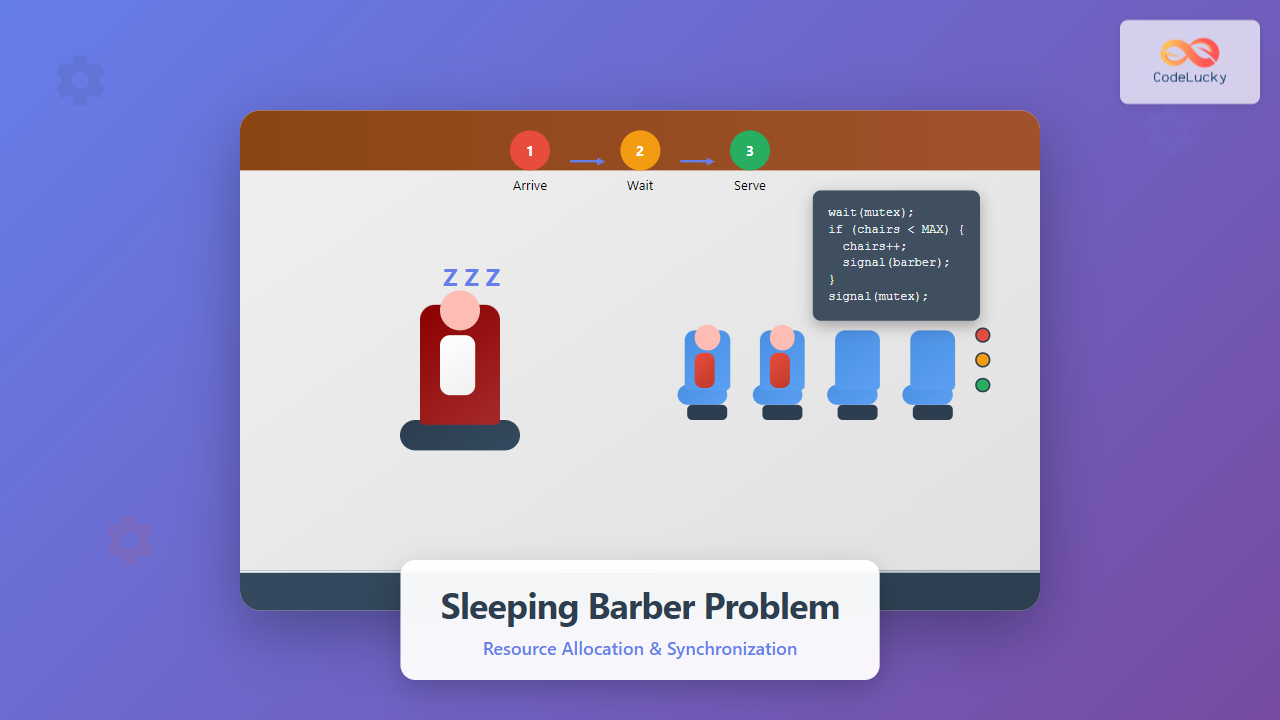
Imagine a barbershop with one barber, one barber chair, and a waiting room with a limited number of chairs. The scenario unfolds as follows:
- When no customers are present, the barber sleeps in his chair
- A customer entering the shop must wake the sleeping barber
- If the barber is busy, customers wait in the waiting room
- When the waiting room is full, new customers leave without getting a haircut
- After finishing with a customer, the barber checks for waiting customers

Why This Problem Matters in Operating Systems
The Sleeping Barber Problem represents a producer-consumer synchronization challenge that mirrors real-world computing scenarios:
Real-World Applications
- Web Server Request Handling: Limited server threads processing incoming HTTP requests
- Database Connection Pools: Managing concurrent database connections with limited resources
- Print Queue Management: Multiple users sending documents to a shared printer
- CPU Scheduling: Operating system managing process execution with limited CPU cores
The Synchronization Challenge
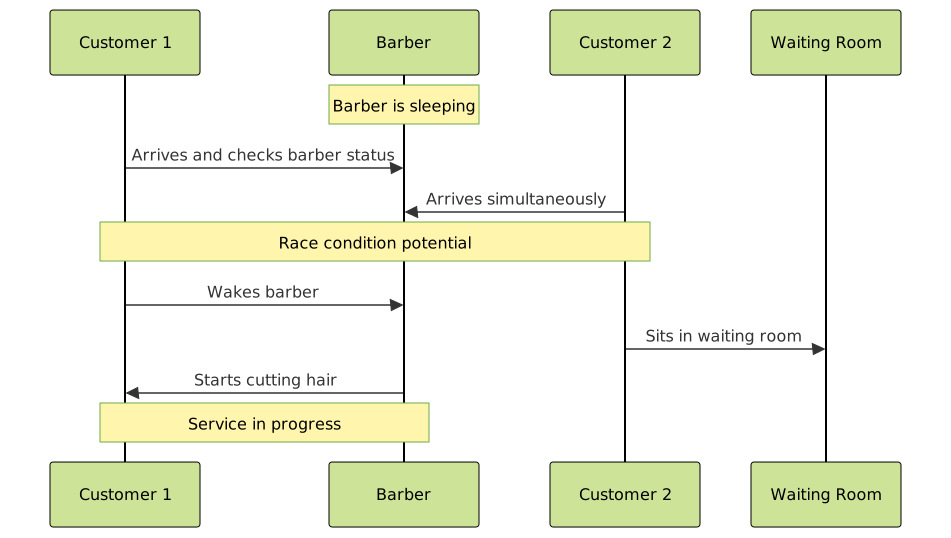
The core challenge lies in preventing race conditions while ensuring efficient resource utilization. Several critical issues must be addressed:
Race Conditions to Avoid
- Lost Customer: Barber checks for customers while a new customer checks if barber is free
- Multiple Wakeups: Several customers simultaneously trying to wake the sleeping barber
- Incorrect Counting: Inaccurate tracking of waiting customers leading to resource conflicts
Semaphore-Based Solution
The elegant solution uses three semaphores to coordinate access and maintain synchronization:
Semaphore Definitions
- customers: Counting semaphore tracking waiting customers (initially 0)
- barber: Binary semaphore indicating barber availability (initially 0)
- mutex: Binary semaphore for mutual exclusion (initially 1)
Customer Process Implementation
void customer_process() {
    wait(mutex);                    // Enter critical section
    if (waiting_customers < MAX_CHAIRS) {
        waiting_customers++;        // Increment waiting count
        signal(customers);          // Signal barber about new customer
        signal(mutex);              // Exit critical section

        wait(barber);               // Wait for barber to be ready
        waiting_customers--;        // Decrement when service starts

        // Get haircut (critical section with barber)
        get_haircut();
    } else {
        signal(mutex);              // Exit critical section
        leave_shop();               // No available chairs
    }
}
Barber Process Implementation
void barber_process() {
    while (true) {
        wait(customers);            // Sleep until customer arrives
        wait(mutex);                // Enter critical section

        signal(barber);             // Signal readiness to customer
        signal(mutex);              // Exit critical section

        // Cut hair (exclusive access with customer)
        cut_hair();
    }
}
Detailed Code Implementation
Here’s a comprehensive implementation demonstrating the complete solution with proper synchronization:
#include <stdio.h>
#include <pthread.h>
#include <semaphore.h>
#include <unistd.h>
#include <stdlib.h>

#define MAX_CHAIRS 5        // Waiting room capacity
#define NUM_CUSTOMERS 10    // Total customers to simulate

// Global variables
int waiting_customers = 0;
int customer_id_counter = 1;

// Semaphores
sem_t customers;    // Count of waiting customers
sem_t barber;       // Barber readiness signal
sem_t mutex;        // Mutual exclusion for shared variables

void* customer(void* arg) {
    int id = *(int*)arg;

    printf("Customer %d arrives at the shop\n", id);

    sem_wait(&mutex);    // Enter critical section

    if (waiting_customers < MAX_CHAIRS) {
        waiting_customers++;
        printf("Customer %d sits in waiting room (Total waiting: %d)\n",
               id, waiting_customers);

        sem_post(&customers);    // Signal new customer to barber
        sem_post(&mutex);        // Exit critical section

        sem_wait(&barber);       // Wait for barber to be ready

        // Customer is now being served
        printf("Customer %d is getting haircut\n", id);
        sleep(3);  // Simulate haircut duration
        printf("Customer %d finished haircut and leaves\n", id);

    } else {
        sem_post(&mutex);    // Exit critical section
        printf("Customer %d leaves - waiting room full\n", id);
    }

    return NULL;
}

void* barber_thread(void* arg) {
    while (1) {
        printf("Barber is sleeping...\n");
        sem_wait(&customers);    // Sleep until customer arrives

        sem_wait(&mutex);        // Enter critical section
        waiting_customers--;     // Customer being served
        printf("Barber wakes up (Customers waiting: %d)\n", waiting_customers);
        sem_post(&mutex);        // Exit critical section

        sem_post(&barber);       // Signal customer that barber is ready

        printf("Barber is cutting hair...\n");
        sleep(2);  // Simulate hair cutting time
        printf("Barber finished cutting hair\n");
    }

    return NULL;
}

int main() {
    pthread_t barber_tid;
    pthread_t customer_tids[NUM_CUSTOMERS];
    int customer_ids[NUM_CUSTOMERS];

    // Initialize semaphores
    sem_init(&customers, 0, 0);    // No customers initially
    sem_init(&barber, 0, 0);       // Barber not ready initially
    sem_init(&mutex, 0, 1);        // Mutex available

    // Create barber thread
    pthread_create(&barber_tid, NULL, barber_thread, NULL);

    // Create customer threads with random arrivals
    for (int i = 0; i < NUM_CUSTOMERS; i++) {
        customer_ids[i] = i + 1;
        pthread_create(&customer_tids[i], NULL, customer, &customer_ids[i]);
        sleep(rand() % 3);  // Random arrival times
    }

    // Wait for all customers to complete
    for (int i = 0; i < NUM_CUSTOMERS; i++) {
        pthread_join(customer_tids[i], NULL);
    }

    printf("All customers served. Shutting down.\n");
    return 0;
}
Expected Output Analysis
When running the above implementation, you’ll observe coordinated behavior demonstrating proper synchronization:
Barber is sleeping...
Customer 1 arrives at the shop
Customer 1 sits in waiting room (Total waiting: 1)
Barber wakes up (Customers waiting: 0)
Customer 1 is getting haircut
Barber is cutting hair...
Customer 2 arrives at the shop
Customer 2 sits in waiting room (Total waiting: 1)
Barber finished cutting hair
Customer 1 finished haircut and leaves
Barber is sleeping...
Barber wakes up (Customers waiting: 0)
Customer 2 is getting haircut
...
Alternative Implementation Approaches
Monitor-Based Solution
Using monitors instead of semaphores provides cleaner encapsulation:
public class BarberShop {
    private int waitingCustomers = 0;
    private final int MAX_CHAIRS = 5;
    private boolean barberSleeping = true;

    public synchronized void enterShop() {
        if (waitingCustomers < MAX_CHAIRS) {
            waitingCustomers++;
            if (barberSleeping) {
                barberSleeping = false;
                notify(); // Wake up barber
            }
            while (waitingCustomers > 0) {
                try {
                    wait(); // Wait for turn
                } catch (InterruptedException e) {
                    Thread.currentThread().interrupt();
                }
            }
            getHaircut();
        } else {
            // Leave shop - no available chairs
            System.out.println("Customer leaves - shop full");
        }
    }

    public synchronized void barberWork() {
        while (true) {
            while (waitingCustomers == 0) {
                barberSleeping = true;
                try {
                    wait(); // Sleep until customer arrives
                } catch (InterruptedException e) {
                    Thread.currentThread().interrupt();
                }
            }
            waitingCustomers--;
            notify(); // Signal customer to start service
            cutHair();
        }
    }
}
Performance Optimization Techniques
Reducing Context Switching
To minimize overhead in high-throughput scenarios:
- Batch Processing: Process multiple customers before checking for new arrivals
- Adaptive Sleeping: Adjust barber sleep duration based on customer arrival patterns
- Priority Queuing: Implement customer prioritization for VIP services
Scalability Considerations
For real-world applications requiring multiple service providers:
// Multiple barbers extension
#define NUM_BARBERS 3

sem_t barbers_available;  // Count of available barbers
sem_t customer_queue;     // Customer waiting queue
sem_t mutex;              // Mutual exclusion

void customer_process() {
    sem_wait(&mutex);
    if (waiting_customers < MAX_CHAIRS) {
        waiting_customers++;
        sem_post(&customer_queue);  // Signal available customer
        sem_post(&mutex);

        sem_wait(&barbers_available);  // Wait for available barber
        // Get service
        sem_post(&barbers_available);  // Release barber
    } else {
        sem_post(&mutex);
        leave_shop();
    }
}
Common Implementation Pitfalls
Deadlock Prevention
Critical mistakes that can lead to system deadlock:
- Incorrect Semaphore Ordering: Always acquire locks in consistent order
- Missing Signal Operations: Ensure every wait() has corresponding signal()
- Resource Leakage: Properly release semaphores in error conditions
Race Condition Scenarios
Subtle timing issues that can corrupt system state:
// INCORRECT - Race condition possible
if (waiting_customers < MAX_CHAIRS) {
    // Another thread might modify waiting_customers here
    waiting_customers++;  // Potentially exceeds MAX_CHAIRS
}

// CORRECT - Atomic operation within critical section
sem_wait(&mutex);
if (waiting_customers < MAX_CHAIRS) {
    waiting_customers++;
    // Additional logic here
}
sem_post(&mutex);
Testing and Validation Strategies
Unit Testing Approach
Comprehensive testing should verify synchronization correctness:
void test_resource_limits() {
    // Test maximum capacity enforcement
    assert(waiting_customers <= MAX_CHAIRS);

    // Test proper customer counting
    int total_in_shop = waiting_customers + (barber_busy ? 1 : 0);
    assert(total_in_shop <= MAX_CHAIRS + 1);
}

void test_no_lost_customers() {
    // Verify all customers are either served or properly rejected
    assert(customers_served + customers_rejected == total_customers);
}

void stress_test_concurrent_access() {
    // Launch multiple threads simultaneously
    // Verify system stability under high load
    pthread_t threads[100];
    for (int i = 0; i < 100; i++) {
        pthread_create(&threads[i], NULL, customer, &customer_ids[i]);
    }
}
Real-World Applications and Extensions
Web Server Architecture
Modern web servers implement similar resource management patterns:
- Connection Pooling: Managing database connections like barber chairs
- Thread Pool Management: Worker threads as barbers serving HTTP requests
- Request Queue Management: Buffering incoming requests when all threads busy
Operating System Scheduling
The principles apply directly to process and thread scheduling:
- CPU Scheduling: Processes waiting for CPU time allocation
- I/O Management: Processes queuing for disk or network resources
- Memory Management: Managing access to limited physical memory
Conclusion
The Sleeping Barber Problem elegantly demonstrates fundamental synchronization concepts essential for operating system design. By mastering semaphore-based coordination, mutex protection, and race condition prevention, developers gain crucial skills for building robust concurrent systems.
Key takeaways include understanding producer-consumer relationships, implementing proper resource counting, and designing scalable solutions for real-world applications. Whether managing web server threads, database connections, or system processes, these synchronization principles ensure efficient and reliable resource allocation in modern computing environments.
The problem’s enduring relevance in computer science education stems from its perfect balance of simplicity and depth, making complex concurrency concepts accessible while providing a foundation for advanced distributed system design.
Related Posts

Dining Philosophers Problem: Classic Synchronization Challenge in Operating Systems
The Dining Philosophers Problem stands as one of the most iconic examples in computer science for understanding synchronization challenges in...
Producer Consumer Problem: Complete Guide to Bounded Buffer Implementation with Code Examples
The Producer Consumer Problem, also known as the bounded buffer problem, is one of the most fundamental synchronization problems in...
Deadlock in Operating System: Complete Guide to Necessary Conditions and Detection Methods
Deadlock is one of the most critical challenges in operating system design, where multiple processes become permanently blocked while waiting...

Spin Locks in Operating System: Complete Guide to Busy Waiting Synchronization
Spin locks are fundamental synchronization primitives in operating systems that implement busy waiting mechanisms to protect critical sections from concurrent...
Lamport’s Bakery Algorithm: Complete Guide to N-Process Mutual Exclusion
Lamport's Bakery Algorithm stands as one of the most elegant solutions to the N-process mutual exclusion problem in concurrent programming....

Shortest Job First Scheduling: SJF Algorithm Explained with Examples and Implementation
What is Shortest Job First (SJF) Scheduling? Shortest Job First (SJF) scheduling is a CPU scheduling algorithm that selects the...

Process Synchronization: Critical Sections and Race Conditions in Operating Systems
Introduction to Process Synchronization Process synchronization is a fundamental concept in operating systems that ensures multiple processes can safely access...
Monitor in Operating System: High-level Synchronization for Process Coordination
What is a Monitor in Operating System? A monitor is a high-level synchronization construct in operating systems that provides a...

Critical Section Problem: Complete Guide to Mutual Exclusion Solutions in Operating Systems
What is the Critical Section Problem? The critical section problem is a fundamental challenge in operating systems where multiple processes...

Deadlock Prevention: Complete Guide to Avoiding Circular Wait Conditions
Understanding Deadlock and Circular Wait Deadlock is one of the most critical issues in operating systems where two or more...

Readers Writers Problem: Complete Guide to Database Synchronization
The Readers Writers Problem is one of the most fundamental synchronization challenges in operating systems and database management. This classic...

Banker’s Algorithm: Complete Guide to Safe State Detection and Resource Allocation
The Banker's Algorithm is a fundamental deadlock avoidance algorithm in operating systems, designed to ensure that resource allocation maintains the...