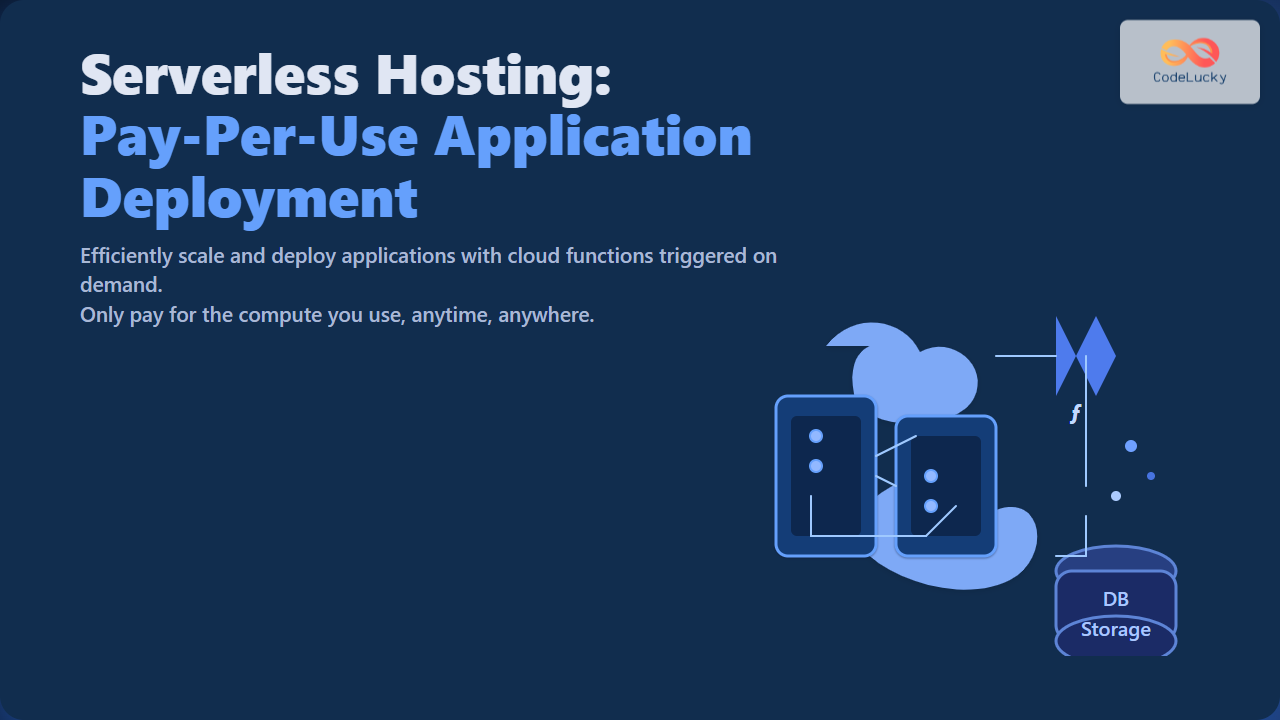
Serverless hosting is transforming the way modern applications are deployed and scaled by enabling a pay-per-use pricing model and eliminating the need to manage infrastructure. This article dives deep into the concept of serverless application deployment, its advantages, practical examples, and how it compares to traditional hosting, creating an ideal guide for developers and tech enthusiasts eager to leverage cloud-native architectures for cost-effective, efficient software delivery.
What is Serverless Hosting?
Serverless hosting is a cloud computing model where application developers deploy code without provisioning or managing the underlying servers. Instead, cloud providers dynamically allocate resources and automatically scale the application. Billing is based purely on usage — meaning you pay only for the compute time your code consumes, often measured in milliseconds.
Commonly offered as Functions-as-a-Service (FaaS), serverless platforms such as AWS Lambda, Azure Functions, and Google Cloud Functions allow developers to focus solely on writing application logic without worrying about infrastructure maintenance.

How Serverless Works: Key Components
- Function/Event-driven architecture: Serverless apps respond to specific events (HTTP requests, database changes, file uploads) by triggering functions that run discrete units of code.
- Automatic scaling: Serverless platforms scale execute instances automatically based on the number of incoming requests, handling from zero to thousands without manual intervention.
- Statelessness: Each function invocation is independent without relying on shared state, encouraging microservices and modular design.
- Pay-Per-Use billing: Billing is based on actual function executions, duration, and resources consumed, leading to cost efficiency.
Benefits of Serverless Hosting
The serverless model offers significant advantages over traditional hosting or containers:
- Cost efficiency: Only pay for what runs; no charges for idle server time.
- Reduced operational overhead: No infrastructure to set up, patch, or scale manually.
- Rapid deployment: Focus purely on code; deploy updates faster without downtime.
- Scalability: Automatically adapts to traffic spikes, optimized global delivery possible.
- Improved fault tolerance: Functions run independently, isolating failures.
Practical Example: Deploying a Serverless Function on AWS Lambda
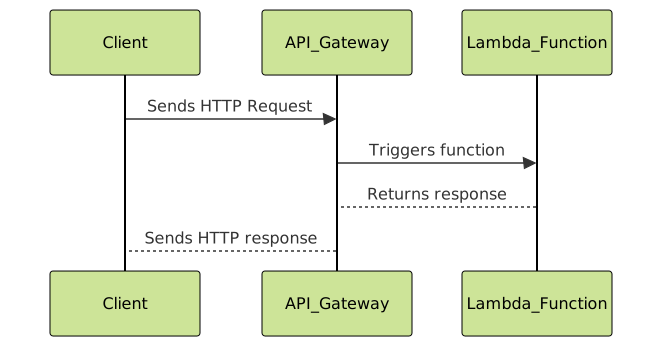
Below is a simple example of creating an AWS Lambda function triggered by an HTTP request via API Gateway. This function returns a greeting message with the current timestamp.
exports.handler = async (event) => {
    const response = {
        statusCode: 200,
        headers: { "Content-Type": "application/json" },
        body: JSON.stringify({
            message: "Hello from serverless!",
            timestamp: new Date().toISOString()
        }),
    };
    return response;
};
This function runs only when a client sends an HTTP GET request to the API Gateway endpoint. You are billed only for the milliseconds the function executes. The serverless platform automatically scales the backend based on user demand.
Visual Flow: Serverless Function Invocation
Interactive Concept: Pay-Per-Use Cost Calculation
Consider a serverless function that executes 1 million times per month, each invocation lasting 200 ms using 128 MB memory.
- Free tier example (AWS Lambda): 1 million free requests + 400,000 GB-seconds free
- Chargeable compute = (1,000,000 × 0.2 seconds × 0.128 GB) – free tier
This granular cost model means small projects or variable traffic applications remain inexpensive compared to fixed-price servers.
When to Use Serverless Hosting?
- Applications with unpredictable or spiky traffic patterns.
- Microservices or API backends requiring rapid scaling.
- Event-driven workloads such as image processing, notifications, or IoT telemetry.
- Rapid prototyping or startups looking to minimize upfront hosting costs.
Limitations and Considerations
- Cold starts: Initial request latency when functions scale from zero.
- Execution duration limits: Popular platforms impose max runtime (e.g., 15 minutes).
- Statelessness: Requires external storage/databases for persistent state.
- Vendor lock-in: Use of proprietary APIs can complicate multi-cloud strategies.
- Debugging complexity: Distributed functions can be harder to monitor and troubleshoot.
Serverless Architecture Diagram
Comparison: Serverless vs Traditional Hosting
| Aspect | Serverless Hosting | Traditional Hosting |
|---|---|---|
| Infrastructure Management | Fully managed by provider | Manual or semi-automated management |
| Scaling | Automatic and instantaneous | Manual or auto-scaling with delay |
| Billing | Pay-per-execution (milliseconds) | Fixed or usage-based server uptime |
| Idle Cost | None | Ongoing server costs |
| Use Case Suitability | Event-driven, unpredictable traffic | Steady traffic, long-running processes |
Conclusion
Serverless hosting empowers developers to deploy applications that seamlessly scale on demand and optimize costs by using a pay-per-use model. While it presents some challenges like cold starts and execution limits, its benefits for agile development, operational simplicity, and scalability outweigh them in many scenarios. Understanding serverless architecture and usage patterns can give businesses a competitive edge in efficient cloud deployment.
For anyone looking to modernize their deployment strategy, diving into serverless computing is a compelling step toward future-proof, cost-effective, and scalable app delivery.