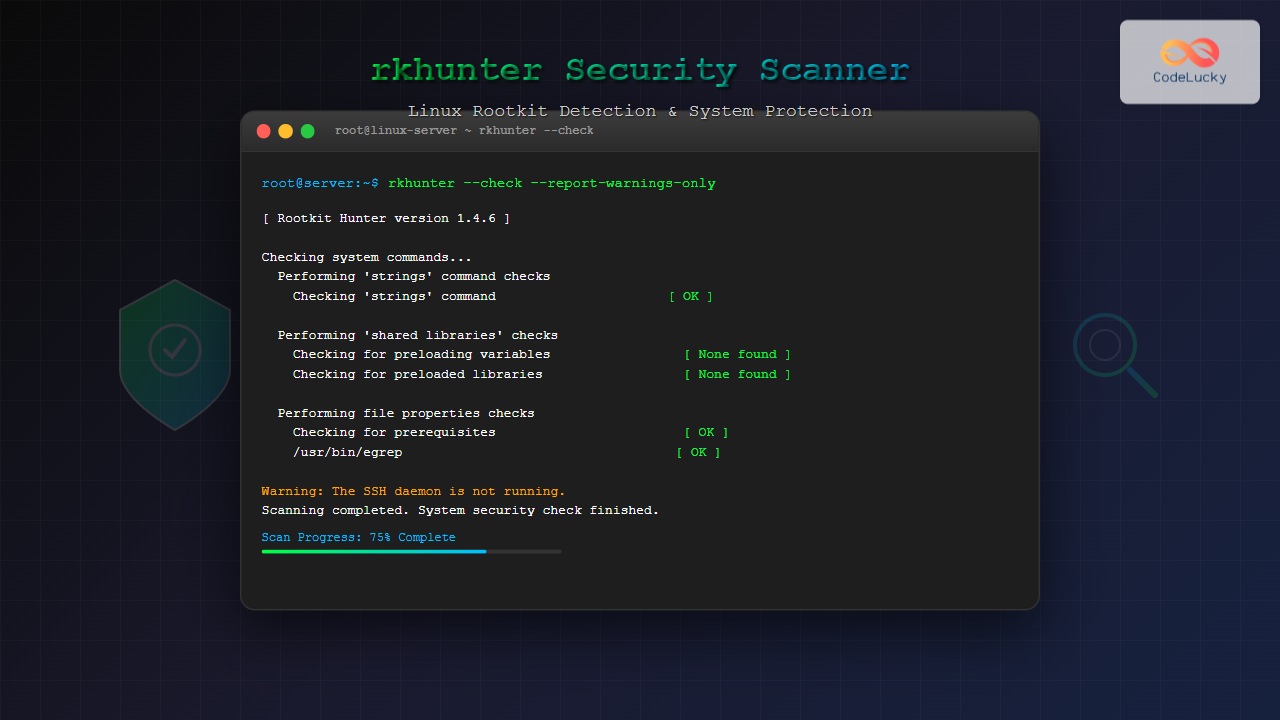
The rkhunter (Rootkit Hunter) is a powerful Unix-based security scanner designed to detect rootkits, backdoors, and local exploits on Linux systems. This comprehensive tool helps system administrators maintain security by scanning for known rootkits, performing various security checks, and monitoring system integrity.
What is rkhunter?
Rkhunter is an open-source security tool that performs over 200 different security checks on your Linux system. It compares SHA-1 hashes of important files with known good ones in online databases, searches for default directories and permissions of rootkits, and looks for wrong file permissions, hidden files, and suspicious strings in kernel modules.
Key Features of rkhunter
- Rootkit Detection: Scans for known rootkits and malicious software
- File Integrity Checking: Monitors changes in critical system files
- Network Port Monitoring: Detects suspicious network activity
- System Command Verification: Checks for trojaned system binaries
- Startup File Analysis: Examines boot scripts and configuration files
- Log File Analysis: Reviews system logs for suspicious activities
Installing rkhunter
Installation methods vary depending on your Linux distribution:
Ubuntu/Debian Systems
sudo apt update
sudo apt install rkhunter
CentOS/RHEL/Fedora Systems
# For CentOS/RHEL 7/8
sudo yum install rkhunter

# For Fedora
sudo dnf install rkhunter
Arch Linux
sudo pacman -S rkhunterManual Installation
# Download the latest version
wget https://downloads.sourceforge.net/project/rkhunter/rkhunter/1.4.6/rkhunter-1.4.6.tar.gz

# Extract and install
tar -xzf rkhunter-1.4.6.tar.gz
cd rkhunter-1.4.6
sudo ./installer.sh --layout default --install
Basic rkhunter Usage
Initial Setup and Database Update
Before running your first scan, update the rkhunter database:
sudo rkhunter --updateSample Output:
[ Rootkit Hunter version 1.4.6 ]

Checking rkhunter data files...
  Checking file mirrors.dat                                  [ No update ]
  Checking file programs_bad.dat                             [ Updated ]
  Checking file backdoorports.dat                            [ No update ]
  Checking file suspscan.dat                                 [ Updated ]
  Checking file i18n/cn                                      [ No update ]
  Checking file i18n/de                                      [ No update ]
  Checking file i18n/en                                      [ No update ]
Initialize the Properties Database
sudo rkhunter --propupdThis command creates a baseline of your system’s current state for future comparisons.
Running Security Scans
Basic System Scan
sudo rkhunter --checkThis performs a comprehensive system scan. You’ll be prompted to press Enter after each section completes.
Silent Scan with Report
sudo rkhunter --check --skip-keypress --report-warnings-onlySample Output:
[ Rootkit Hunter version 1.4.6 ]

Checking system commands...

  Performing 'strings' command checks
    Checking 'strings' command                              [ OK ]

  Performing 'shared libraries' checks
    Checking for preloading variables                       [ None found ]
    Checking for preloaded libraries                        [ None found ]
    Checking LD_LIBRARY_PATH variable                       [ Not found ]

  Performing file properties checks
    Checking for prerequisites                              [ OK ]
    /usr/bin/egrep                                          [ OK ]
    /usr/bin/fgrep                                          [ OK ]
    /usr/bin/which                                          [ OK ]

Warning: The SSH daemon is not running.
Warning: The command '/usr/bin/lwp-request' has been replaced by a script: /usr/bin/lwp-request: Perl script text executable
Check Specific Components
You can scan specific system components:
# Check only for rootkits
sudo rkhunter --check --enable rootkits

# Check system commands only
sudo rkhunter --check --enable system_commands

# Check network interfaces
sudo rkhunter --check --enable network
Configuration and Customization
The main configuration file is located at /etc/rkhunter.conf. Here are important configuration options:
Email Notifications
# Enable email notifications
[email protected]

# Set mail command
MAIL_CMD=mail -s "[rkhunter] Warnings found for ${HOST_NAME}"
Whitelisting
Add trusted applications and directories:
# Whitelist specific files
ALLOWHIDDENFILE=/etc/.java
ALLOWHIDDENFILE=/dev/.udev

# Allow specific processes
ALLOWPROCLIST=/usr/sbin/mysqld
Disable Specific Tests
# Disable tests that may cause false positives
DISABLE_TESTS="suspscan hidden_procs deleted_files packet_cap_apps apps"
Advanced rkhunter Commands
View Current Configuration
sudo rkhunter --config-checkList Available Tests
sudo rkhunter --listSample Output:
Available test names:
  all
  additional_rkts
  apps
  attributes
  avail_modules
  backdoorports
  deleted_files
  filesystem
  group_accounts
  group_changes
  hashes
  hidden_ports
  hidden_procs
  immutable
  known_rkts
  loaded_modules
  local_host
  malware
  network
  none
  os_specific
  packet_cap_apps
  passwd_changes
  ports
  possible_rkt_files
  possible_rkt_strings
  promisc
  properties
  rootkits
  running_procs
  scripts
  shared_libs
  startup_files
  startup_malware
  suspscan
  system_commands
  system_configs
  trojans
Generate Reports
# Generate detailed report
sudo rkhunter --check --report-warnings-only --logfile /var/log/rkhunter-scan.log

# View the report
sudo cat /var/log/rkhunter-scan.log
Version and Help Information
# Check version
rkhunter --version

# Display help
rkhunter --help
Interpreting Scan Results
Understanding Status Messages
- [OK] – Test passed successfully
- [Warning] – Potential issue found, requires investigation
- [Not found] – Expected file or process not found
- [None found] – No suspicious items detected
- [Skipped] – Test was skipped due to configuration
Common Warnings and Solutions
SSH Configuration Warning
Warning: The SSH daemon configuration may have some non-default settings:
         SSH daemon is configured to use a non-standard port: 2222
Solution: This is often intentional. Whitelist in configuration:
ALLOW_SSH_ROOT_USER=yes
ALLOW_SSH_PROT_V1=2
File Properties Changed
Warning: The file properties have changed:
File: /usr/bin/curl
Current hash: SHA1:a1b2c3d4e5f6...
Stored hash:  SHA1:f6e5d4c3b2a1...
Solution: If legitimate update occurred, refresh the database:
sudo rkhunter --propupdAutomating rkhunter Scans
Creating Scheduled Scans with Cron
Add to crontab for daily scans:
# Edit root crontab
sudo crontab -e

# Add daily scan at 2 AM
0 2 * * * /usr/bin/rkhunter --cronjob --update --quiet
Weekly Comprehensive Scan Script
Create a script for detailed weekly scans:
#!/bin/bash
# /usr/local/bin/rkhunter_weekly.sh

# Update database
/usr/bin/rkhunter --update --quiet

# Perform comprehensive scan
/usr/bin/rkhunter --cronjob --report-warnings-only --logfile /var/log/rkhunter-weekly.log

# Email results if warnings found
if [ -s /var/log/rkhunter-weekly.log ]; then
    mail -s "rkhunter Weekly Scan - Warnings Found" [email protected] < /var/log/rkhunter-weekly.log
fi
Make executable and add to cron:
sudo chmod +x /usr/local/bin/rkhunter_weekly.sh

# Add to crontab for Sunday at 3 AM
0 3 * * 0 /usr/local/bin/rkhunter_weekly.sh
Integration with System Monitoring
Log File Locations
Rkhunter logs are typically stored in:
/var/log/rkhunter.log– Main log file/var/lib/rkhunter/db/rkhunter.dat– Properties database/var/lib/rkhunter/tmp/– Temporary files during scans
Monitoring with journalctl
# View rkhunter systemd logs
sudo journalctl -u rkhunter

# Follow real-time logs
sudo journalctl -u rkhunter -f
Troubleshooting Common Issues
Database Update Failures
If updates fail due to network issues:
# Check connectivity
ping -c 4 rkhunter.sourceforge.net

# Manual database download
sudo rkhunter --update --debug
False Positives
To handle false positives effectively:
- Verify the warning is legitimate
- Check system logs for corresponding activities
- Update whitelist in configuration if appropriate
- Refresh properties database after legitimate changes
Performance Optimization
For systems with performance concerns:
# Disable resource-intensive tests
DISABLE_TESTS="suspscan apps"

# Limit scan depth
SCANROOTKITMODE=1
Security Best Practices
Regular Maintenance
- Update rkhunter database weekly
- Review scan logs regularly
- Keep the rkhunter software updated
- Maintain system patches and updates
Complementary Security Tools
Use rkhunter alongside other security tools:
- ClamAV for virus scanning
- AIDE/Tripwire for file integrity monitoring
- fail2ban for intrusion prevention
- chkrootkit as secondary rootkit scanner
Conclusion
The rkhunter command is an essential tool for Linux system security, providing comprehensive rootkit detection and system integrity monitoring. Regular use of rkhunter, combined with proper configuration and automation, significantly enhances your system’s security posture. Remember to keep the tool updated, review scan results carefully, and integrate it with your broader security monitoring strategy.
By implementing the practices and commands covered in this guide, you’ll be well-equipped to detect and respond to potential security threats on your Linux systems. Regular scanning with rkhunter should be part of every system administrator’s security toolkit.
Related Posts
chkrootkit Command Linux: Complete Guide to Rootkit Detection and System Security
System security is paramount in Linux administration, and rootkits pose one of the most serious threats to system integrity. The...

samhain Linux: Complete Guide to Host-based Intrusion Detection System
Samhain is a powerful host-based intrusion detection system (HIDS) designed specifically for Linux and Unix-like systems. This comprehensive security tool...
aide Command Linux: Complete Guide to Advanced Intrusion Detection Environment
The AIDE (Advanced Intrusion Detection Environment) command is a powerful security tool for Linux systems that monitors file and directory...
tiger Command Linux: Complete Security Audit and Intrusion Detection Guide
The tiger command is a powerful security auditing tool designed specifically for Unix-like systems, including Linux distributions. This comprehensive security...
tripwire Linux: Complete Guide to File Integrity Monitoring and Security
Tripwire is a powerful file integrity monitoring (FIM) tool that helps system administrators detect unauthorized changes to critical system files,...
OSSEC Linux: Complete Guide to Host-based Intrusion Detection System for Enterprise Security
What is OSSEC Linux? OSSEC (Open Source Security Event Correlator) is a powerful, open-source Host-based Intrusion Detection System (HIDS) that...
lynis Command Linux: Complete Security Auditing Tool Guide
The lynis command is a powerful, open-source security auditing tool designed specifically for Unix-based systems including Linux, macOS, and BSD....
strace Advanced Linux: Complete Guide to System Call Tracing and Debugging
strace is one of the most powerful debugging and diagnostic tools available in Linux systems. It allows you to trace...
Intrusion Detection System: Complete Guide to OS-Level Security Monitoring
Understanding Intrusion Detection Systems An Intrusion Detection System (IDS) is a critical security tool that monitors network traffic and system...
ltrace Command Linux: Complete Guide to Trace Library Calls and Debug Programs
The ltrace command is a powerful debugging and analysis tool in Linux that allows you to trace library calls made...
check_mk Linux: Complete Guide to Nagios-Based System Monitoring
check_mk is a powerful monitoring system built on top of Nagios that simplifies infrastructure monitoring with automated service discovery and...

fsck Command Linux: Complete Guide to Filesystem Check and Repair
The fsck (file system check) command is one of the most crucial system administration tools in Linux, designed to check...