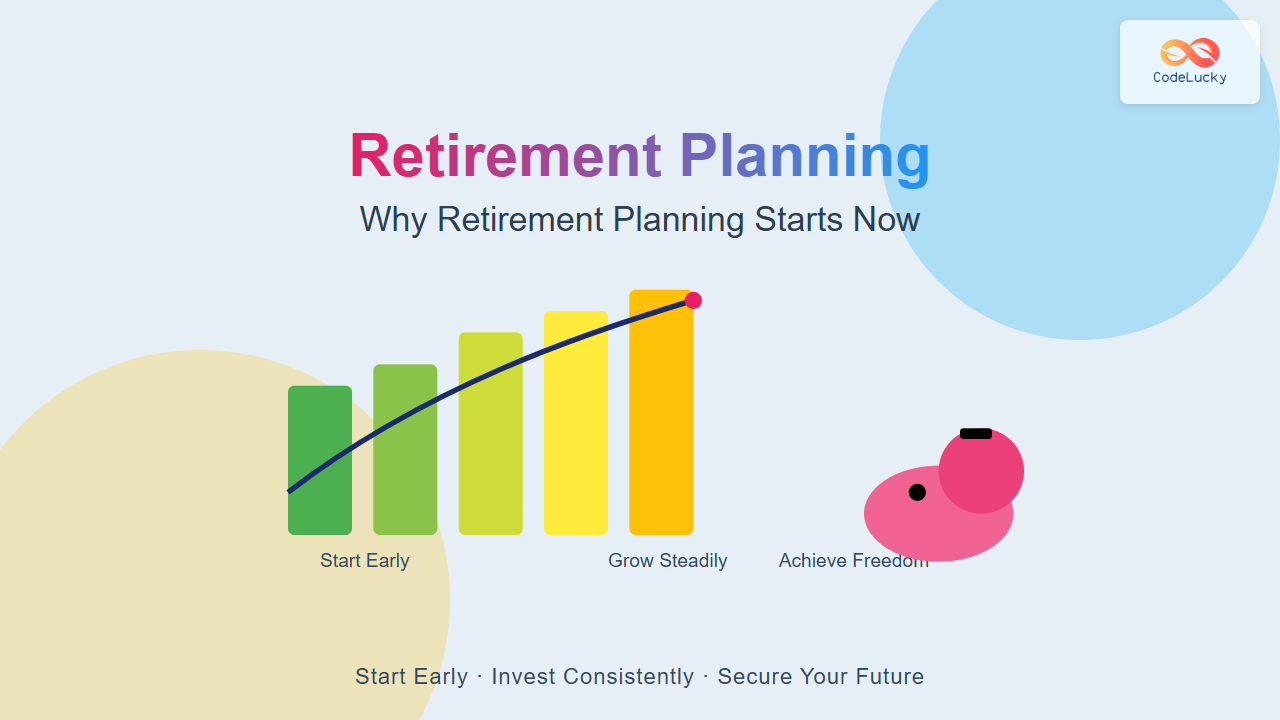
Retirement Planning: Why Retirement Planning Starts Now
Retirement is not a distant dream—it’s a financial goal that requires consistent planning and discipline. The earlier you begin, the easier it becomes to leverage the magic of compounding, reduce stress, and create lasting financial freedom. In this comprehensive guide, we’ll explain why retirement planning starts now and how you can build your ideal future step by step.
What Is Retirement Planning?
Retirement planning is the process of setting financial goals for your post-working years and developing a strategy to achieve them. It includes estimating expenses, identifying income sources, setting up retirement accounts, and planning for healthcare needs. The objective is to ensure that when you retire, you can maintain your current lifestyle without depending on others.
Why You Should Start Retirement Planning Early
The key advantage of starting early lies in time and compounding interest. When you start saving early, your money doesn’t just grow—it grows exponentially because of compounding returns. Let’s understand this with an example.
Example: The Power of Compounding
Imagine two individuals, Riya and Arjun:
- Riya starts saving ₹5,000 per month at age 25.
- Arjun starts saving ₹5,000 per month at age 35.
- Both plan to retire at 60 with an average annual return of 10%.
At retirement:
- Riya’s corpus: ₹3.17 Crore
- Arjun’s corpus: ₹1.18 Crore
Even though Riya invested only ₹6 Lakhs more, she ends up with nearly ₹2 Crores extra—thanks to early compounding. The difference isn’t just time, it’s exponential growth.

Key Steps to Effective Retirement Planning
1. Define Your Retirement Goals
Ask yourself what kind of retirement lifestyle you want. For instance, do you want to travel, pursue hobbies, or buy a second home? Estimating lifestyle expenses gives you a target value to plan toward.
2. Estimate Your Retirement Corpus
Use the retirement formula to calculate your required corpus:
Future Corpus = Monthly Expense × 12 × (Number of Years in Retirement)
Consider inflation and healthcare inflation to get accurate figures.

3. Choose the Right Investment Vehicles
Invest in a mix of assets:
- Equity Mutual Funds: For long-term growth and higher returns.
- Provident Funds (EPF/PPF): For security and steady returns.
- Pension Plans & NPS: For structured retirement payouts.
- Gold, REITs, and Bonds: For diversification and stability.
4. Rebalance and Review Regularly
Your investment plan must evolve as your goals, income, and risk appetite change. A good practice is to review your portfolio every 6–12 months.

Common Mistakes to Avoid
Many individuals delay retirement planning due to misconceptions. Avoid these mistakes:
- Starting late: Lost compounding years can’t be recovered.
- Ignoring inflation: The cost of living doubles every ~7-8 years.
- Not diversifying: Relying on a single asset class increases risk.
- Skipping insurance: Medical emergencies can drain savings.
Interactive Example: Estimate Your Retirement Need
Try this simple interactive formula (you can implement it in a calculator or spreadsheet):
Monthly Expense × (1 + Inflation Rate) ^ Years till Retirement × 12 × Years of Retirement
For example, if your monthly cost is ₹50,000, inflation is 6%, and retirement is 25 years away:
Future Corpus: ₹50,000 × (1.06)^25 × 12 × 25 = ₹6.45 Crore (approx.)

Example Financial Paths Based on Age
The amount to save varies depending on your current age and risk capacity:
| Age | Monthly Savings (approx) | Expected Corpus by 60 (10% ROI) |
|---|---|---|
| 25 | ₹5,000 | ₹3.17 Crore |
| 30 | ₹8,000 | ₹2.65 Crore |
| 35 | ₹12,000 | ₹2.27 Crore |
| 40 | ₹18,000 | ₹1.88 Crore |
Building a Sustainable Retirement Plan
To make your plan sustainable, ensure you:
- Automate your investments (SIPs/NPS contributions).
- Increase contributions annually by at least 5–10%.
- Keep an emergency fund separate from retirement savings.
- Plan for post-retirement passive income—rentals, dividends, etc.

Final Thoughts
Retirement planning isn’t about age; it’s about awareness. Whether you’re 25 or 45, the best time to start is now. Even small, consistent investments can compound into large wealth over time. The earlier you start, the more freedom you gain to design your life after work on your own terms.
So take the first step—define your goals, start saving, and let time and compounding do the rest. Your future self will thank you for starting today.