Real Estate Investment Trusts (REITs) have revolutionized how individuals can invest in real estate without owning property directly. They provide a simple, liquid, and regulated way to invest in profitable real estate ventures — from shopping malls and apartments to data centers and hospitals.
What is a REIT?
A Real Estate Investment Trust (REIT) is a company that owns, operates, or finances income-producing real estate. It pools capital from multiple investors to purchase and manage real estate assets, distributing most of its earnings as dividends.
Legally, REITs must distribute at least 90% of their taxable income to shareholders annually, making them attractive for dividend-focused investors.

Types of REITs
There are several types of REITs depending on how they generate income and what kind of real estate they deal with:
- Equity REITs: Own and manage real estate properties, earning through rent and property value appreciation.
- Mortgage REITs (mREITs): Provide financing for real estate by purchasing or originating mortgages and mortgage-backed securities.
- Hybrid REITs: Combine both property ownership and mortgage lending activities.
- Publicly Traded REITs: Listed on stock exchanges and easy to buy/sell like regular stocks.
- Private REITs: Not listed on exchanges and typically limited to institutional investors.

How Do REITs Work?
REITs function similarly to mutual funds but for real estate. The pooled capital is invested into various real estate assets, and investors receive income proportionally based on their shareholding.
Here’s a simplified view of how REITs generate returns:
- Investors buy shares of a REIT.
- The REIT uses these funds to purchase income-generating properties.
- The properties earn rental or lease income.
- The REIT pays out dividends to investors from profits after expenses.
- Investors may also benefit from long-term capital appreciation.
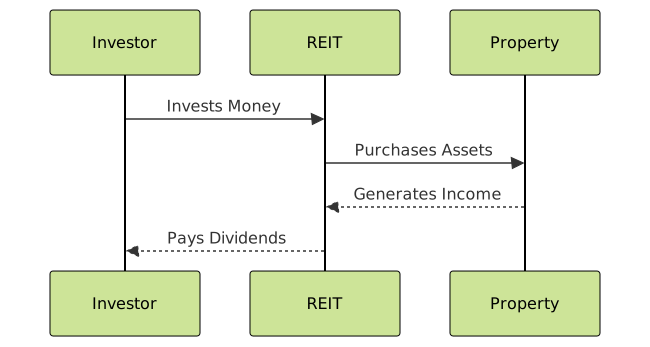
Example: Understanding REIT Income Flow
Suppose you invest ₹1,00,000 into an equity REIT that owns commercial office spaces. The REIT earns rental income, pays operating expenses, and then distributes remaining profit as dividends. If the REIT offers a dividend yield of 8%, you’ll earn ₹8,000 in a year — without maintaining or managing any property.
Advantages of Investing in REITs
- Passive Income: Receive regular dividend payouts without direct property management.
- Diversification: Gain exposure across various real estate sectors and geographies.
- Liquidity: Public REIT shares are traded easily on exchanges, unlike direct property.
- Accessibility: Low entry barriers allow small investors to participate in large-scale projects.
- Inflation Hedge: Real estate often appreciates with inflation, maintaining purchasing power.
Risks Involved with REITs
Despite their benefits, REITs are not risk-free. Investors must consider:
- Market Volatility: Like stocks, public REIT prices fluctuate with market sentiment and interest rates.
- Interest Rate Sensitivity: Higher interest rates can reduce REIT attractiveness as bond yields rise.
- Sector Risks: REITs focused on certain sectors (e.g., retail) may face cyclical demand changes.
- Management Quality: Returns depend heavily on management’s ability to acquire and operate profitable assets.
How to Invest in REITs
Investing in REITs is simple, and there are several routes to do so:
- Stock Exchanges: Buy publicly traded REIT shares through a brokerage account.
- Mutual Funds & ETFs: Invest in REIT-focused mutual funds or exchange-traded funds for diversification.
- Private Platforms: High-net-worth investors can participate in private or unlisted REITs.
REIT Selection Checklist
Before investing, analyze the REIT’s:
- Historical dividend yield and consistency.
- Portfolio occupancy rate and asset quality.
- Debt-to-equity ratio and leverage level.
- Management performance track record.
- Sectoral exposure (Retail, Office, Industrial, Data Centers, etc.).

Popular REIT Sectors and Examples
Globally, REITs cover a range of industries, each serving unique demand patterns:
| Sector | Example REIT Focus | Growth Drivers |
|---|---|---|
| Residential | Apartments, Housing Complexes | Urbanization & Rental Demand |
| Commercial | Offices, Business Parks | Corporate Leasing Needs |
| Industrial | Warehouses, Logistics Centers | E-commerce Supply Chain |
| Retail | Malls, Shopping Complexes | Consumer Spending Trends |
| Infrastructure | Data Centers, Telecom Towers | Digital Economy Growth |
Interactive Example: Simulating REIT Returns
If you want to estimate annual income from a REIT investment, use this simple interactive example:
Formula:
Annual Income = Investment Amount × Dividend YieldTry adjusting the yield:
Taxation on REIT Dividends
In most jurisdictions, REIT dividends are taxed as ordinary income. However, some countries offer tax exemptions or lower rates to encourage real estate investment. Always review the tax policy specific to your jurisdiction.

Conclusion
REITs democratize real estate investment by allowing anyone to earn income from large-scale properties with minimal capital and effort. Whether you’re a beginner investor seeking stable dividend returns or a professional portfolio manager diversifying asset classes, REITs offer an accessible and rewarding path.
Pro Tip: Combine REITs with other asset classes like equities and bonds to create a well-balanced, inflation-resistant portfolio for the long term.
At CodeLucky.com, we believe financial literacy empowers investors to make smart, informed decisions. REITs are an excellent example of how modern finance can make real estate accessible for everyone.