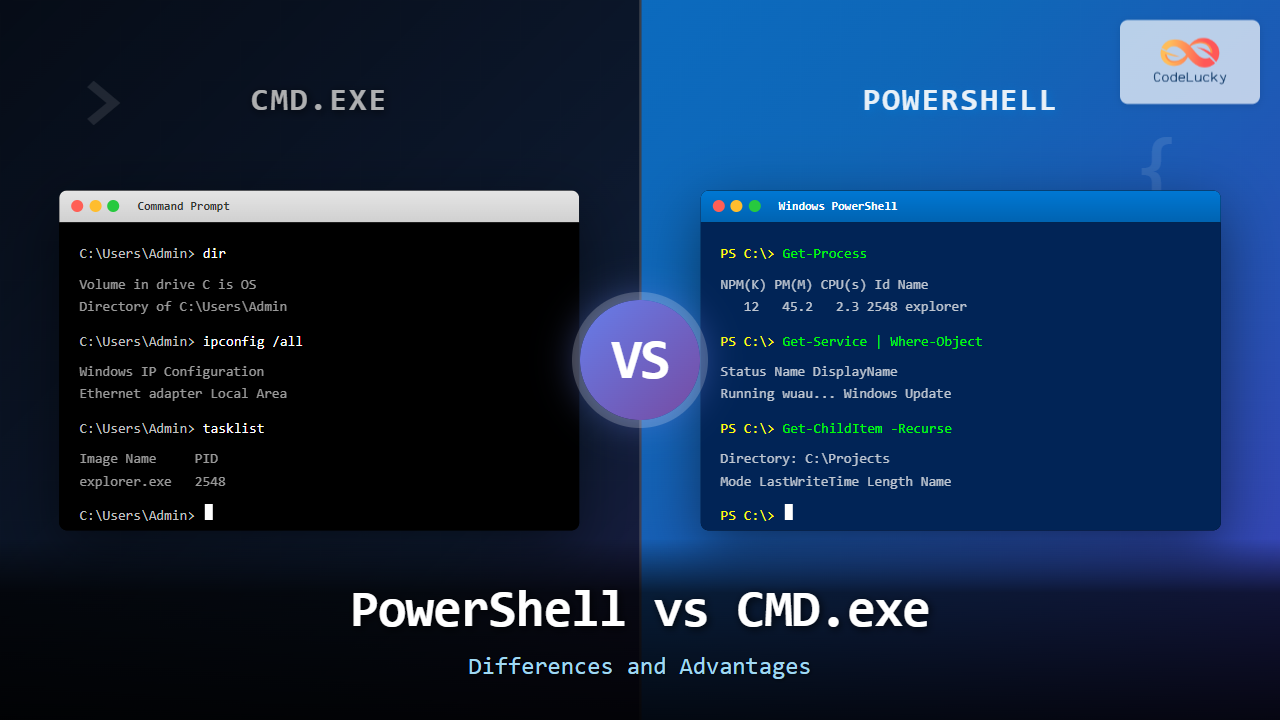
Windows provides two primary command-line interfaces: the traditional Command Prompt (cmd.exe) and the modern PowerShell. While both allow you to execute commands and automate tasks, they differ significantly in capabilities, architecture, and use cases. This guide explores their fundamental differences and helps you understand when to use each tool.
Architecture and Foundation
The architectural differences between PowerShell and CMD are fundamental to understanding their capabilities.

CMD.exe Architecture
Command Prompt is a legacy shell inherited from MS-DOS and early Windows versions. It processes commands as text strings and returns text output. Every command communicates through plain text, requiring manual parsing for complex operations.
REM CMD example - text-based output
dir C:\Users
Output characteristics: Plain text formatted for human readability, requiring string manipulation for programmatic processing.
PowerShell Architecture
PowerShell is built on the .NET Framework, treating everything as objects rather than text. Commands (called cmdlets) pass structured .NET objects between each other, enabling powerful data manipulation without parsing.
# PowerShell example - object-based output
Get-ChildItem C:\Users | Select-Object Name, Length, LastWriteTime
Output characteristics: Structured .NET objects with properties and methods, allowing direct access to specific data elements.
Command Structure and Syntax
CMD Command Format
CMD uses simple, often abbreviated command names with slash-based switches:
dir /s /b C:\Windows
ipconfig /all
netstat -an
tasklist /v
PowerShell Cmdlet Format
PowerShell follows a consistent Verb-Noun naming convention with hyphenated parameters:
Get-ChildItem -Path C:\Windows -Recurse
Get-NetIPConfiguration -Detailed
Get-NetTCPConnection
Get-Process -Name explorer

Key Differences in Functionality
Pipeline Behavior
The pipeline is where PowerShell’s object-oriented nature shines compared to CMD’s text-based approach.
CMD Pipeline:
REM Counting files - text manipulation required
dir /b | find /c /v ""
PowerShell Pipeline:
# Counting files - direct property access
Get-ChildItem | Measure-Object | Select-Object Count

# Advanced filtering with object properties
Get-ChildItem | Where-Object {$_.Length -gt 1MB} | Select-Object Name, Length
Example Output:
Name                Length
----                ------
LargeFile1.zip      2547896
Database.mdf        5242880
VideoFile.mp4       15728640
Variables and Data Types
CMD Variables:
SET username=John
SET count=5
ECHO %username% has %count% items
CMD variables are always strings with limited manipulation capabilities.
PowerShell Variables:
# PowerShell supports typed variables
$username = "John"
$count = 5
$items = @("apple", "banana", "orange")
$config = @{Server="localhost"; Port=8080}

Write-Host "$username has $count items"
Output: John has 5 items
Scripting Capabilities
CMD Batch Script (.bat):
@ECHO OFF
REM Simple loop example
FOR %%F IN (*.txt) DO (
    ECHO Processing %%F
    TYPE %%F
)

IF EXIST "config.txt" (
    ECHO Config file found
) ELSE (
    ECHO Config file missing
)
PowerShell Script (.ps1):
# Advanced scripting with functions and error handling
function Process-Files {
    param(
        [string]$Path,
        [string]$Extension = "*.txt"
    )

    try {
        Get-ChildItem -Path $Path -Filter $Extension | ForEach-Object {
            Write-Host "Processing $($_.Name)" -ForegroundColor Green
            $content = Get-Content $_.FullName
            # Process content
        }
    }
    catch {
        Write-Error "Error processing files: $_"
    }
}

Process-Files -Path "C:\Data" -Extension "*.log"
Advantages of PowerShell
Object Manipulation
PowerShell’s object-oriented approach eliminates complex text parsing:
# Get services sorted by status and display specific properties
Get-Service | Sort-Object Status |
    Select-Object Name, Status, StartType |
    Format-Table -AutoSize
Sample Output:
Name           Status  StartType
----           ------  ---------
Spooler        Running Automatic
Themes         Running Automatic
wuauserv       Stopped    Manual
BITS           Stopped    Manual
Remote Management
PowerShell includes built-in remoting capabilities:
# Execute commands on remote computers
Invoke-Command -ComputerName Server01, Server02 -ScriptBlock {
    Get-Process | Where-Object {$_.CPU -gt 100}
}

# Establish persistent session
$session = New-PSSession -ComputerName Server01
Invoke-Command -Session $session -ScriptBlock {Get-EventLog -LogName System -Newest 10}
Module System
PowerShell’s extensible module system provides specialized functionality:
# Import and use modules
Import-Module ActiveDirectory
Get-ADUser -Filter {Enabled -eq $true} | Select-Object Name, Department

# Azure management
Import-Module Az
Connect-AzAccount
Get-AzVM | Select-Object Name, ResourceGroupName, Location

Error Handling
PowerShell offers sophisticated error handling mechanisms:
try {
    Get-Content "C:\NonExistent.txt" -ErrorAction Stop
    # Process file
}
catch [System.IO.FileNotFoundException] {
    Write-Warning "File not found. Creating default configuration."
    New-Item -Path "C:\NonExistent.txt" -ItemType File
}
catch {
    Write-Error "Unexpected error: $_"
}
finally {
    Write-Host "Cleanup completed"
}
Advantages of CMD
Simplicity and Speed
CMD remains useful for simple, quick tasks:
REM Quick file operations
copy file1.txt file2.txt
del *.tmp
ren oldname.txt newname.txt

REM Fast directory navigation
cd C:\Windows\System32
dir /od
Universal Availability
CMD is available on every Windows system without configuration, making it reliable for basic automation that must work across all Windows versions.
Lightweight Resource Usage
CMD starts faster and uses less memory than PowerShell, beneficial for resource-constrained environments or simple scripts embedded in applications.
Performance Comparison

Startup Time
# Measure PowerShell startup
Measure-Command {powershell -Command "Write-Host 'Test'"}

# Typical results:
# CMD: ~50-100ms
# PowerShell 5.1: ~400-600ms
# PowerShell 7: ~200-400ms
Script Execution
For simple file operations, CMD executes faster. For complex data manipulation, PowerShell’s object model provides better performance despite initial overhead.
Real-World Use Cases
When to Use CMD
- Simple file operations (copy, move, delete)
- Quick directory navigation and listing
- Running legacy batch scripts
- Embedded commands in legacy applications
- Resource-constrained environments
- Immediate command execution without scripting complexity
When to Use PowerShell
- System administration and automation
- Active Directory management
- Cloud resource management (Azure, AWS)
- Complex data filtering and transformation
- Remote server management
- DevOps and CI/CD pipelines
- Working with APIs and web services
Practical Examples Comparison
Task: Find Large Files
CMD Approach:
REM Limited capability - requires third-party tools
forfiles /S /C "cmd /c if @fsize GTR 104857600 echo @path @fsize"
PowerShell Approach:
# Comprehensive solution with formatting
Get-ChildItem -Path C:\Data -Recurse -File |
    Where-Object {$_.Length -gt 100MB} |
    Select-Object FullName,
        @{Name="SizeMB";Expression={[math]::Round($_.Length/1MB, 2)}},
        LastWriteTime |
    Sort-Object SizeMB -Descending |
    Format-Table -AutoSize
Output:
FullName                         SizeMB LastWriteTime
--------                         ------ -------------
C:\Data\backup.zip              523.45 10/20/2025 2:30 PM
C:\Data\video.mp4               387.92 10/19/2025 11:15 AM
C:\Data\database.bak            256.78 10/18/2025 9:45 AM
Task: Process Management
CMD Approach:
REM Basic process listing
tasklist | find "chrome"
taskkill /IM chrome.exe /F
PowerShell Approach:
# Advanced process management
Get-Process chrome | Select-Object Id, ProcessName,
    @{Name="MemoryMB";Expression={[math]::Round($_.WS/1MB, 2)}},
    CPU, StartTime

# Conditional termination
Get-Process | Where-Object {$_.CPU -gt 100 -and $_.Name -like "*chrome*"} |
    Stop-Process -Force
Task: Network Configuration
CMD Approach:
ipconfig /all
netsh interface ip show config
ping google.com
PowerShell Approach:
# Structured network information
Get-NetIPConfiguration | Select-Object InterfaceAlias, IPv4Address, IPv4DefaultGateway

# Advanced network testing
Test-NetConnection -ComputerName google.com -InformationLevel Detailed

# Network adapter configuration
Get-NetAdapter | Where-Object Status -eq "Up" |
    Select-Object Name, Status, LinkSpeed, MacAddress
Integration and Compatibility
Running CMD Commands in PowerShell
PowerShell can execute CMD commands directly:
# Direct execution
ipconfig /all
dir C:\Windows

# Explicit CMD invocation
cmd /c "echo %PATH%"

# Capture CMD output as PowerShell object
$output = cmd /c dir /b
$output | ForEach-Object { Write-Host $_ }
Running PowerShell from CMD
REM Execute PowerShell commands from CMD
powershell -Command "Get-Process | Where-Object {$_.CPU -gt 100}"

REM Execute PowerShell script
powershell -File "C:\Scripts\backup.ps1"

REM Execute with specific execution policy
powershell -ExecutionPolicy Bypass -File "script.ps1"
Security Considerations
Execution Policy
PowerShell includes execution policies to prevent unauthorized script execution:
# Check current execution policy
Get-ExecutionPolicy

# Set execution policy
Set-ExecutionPolicy RemoteSigned -Scope CurrentUser

# Bypass for single script
powershell -ExecutionPolicy Bypass -File script.ps1
Credential Management
PowerShell provides secure credential handling:
# Prompt for credentials
$cred = Get-Credential

# Use credentials with cmdlets
Get-WmiObject -Class Win32_Service -ComputerName Server01 -Credential $cred

# Store encrypted credentials
$securePassword = ConvertTo-SecureString "P@ssw0rd" -AsPlainText -Force
$cred = New-Object System.Management.Automation.PSCredential("username", $securePassword)
Migration Path
Transitioning from CMD to PowerShell requires understanding command equivalents:
| CMD Command | PowerShell Equivalent | Notes |
|---|---|---|
| dir | Get-ChildItem | Alias: ls, gci |
| cd | Set-Location | Alias: cd |
| copy | Copy-Item | Alias: copy, cp |
| del | Remove-Item | Alias: del, rm |
| type | Get-Content | Alias: cat, type |
| move | Move-Item | Alias: move, mv |
| ren | Rename-Item | Alias: ren |
| echo | Write-Output | Alias: echo |
Best Practices
For CMD Scripts
- Use @ECHO OFF to suppress command echoing
- Include error checking with ERRORLEVEL
- Add comments using REM for documentation
- Quote paths containing spaces
- Use SETLOCAL to limit variable scope
For PowerShell Scripts
- Use approved verbs for function names (Get-Verb for list)
- Implement proper error handling with try-catch
- Include comment-based help for functions
- Use parameter validation attributes
- Follow consistent naming conventions
- Test scripts with different execution policies
Conclusion
PowerShell represents the future of Windows command-line automation with its object-oriented architecture, extensive module ecosystem, and powerful scripting capabilities. While CMD remains useful for simple tasks and legacy compatibility, PowerShell provides superior functionality for modern system administration, automation, and DevOps workflows.
For new projects and scripts, PowerShell is the recommended choice. Its learning curve is steeper than CMD, but the investment pays dividends through increased productivity, better error handling, and access to the full .NET Framework. CMD should be reserved for simple tasks, quick commands, and maintaining legacy scripts where migration isn’t cost-effective.
The choice between PowerShell and CMD ultimately depends on your specific requirements, existing infrastructure, and the complexity of tasks you need to accomplish. Understanding both tools and their strengths enables you to select the right tool for each situation, maximizing efficiency and maintainability of your Windows automation solutions.