What is Paging in Operating Systems?
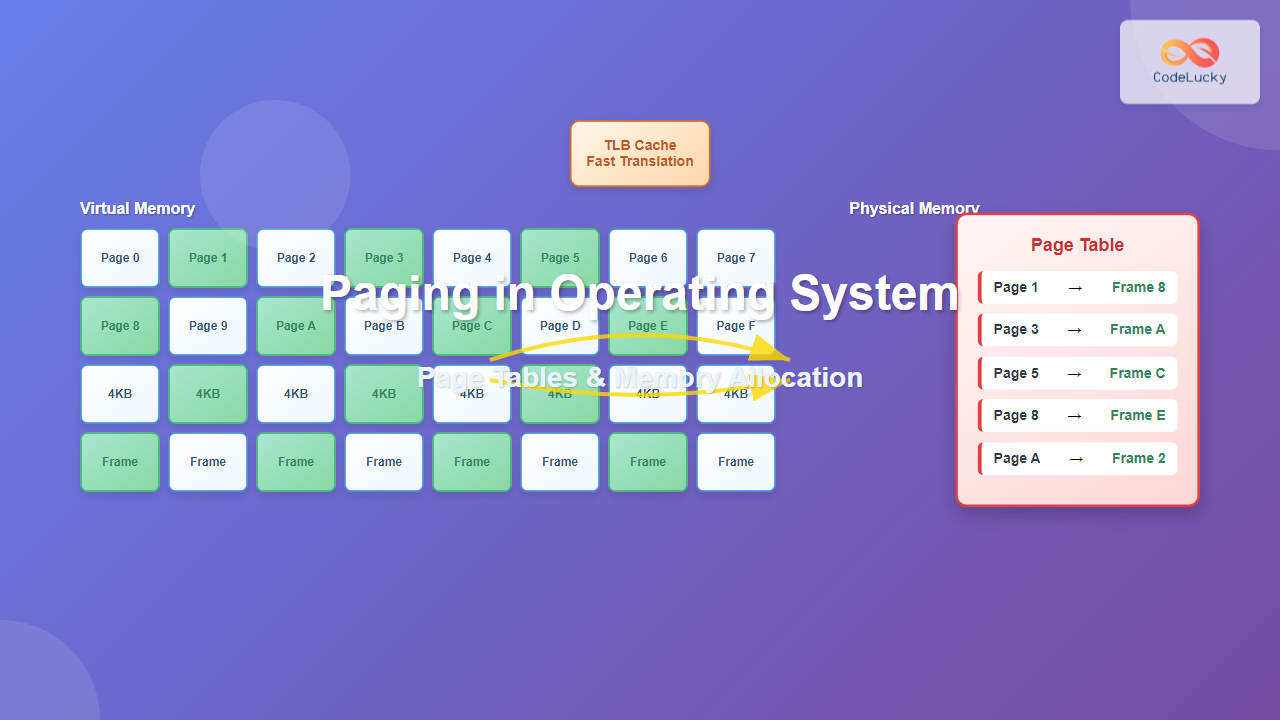
Paging is a memory management scheme that allows the operating system to store and retrieve data from secondary storage for use in main memory. It divides both virtual memory and physical memory into fixed-size blocks called pages (virtual memory) and frames (physical memory), enabling non-contiguous memory allocation and efficient memory utilization.
Unlike segmentation, which uses variable-sized memory blocks, paging uses uniform page sizes (typically 4KB, 8KB, or 16KB) to eliminate external fragmentation while providing a clean abstraction layer between logical and physical addresses.

Core Components of Paging System
Pages and Frames
Pages are fixed-size blocks of virtual memory, while frames are corresponding fixed-size blocks of physical memory. The operating system maintains a one-to-one mapping between pages and frames through page tables.
- Page Size: Common sizes include 4KB (4,096 bytes), 8KB, and 16KB
- Page Number: Higher-order bits of virtual address
- Page Offset: Lower-order bits indicating position within page
- Frame Number: Physical memory frame identifier
Address Translation Process
Virtual addresses are translated to physical addresses through a systematic process:
Virtual Address = [Page Number | Page Offset]
Physical Address = [Frame Number | Page Offset]
For a 32-bit system with 4KB pages:
Page Size = 4KB = 4,096 bytes = 2^12 bytes
Page Offset = 12 bits (0-11)
Page Number = 20 bits (12-31)
Total Virtual Address Space = 2^32 = 4GB
Page Table Structure and Implementation
Single-Level Page Tables
The simplest page table implementation uses a single array where the page number serves as an index. Each entry contains the corresponding frame number and control bits.

Page Table Entry Structure
Each page table entry typically contains:
| Bit Field | Purpose | Description |
|---|---|---|
| Frame Number | Address Translation | Physical frame number for mapping |
| Valid Bit | Presence Check | Indicates if page is in physical memory |
| Dirty Bit | Modification Flag | Set when page has been written to |
| Reference Bit | Access Tracking | Set when page is accessed |
| Protection Bits | Access Control | Read, Write, Execute permissions |
| Caching Bits | Cache Control | Cache disable, write-through flags |
Multi-Level Page Tables
Large address spaces require hierarchical page tables to reduce memory overhead. A two-level system divides the page number into multiple parts:
32-bit Address with 4KB pages, 2-level paging:
- Page Directory Index: 10 bits (bits 22-31)
- Page Table Index: 10 bits (bits 12-21)
- Page Offset: 12 bits (bits 0-11)
Memory Allocation Strategies
Demand Paging
Demand paging loads pages into memory only when they are accessed, reducing initial memory requirements and startup time. When a process attempts to access a page not in memory, a page fault occurs.
Page Fault Handling Process:
- Trap Generation: CPU generates trap when accessing invalid page
- Page Fault Handler: OS kernel handles the interrupt
- Page Location: OS locates page in secondary storage
- Frame Allocation: Free frame is allocated or victim page is evicted
- Page Loading: Page is loaded from storage to memory
- Table Update: Page table entry is updated with new frame number
- Restart Instruction: Faulting instruction is restarted
Page Replacement Algorithms
When physical memory is full, the OS must select victim pages for replacement:
First-In-First-Out (FIFO)
Reference String: 7, 0, 1, 2, 0, 3, 0, 4, 2, 3, 0, 3, 2
Frames = 3

Frame 1: [7] [7] [7] [2] [2] [2] [4] [4] [4] [0] [0] [0] [0]
Frame 2: [-] [0] [0] [0] [0] [3] [3] [3] [2] [2] [2] [3] [3]
Frame 3: [-] [-] [1] [1] [1] [1] [0] [0] [0] [3] [3] [3] [2]

Page Faults: 7  0  1  2     3     4     2  3     0     3  2
Total Page Faults: 9
Least Recently Used (LRU)
Reference String: 7, 0, 1, 2, 0, 3, 0, 4, 2, 3, 0, 3, 2
Frames = 3

Frame 1: [7] [7] [7] [2] [2] [2] [0] [4] [4] [4] [0] [0] [0]
Frame 2: [-] [0] [0] [0] [0] [3] [3] [3] [2] [2] [2] [3] [3]
Frame 3: [-] [-] [1] [1] [1] [1] [1] [1] [1] [3] [3] [3] [2]

Page Faults: 7  0  1  2     3     0  4     2  3     0     2
Total Page Faults: 8
Translation Lookaside Buffer (TLB)
The Translation Lookaside Buffer is a high-speed cache that stores recent virtual-to-physical address translations, significantly reducing memory access time by avoiding page table lookups.

TLB Performance Metrics
TLB effectiveness is measured by hit ratio and effective access time:
Effective Access Time = (TLB Hit Time × Hit Ratio) +
                       (Page Table Access Time + Memory Access Time) × Miss Ratio

Example:
- TLB Hit Time: 1 ns
- Memory Access Time: 100 ns
- TLB Hit Ratio: 98%

Effective Access Time = (1 × 0.98) + (100 + 100) × 0.02
                     = 0.98 + 4 = 4.98 ns
Advanced Paging Concepts
Copy-on-Write (COW)
Copy-on-Write is an optimization technique where multiple processes share the same physical pages until one process modifies the data. This reduces memory usage and improves process creation performance.
COW Implementation Example:
Process Creation:
1. Parent process has pages marked as read-only
2. Child process shares same physical pages
3. On write attempt:
   - Page fault occurs
   - OS allocates new physical frame
   - Original page is copied to new frame
   - Page tables updated for writing process
   - Write operation proceeds
Memory-Mapped Files
Memory-mapped files allow file I/O operations through memory access, treating file contents as virtual memory pages.
// C Example: Memory-mapped file
#include <sys/mman.h>
#include <fcntl.h>

int fd = open("data.txt", O_RDWR);
void *ptr = mmap(NULL, file_size, PROT_READ | PROT_WRITE,
                 MAP_SHARED, fd, 0);

// Access file through memory operations
*(char*)ptr = 'A';  // Modifies first byte of file
munmap(ptr, file_size);
Paging vs Other Memory Management Schemes
| Aspect | Paging | Segmentation | Continuous Allocation |
|---|---|---|---|
| Fragmentation | Internal only | External possible | Both types |
| Memory Utilization | High | Variable | Low |
| Address Translation | Simple arithmetic | Base + limit | Base register |
| Sharing Support | Page-level | Segment-level | Process-level |
| Protection | Page-granular | Segment-granular | Process-granular |
Performance Optimization Techniques
Page Size Selection
Page size affects system performance through multiple factors:
- Small pages: Reduce internal fragmentation, increase page table size
- Large pages: Reduce page table overhead, increase internal fragmentation
- Optimal size: Balance between fragmentation and table overhead
Prefetching Strategies
Predictive page loading can reduce page fault penalties:
Sequential Prefetching:
- Load next N pages when accessing page P
- Effective for sequential access patterns

Spatial Prefetching:
- Load nearby pages based on locality
- Uses working set analysis
Implementation Examples
Simplified Page Table Implementation
// Basic page table structure in C
#define PAGE_SIZE 4096
#define PAGE_BITS 12
#define PAGES_PER_TABLE 1024

typedef struct page_entry {
    unsigned int frame_number : 20;  // Physical frame number
    unsigned int valid : 1;          // Present in memory
    unsigned int dirty : 1;          // Modified since load
    unsigned int accessed : 1;       // Recently accessed
    unsigned int user : 1;           // User accessible
    unsigned int writable : 1;       // Write permission
    unsigned int reserved : 7;       // Reserved bits
} page_entry_t;

// Address translation function
unsigned long translate_address(unsigned long virtual_addr,
                               page_entry_t *page_table) {
    unsigned long page_num = virtual_addr >> PAGE_BITS;
    unsigned long offset = virtual_addr & (PAGE_SIZE - 1);

    page_entry_t *entry = &page_table[page_num];

    if (!entry->valid) {
        // Page fault - handle page loading
        handle_page_fault(page_num);
        return 0;  // Will retry after page load
    }

    entry->accessed = 1;  // Set access bit
    return (entry->frame_number << PAGE_BITS) | offset;
}
Page Replacement Algorithm Implementation
// LRU page replacement using counter method
typedef struct lru_entry {
    unsigned int frame_number;
    unsigned int counter;
    struct lru_entry *next;
} lru_entry_t;

static unsigned int global_counter = 0;

int lru_replace_page(lru_entry_t *lru_list, int num_frames) {
    lru_entry_t *current = lru_list;
    lru_entry_t *victim = lru_list;
    unsigned int min_counter = current->counter;

    // Find page with minimum counter value
    while (current != NULL) {
        if (current->counter < min_counter) {
            min_counter = current->counter;
            victim = current;
        }
        current = current->next;
    }

    int victim_frame = victim->frame_number;

    // Update counter for new page
    victim->counter = ++global_counter;

    return victim_frame;
}
Common Challenges and Solutions
Thrashing Prevention
Thrashing occurs when excessive paging activity degrades system performance. Prevention strategies include:
- Working Set Model: Maintain pages frequently used by process
- Page Fault Frequency: Monitor and control fault rates
- Load Control: Reduce multiprogramming degree when thrashing detected
Memory Overhead Reduction
Large page tables consume significant memory. Solutions include:
- Inverted Page Tables: One entry per physical frame
- Hashed Page Tables: Hash function maps virtual pages
- Clustered Page Tables: Group related page table entries
Modern Implementations
64-bit Architecture Considerations
64-bit systems require sophisticated paging schemes due to massive address spaces:
x86-64 Paging Structure:
- 4-level page tables (PML4, PDPT, PD, PT)
- 48-bit virtual addresses (256 TB virtual space)
- Sign extension for higher 16 bits
- 2MB and 1GB huge pages support
NUMA-Aware Paging
Non-Uniform Memory Access systems require locality-aware page allocation:
- Local allocation: Prefer memory on same NUMA node
- Migration policies: Move pages closer to accessing threads
- Interleaving: Distribute pages across nodes for bandwidth
Paging remains fundamental to modern operating system design, enabling efficient memory utilization, process isolation, and virtual memory capabilities. Understanding these concepts is crucial for system programmers, kernel developers, and anyone working with memory-intensive applications.
Related Posts
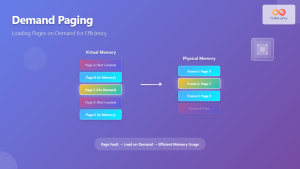
Demand Paging: Loading Pages on Demand for Efficiency
Introduction to Demand Paging Demand paging is a sophisticated memory management technique used by modern operating systems to optimize memory...
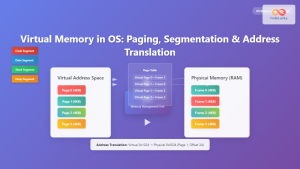
Virtual Memory in OS: Complete Guide to Paging, Segmentation and Address Translation
Virtual memory is one of the most fundamental concepts in modern operating systems, enabling efficient memory management and providing crucial...
Page Replacement Algorithms: FIFO, LRU, Optimal – Complete Guide
Introduction to Page Replacement Algorithms Page replacement algorithms are fundamental components of virtual memory systems in modern operating systems. When...
Windows Memory Management: Virtual Memory Implementation and Optimization Guide
Introduction to Windows Virtual Memory Windows virtual memory is a sophisticated memory management system that allows programs to use more...
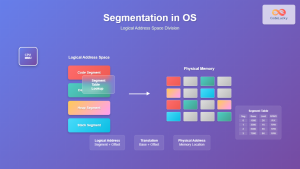
Segmentation in OS: Memory Management Through Logical Address Space Division
Introduction to Segmentation in Operating Systems Segmentation is a fundamental memory management technique in operating systems that divides the logical...
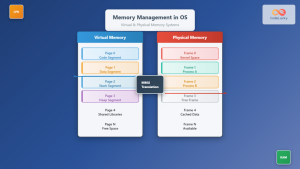
Memory Management in Operating System: Virtual and Physical Memory Fundamentals
Introduction to Memory Management Memory management is one of the most critical functions of an operating system, responsible for efficiently...
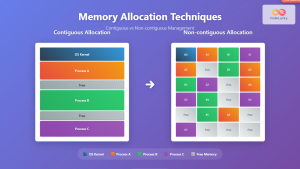
Memory Allocation Techniques: Contiguous vs Non-contiguous Management Strategies
Memory allocation is a fundamental aspect of operating system design that determines how programs and data are stored and accessed...
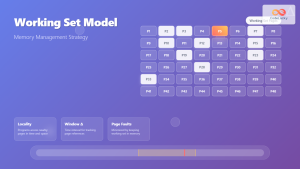
Working Set Model: Memory Management Strategy for Operating Systems
The Working Set Model is a fundamental memory management strategy that revolutionized how operating systems handle virtual memory allocation and...
Memory Fragmentation: Internal vs External Fragmentation in Operating Systems
Memory fragmentation is one of the most critical challenges in operating system memory management, directly impacting system performance and resource...
Virtual Memory in Virtualization: Memory Overcommitment Strategies and Implementation
Introduction to Memory Overcommitment Memory overcommitment is a fundamental virtualization technique that allows hypervisors to allocate more virtual memory to...
Thrashing in Operating System: Complete Guide to Causes, Effects and Prevention Techniques
What is Thrashing in Operating System? Thrashing is a critical performance degradation condition in operating systems where the system spends...
Memory Protection: Hardware and Software Mechanisms for Secure Computing
Understanding Memory Protection in Modern Computing Memory protection is a fundamental security mechanism that prevents programs from accessing memory regions...