The National Pension System (NPS) is a government-backed retirement savings plan designed to help Indian citizens build a long-term retirement corpus while enjoying tax benefits. Whether you are a salaried employee, self-employed, or government servant, NPS offers a disciplined and flexible investment framework to ensure financial stability post-retirement.
What is the National Pension System (NPS)?
NPS is a voluntary, long-term retirement savings scheme launched by the Government of India and regulated by the Pension Fund Regulatory and Development Authority (PFRDA). It aims to provide retirement income through systematic savings during your working life.
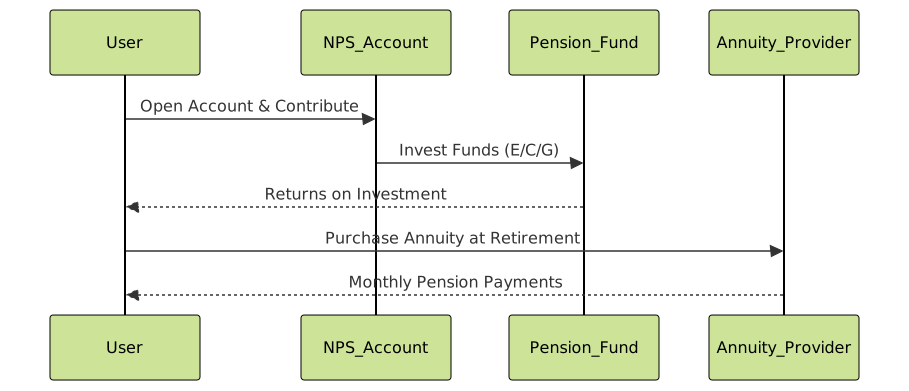
Under NPS, you contribute regularly to your pension account, and these contributions are invested in market-linked instruments such as equities, corporate bonds, and government securities. Upon retirement, you can withdraw a portion of your corpus as a lump sum and use the rest to purchase an annuity, ensuring regular pension payments.
Key Features of NPS
- Eligibility: Any Indian citizen aged between 18 and 70 years can open an NPS account.
- Two Account Types: Tier I (mandatory, for retirement corpus) and Tier II (optional, for flexible savings).
- Tax Benefits: Deductions under Section 80CCD(1), 80CCD(1B), and 80CCD(2) of the Income Tax Act.
- Investment Flexibility: Choice between Active and Auto investment options.
- Low Cost: One of the lowest-cost pension schemes globally.
Understanding NPS Account Structure
Let’s visualize how NPS accounts are structured for individuals.
Tier I Account: This is the main retirement account with restrictions on withdrawal until the age of 60. It offers higher tax benefits and long-term wealth creation.
Tier II Account: Functions like a regular investment account and allows easy withdrawal, but does not provide all the tax benefits of Tier I.
How NPS Works – Step-by-Step Process
- Registration: Visit the eNPS portal or any POP-SP (Point of Presence – Service Provider) to open an account. Choose your Tier option.
- Contribution: Deposit a minimum of ₹500 for Tier I or ₹250 for Tier II accounts. You can contribute anytime online or offline.
- Investment Allocation: Decide your asset allocation — Equity (E), Corporate Bonds (C), and Government Securities (G).
- Fund Growth: Your money grows over time based on chosen fund performance.
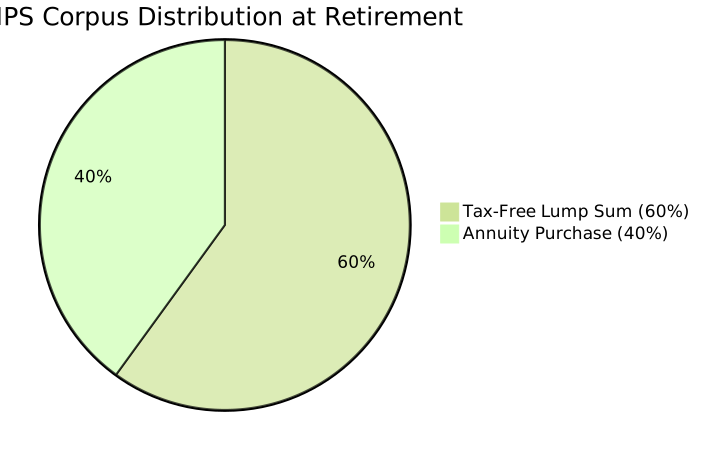
- Retirement & Withdrawal: Upon turning 60, you can withdraw up to 60% of your corpus as a lump sum. The remaining 40% must be used to buy an annuity.
Investment Options: Active vs Auto Choice
NPS allows you to actively manage your investment or delegate it through an automated allocation strategy called Auto Choice.

Active Choice: You can decide how much to invest in Equity (E), Corporate Bonds (C), and Government Securities (G). This is ideal for experienced investors with specific goals.
Auto Choice: The investment mix automatically adjusts with age — focusing more on equity when young and shifting towards safer instruments as you approach retirement.
Tax Benefits of NPS (2025 Rules)
NPS is attractive for its multiple tax-saving provisions:
| Section | Eligible Deduction | Maximum Limit |
|---|---|---|
| 80CCD(1) | Employee’s own contribution | Up to ₹1.5 lakh (within Section 80C limit) |
| 80CCD(1B) | Additional self-contribution | ₹50,000 (exclusive benefit) |
| 80CCD(2) | Employer’s contribution | Up to 10% of salary (without upper limit for deduction) |
Example: If your annual income is ₹10 lakh, contributing ₹1.5 lakh under 80CCD(1) and ₹50,000 under 80CCD(1B) reduces your taxable income to ₹8 lakh — a direct saving of nearly ₹52,000 in taxes (assuming 20% bracket, excluding cess).
Withdrawal Rules & Retirement Benefits
NPS offers flexibility and options at the time of retirement:
- At 60: Withdraw up to 60% of the corpus (tax-free) and convert the remaining 40% into an annuity.
- Before 60: Only up to 20% can be withdrawn; 80% must be used to buy an annuity.
- After Retirement: Pension is taxable as per income slab.
NPS Withdrawal Example
Suppose you retire at age 60 with an NPS corpus of ₹50 lakh:
- You can withdraw ₹30 lakh (60%) tax-free.
- The remaining ₹20 lakh (40%) is used to buy an annuity providing monthly pension.
If the annuity rate is 6.5%, you’ll receive around ₹10,833 per month as a lifetime pension.
Benefits of Investing in NPS
- Long-term wealth creation through compounding returns.
- Flexible fund management with multiple investment choices.
- Portable across jobs and locations.
- Strong tax benefits and government regulatory backing.
- Online management and easy contribution tracking.
Comparison: NPS vs EPF vs PPF
| Parameter | NPS | EPF | PPF |
|---|---|---|---|
| Returns | Market-linked (8%–10%) | Fixed (8.25%) | Fixed (7.1%) |
| Lock-in Period | Until 60 years | Until retirement | 15 years |
| Tax Benefits | ₹2 lakh total + employer contribution benefit | ₹1.5 lakh under 80C | ₹1.5 lakh under 80C |
Interactive Example: Estimate Your NPS Returns
You can try this simple calculation: Imagine you invest ₹5,000 monthly for 30 years with an average annual return of 9%.
Initial Investment: ₹5,000/month
Period: 30 years (360 months)
Expected Return: 9% p.a.

Total investment = ₹5,000 × 360 = ₹18,00,000
Expected Corpus ≈ ₹90,00,000
Over 30 years, your wealth multiplies fivefold due to compounding — highlighting why early and consistent NPS investment matters for a secure retirement.

Final Thoughts
The National Pension System is not just a savings tool — it’s a disciplined path to financial independence in retirement. Combining flexibility, low costs, and robust tax advantages, NPS stands out as one of the most efficient retirement planning instruments for 2025 and beyond.
Whether you’re a salaried professional or self-employed entrepreneur, starting early and staying consistent with NPS can make the difference between uncertainty and confidence in your golden years.