Mutual Funds: SIP (Systematic Investment Plan) Guide is your one-stop resource for understanding how to invest regularly and build wealth smartly. Whether you are just starting or want to optimize your existing investments, this detailed guide from CodeLucky.com explains SIPs step-by-step, complete with examples, visuals, and pro tips.
What is a SIP (Systematic Investment Plan)?
A Systematic Investment Plan (SIP) allows you to invest a fixed amount regularly in mutual funds. Instead of making one large investment, SIP breaks it into affordable monthly or quarterly installments. This habit encourages financial discipline and leverages the power of rupee cost averaging and compound growth.
In simpler terms, through SIP you buy more mutual fund units when prices are low and fewer when prices are high, balancing your buying price over time.

How Does a SIP Work?
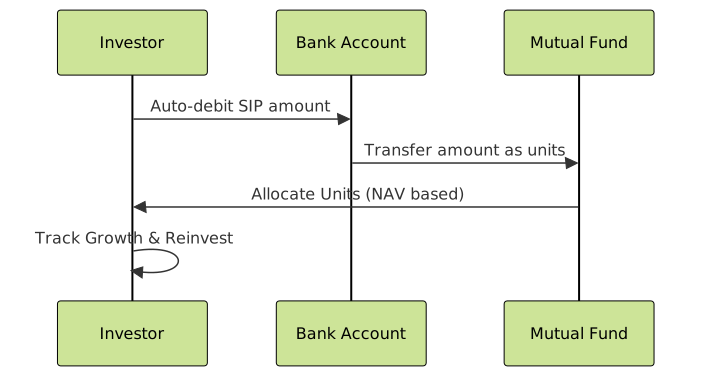
Let’s understand how a SIP works in a typical scenario:
- You choose a mutual fund scheme based on your goals.
- You decide an amount to invest (for example, ₹2,000 per month).
- The specified amount is auto-debited every month and invested in the fund.
- You receive fund units based on the fund’s Net Asset Value (NAV) at that time.
Example with Numbers
Let’s assume you start a SIP of ₹2,000 per month in an equity fund:
| Month | Investment (₹) | NAV (₹) | Units Purchased |
|---|---|---|---|
| Month 1 | 2,000 | 40 | 50.00 |
| Month 2 | 2,000 | 38 | 52.63 |
| Month 3 | 2,000 | 42 | 47.62 |
| Month 4 | 2,000 | 37 | 54.05 |
Total Units Purchased = 204.30 and Total Investment = ₹8,000.
If after four months, the NAV rises to ₹45, your investment value becomes ₹9,193.50. That’s the beauty of rupee cost averaging—it helps you gain even with market fluctuations.

Benefits of SIP
- Disciplined investing: SIP encourages regular, long-term commitment.
- No need to time the market: You invest consistently regardless of market ups and downs.
- Power of compounding: Returns grow exponentially over time as your earnings generate returns too.
- Affordable: You can start with as little as ₹500 per month.
- Flexibility: Modify, pause, or stop your SIP anytime.
Types of SIPs
Understanding different types of SIPs helps you choose what suits you best:
- Regular SIP: Fixed amount invested at fixed intervals.
- Top-up SIP: Allows increasing investment periodically, e.g., every year.
- Flexible SIP: Lets you change the SIP amount based on your financial situation.
- Perpetual SIP: Continues until cancelled, unlike SIPs with defined tenure.
- Trigger SIP: Executes based on specific conditions like fund value or NAV.
The Power of Compounding in SIP
Compounding means your investments generate earnings, and those earnings also earn returns over time. It’s like planting a tree—your small seed (investment) grows steadily when watered regularly (monthly SIP).

For example, investing ₹5,000 monthly in a SIP that gives 12% annual returns for 15 years results in a corpus of over ₹25 lakhs from a total investment of ₹9 lakhs.
How to Start a SIP
- Set a financial goal: Define purpose—retirement, education, or wealth creation.
- Choose a mutual fund: Research fund categories (equity, debt, hybrid) and historical performance.
- Decide SIP amount and tenure: Use an online SIP calculator to plan efficiently.
- KYC process: Complete KYC and PAN verification.
- Start and monitor: Set auto-debit and review performance every 6–12 months.
Interactive SIP Growth Example
Below is a simple way to visualize your SIP growth interactively using basic math logic in an embedded tool or calculator widget:
<script>
// Simple SIP return visualization
function calculateSIP(amount, rate, years) {
  let months = years * 12;
  let r = rate / 12 / 100;
  let futureValue = amount * ((Math.pow(1 + r, months) - 1) / r) * (1 + r);
  return futureValue.toFixed(2);
}
console.log("Future Value:", calculateSIP(5000, 12, 15));
</script>
This simple function can be integrated into an interactive web calculator to display ‘Future Value’ of any SIP based on user input.
Common Mistakes to Avoid
- Stopping SIPs when markets fall (stay invested for long-term).
- Ignoring fund performance for several years without review.
- Setting unclear goals or overlapping SIPs across multiple funds.
- Lack of diversification across asset classes.
Conclusion
SIPs are one of the simplest and smartest ways to achieve financial independence. By investing systematically, staying consistent, and leveraging compounding, you can turn small monthly investments into significant long-term wealth. Whether you are a beginner or experienced investor, start early and stay disciplined — that’s the real secret behind successful mutual fund investing.
Written by the CodeLucky Finance Desk to simplify smart investing for everyone.