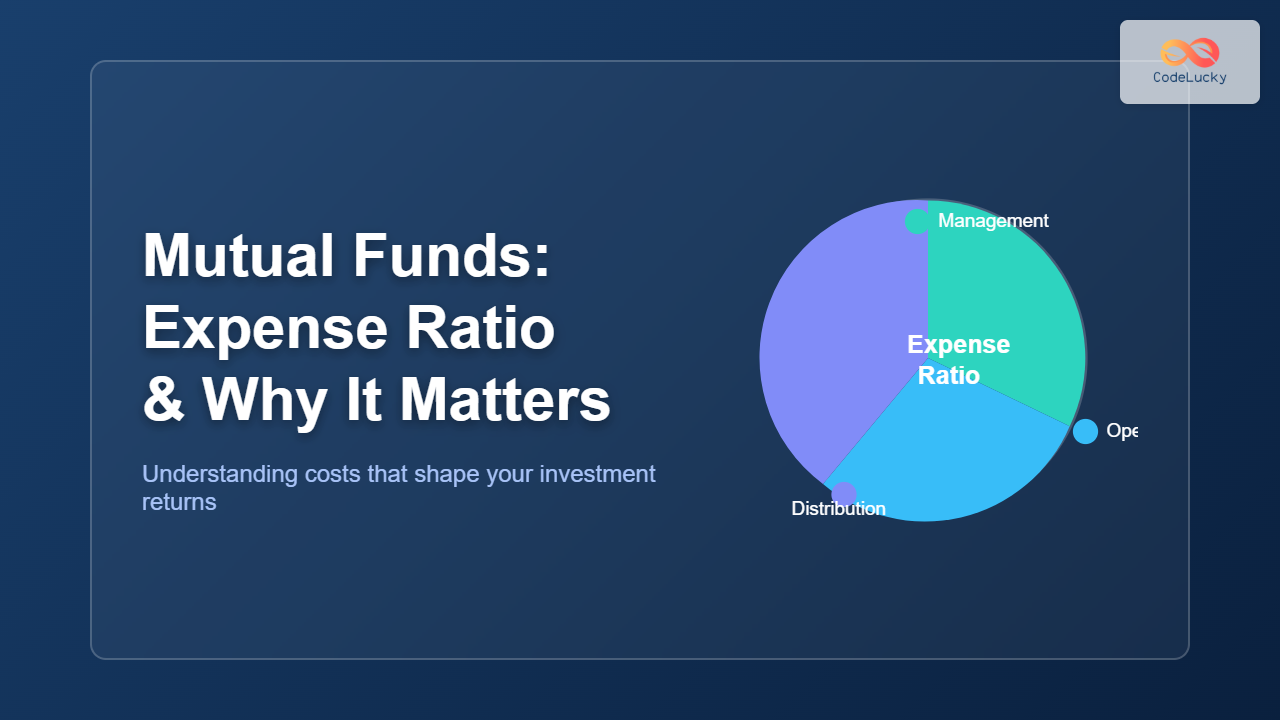
When investing in mutual funds, one crucial yet often overlooked factor is the expense ratio. It directly affects your take-home returns and plays a big role in determining how efficiently your money is managed. Whether you’re a first-time investor or someone re-evaluating your portfolio, understanding the expense ratio can help you make informed financial decisions.
What Is a Mutual Fund Expense Ratio?
The expense ratio is the percentage of a mutual fund’s total assets that goes toward its operating expenses. These costs include fund management fees, administrative expenses, marketing, and distribution costs. In essence, it represents the cost of owning and maintaining your investment in the fund.
For example, if a fund has an expense ratio of 1.5%, that means ₹1.5 out of every ₹100 you’ve invested goes toward managing and operating the fund annually.
Breaking Down the Components

This pie chart helps visualize the key areas where fund expenses are allocated. The major portion usually goes to fund management fees, as professional fund managers make active decisions about which securities to buy or sell.
How Expense Ratio Affects Your Returns
The expense ratio is deducted from the fund’s total returns before it reaches investors. Therefore, the lower the expense ratio, the higher your potential returns—assuming all other factors remain constant. This becomes even more impactful over the long term due to the power of compounding.
Example: Impact Over 10 Years
Let’s compare two equity mutual funds, both offering gross returns of 12% annually before expenses.
| Fund | Expense Ratio | Effective Annual Return | Value After 10 Years (on ₹1,00,000) |
|---|---|---|---|
| Fund X | 1.5% | 10.5% | ₹2,71,668 |
| Fund Y | 0.5% | 11.5% | ₹2,97,618 |
Even a 1% difference in the expense ratio can result in a ₹25,000–₹30,000 difference over 10 years. That’s the silent power of cost-efficiency in long-term investing.

Expense Ratio in Active vs. Passive Funds
Expense ratios vary significantly across fund types. Active mutual funds typically have higher ratios because fund managers actively make decisions to outperform benchmarks. Passive funds like index funds and ETFs, on the other hand, simply track an index, resulting in much lower expenses.
| Fund Type | Average Expense Ratio | Management Style |
|---|---|---|
| Active Equity Fund | 1.5% – 2.5% | Actively managed portfolio |
| Index Fund / ETF | 0.1% – 0.5% | Passively tracks market index |
| Debt Fund | 0.5% – 1.0% | Active or passive, lower complexity |

How to Check the Expense Ratio of a Fund
You can find the expense ratio in the fund’s fact sheet or on the AMC (Asset Management Company) website. Regulatory filings through bodies like SEBI (in India) or the SEC (in the U.S.) also display this detail. Fund tracking sites and investment platforms often highlight it prominently to help investors compare options easily.
Simple Calculation

If a mutual fund incurs ₹10 crore in expenses while managing ₹1000 crore worth of assets, its expense ratio would be 1%.
How to Use Expense Ratio as a Selection Metric
While choosing a mutual fund, expense ratio should not be the only consideration. It’s a critical factor but must be viewed alongside other parameters like past performance, risk exposure, and fund manager’s track record.
- Compare within the same category: Evaluate the expense ratios of funds within the same segment (e.g., large-cap or mid-cap fund) rather than across types.
- Balance cost and performance: A slightly higher expense may be acceptable if the fund consistently outperforms benchmarks.
- Long-term view: In systematic investment plans (SIPs), even small differences in expense ratios compound over time.
For long-term goals such as retirement or wealth accumulation, even a 0.5% difference in expense ratio can lead to significant value erosion over decades of investing.
Regulatory Limits on Expense Ratios in India
The Securities and Exchange Board of India (SEBI) has set upper limits on expense ratios to protect investors. These vary depending on the fund size. As the fund’s assets under management (AUM) increase, the permissible expense ratio decreases to ensure fairness and efficiency.
| AUM Range | Maximum TER Allowed (Equity Funds) |
|---|---|
| Up to ₹500 crore | 2.25% |
| ₹500 crore – ₹750 crore | 2.00% |
| ₹750 crore – ₹2,000 crore | 1.75% |
| ₹2,000 crore – ₹5,000 crore | 1.60% |
| Above ₹5,000 crore | 1.50% |
Key Takeaways
- The expense ratio measures the cost of managing a mutual fund.
- Lower expense ratios generally mean higher net returns for investors.
- Active funds have higher expense ratios than passive funds due to management effort.
- Always compare expense ratios within the same fund category before investing.
- Over time, even small cost differences can erode or enhance wealth due to compounding.
Final Thoughts
The expense ratio might seem like a minor detail, but in the world of mutual funds, it’s one of the most powerful determinants of your effective returns. Choosing funds that balance performance with reasonable costs can accelerate your financial growth. As an investor, treat expense ratios not as just another number—but as an indicator of how efficiently your money is working for you.
By understanding and monitoring expense ratios, you’re not just saving on costs—you’re enhancing the power of your compounding journey.