Mutual funds have become one of the most popular investment options for individuals seeking to grow their wealth without needing deep market knowledge. They offer accessibility, diversification, and professional management. If you are just starting your investment journey, understanding mutual funds is an essential step toward financial independence.
What Are Mutual Funds?
A mutual fund is a pool of money collected from many investors to invest in a diversified portfolio of stocks, bonds, or other securities. Each investor owns units of the fund, representing a proportionate share of its holdings. The fund is managed by professional fund managers who decide where and when to invest the pooled money to generate returns.
Visual Explanation: How Mutual Funds Work

In essence, mutual funds function as intermediaries that help investors participate in financial markets indirectly while spreading risks across multiple securities.
Why Choose Mutual Funds?
Mutual funds are designed for everyone — from beginners to seasoned investors. Here are the major benefits that make them attractive:
- Diversification: Mutual funds invest across various assets, reducing risk through spreading investments.
- Professional Management: Skilled fund managers handle the complex work of analyzing markets and choosing the right assets.
- Liquidity: You can buy or sell mutual fund units anytime (for open-ended funds).
- Affordability: Start investing with as little as ₹500 in India via SIP (Systematic Investment Plan).
- Transparency: Mutual funds are regulated by SEBI (Securities and Exchange Board of India), ensuring investor protection and disclosure.
Types of Mutual Funds
There are several types of mutual funds based on investment objectives, asset class, and risk profile.
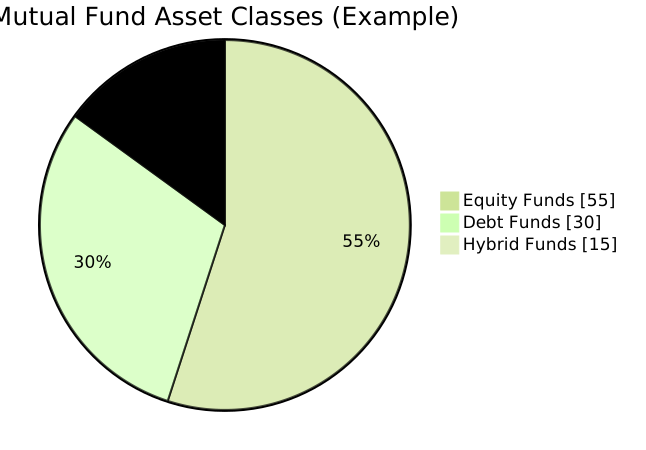
By Asset Class
- Equity Funds: Invest primarily in shares of companies. Higher risk, potentially higher return.
- Debt Funds: Focus on safer instruments like government securities and bonds. Lower risk, stable returns.
- Hybrid Funds: Combine both equity and debt to balance risk and return.
By Structure
- Open-Ended Funds: Investors can buy or sell units at any time.
- Close-Ended Funds: Have a fixed maturity period; units are traded on stock exchanges.
By Investment Objective
- Growth Funds: Aim for long-term capital appreciation.
- Income Funds: Focus on generating regular income through interest or dividends.
- Tax Saving Funds (ELSS): Eligible for tax deductions under Section 80C of the Income Tax Act.
Example: Investing ₹1,000 Monthly via SIP
Suppose you invest ₹1,000 every month into an equity mutual fund with an average annual return of 10%. Let’s see what it could grow into over time:
| Investment Duration | Total Invested (₹) | Estimated Future Value (₹) |
|---|---|---|
| 5 years | 60,000 | 77,000 |
| 10 years | 1,20,000 | 2,00,000 |
| 20 years | 2,40,000 | 7,63,000 |
Note: These values are estimates and actual returns depend on market performance.

Cost Components of Mutual Funds
Mutual funds are managed professionally, but that comes with costs, primarily expressed as the Expense Ratio — a small percentage of the fund’s assets deducted annually to cover management fees and administrative costs.
- Entry Load: Fee charged when you buy fund units (mostly abolished in India).
- Exit Load: Charge if you redeem (withdraw) units before a specific period.
- Expense Ratio: Annual charges (usually 0.5%–2.5%) for fund management.

How to Start Investing in Mutual Funds
Starting with mutual funds is easier than ever. Here’s a simple roadmap for beginners:
- Define your goals: Short-term or long-term, retirement or education — know your purpose.
- Assess your risk profile: Conservative, moderate, or aggressive?
- Choose the right fund type: Based on your goal and risk level.
- Complete KYC: Uplink your PAN, Aadhaar for KYC verification.
- Use trusted platforms: Invest through official AMC websites or registered apps.
- Start SIP or lump sum: SIP for disciplined investing; lump sum for one-time investments.
Risks and Considerations
Though mutual funds are safer than investing directly in stocks, they are not risk-free. Here are key risks to consider:
- Market Risk: Equity fund values fluctuate with market movements.
- Interest Rate Risk: Debt fund values fall when interest rates rise.
- Inflation Risk: Returns may not always outpace inflation.
Always align investments with your financial goals and risk tolerance. Consider consulting a certified financial advisor before large investments.
Interactive Concept: Understanding NAV
The Net Asset Value (NAV) represents the per-unit price of a mutual fund. It is calculated daily using:
NAV = (Total Assets – Liabilities) / Number of Units Outstanding
You can interactively experiment with different values of assets and units to see how NAV changes using this basic embedded calculator:
Final Thoughts
Mutual funds offer an excellent path for individuals to participate in financial markets with diversification, professional management, and convenience. They are suitable for both beginners seeking long-term growth and experienced investors focusing on wealth stability. Start small, choose wisely, and stay consistent — that’s the golden rule of successful mutual fund investing.