Memory fragmentation is one of the most critical challenges in operating system memory management, directly impacting system performance and resource utilization. Understanding the difference between internal and external fragmentation is essential for system administrators, developers, and anyone working with memory-intensive applications.
This comprehensive guide explores both types of memory fragmentation, their causes, consequences, and practical solutions with detailed examples and visual representations.
What is Memory Fragmentation?
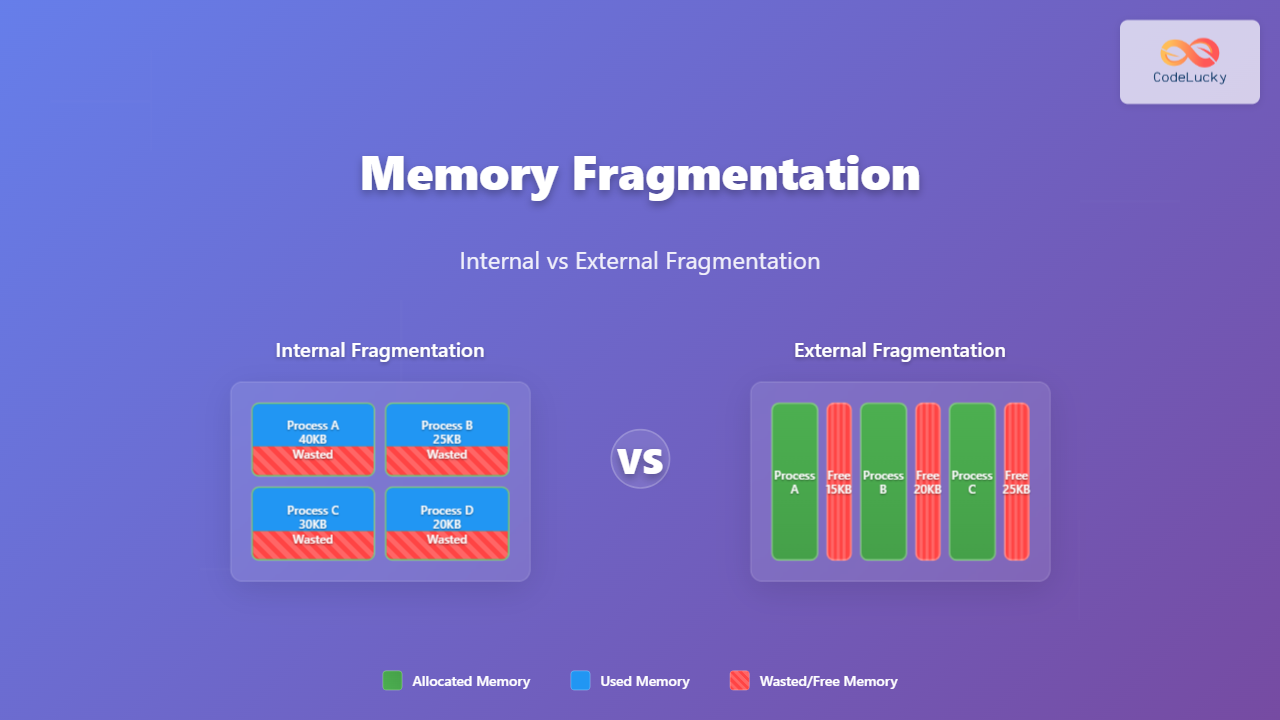
Memory fragmentation occurs when available memory becomes divided into small, non-contiguous blocks, making it difficult or impossible to allocate larger chunks of memory even when sufficient total memory is available. This phenomenon leads to memory waste and degraded system performance.
There are two primary types of memory fragmentation:
- Internal Fragmentation – Wasted space within allocated memory blocks
- External Fragmentation – Wasted space between allocated memory blocks

Internal Fragmentation Explained
Internal fragmentation occurs when allocated memory blocks contain unused space that cannot be utilized by other processes. This happens when the allocated memory size exceeds the actual memory requirement of a process.
Causes of Internal Fragmentation
Internal fragmentation primarily occurs in:
- Fixed Partition Memory Management – When processes are allocated fixed-size partitions regardless of their actual memory needs
- Paging Systems – When the last page of a process doesn’t fully utilize the entire page frame
- Memory Alignment Requirements – When memory must be allocated in specific byte boundaries
Internal Fragmentation Example
Consider a system with fixed partitions of 100KB each:

In this scenario, three processes waste a total of 135KB (40KB + 25KB + 70KB) out of 300KB allocated memory, resulting in 45% memory waste due to internal fragmentation.
Calculating Internal Fragmentation
The formula for internal fragmentation is:
Internal Fragmentation = Allocated Memory – Used Memory
// Example calculation
int allocated_memory = 100; // KB
int used_memory = 60;       // KB
int internal_fragmentation = allocated_memory - used_memory;
printf("Internal Fragmentation: %d KB\n", internal_fragmentation);
// Output: Internal Fragmentation: 40 KB
External Fragmentation Explained
External fragmentation occurs when free memory is divided into small, non-contiguous blocks that cannot satisfy allocation requests for larger memory chunks, even though the total free memory might be sufficient.
Causes of External Fragmentation
External fragmentation typically occurs in:
- Dynamic Memory Allocation – When processes of varying sizes are allocated and deallocated randomly
- Variable Partition Schemes – When memory is divided into partitions of different sizes
- Heap Memory Management – In programming languages with dynamic memory allocation
External Fragmentation Example
Consider a memory system with the following allocation pattern:

In this scenario, there are 60KB of free memory (20KB + 15KB + 25KB), but a new process requiring 50KB cannot be allocated because no single contiguous block is large enough, despite having sufficient total free memory.
Real-World External Fragmentation Scenario
// Memory allocation simulation
struct memory_block {
    int size;
    int is_allocated;
};

// Initial memory state
struct memory_block memory[] = {
    {50, 1},   // Process A
    {20, 0},   // Free
    {80, 1},   // Process B
    {15, 0},   // Free
    {60, 1},   // Process C
    {25, 0}    // Free
};

// Attempting to allocate 50KB
int request_size = 50;
int total_free = 20 + 15 + 25; // 60KB total free
// Cannot allocate despite sufficient total memory!
Comparison: Internal vs External Fragmentation
| Aspect | Internal Fragmentation | External Fragmentation |
|---|---|---|
| Location | Within allocated blocks | Between allocated blocks |
| Primary Cause | Fixed partition sizes | Variable allocation patterns |
| Memory Waste | Unused space in allocated blocks | Unusable free space fragments |
| Common in | Paging systems, fixed partitions | Dynamic allocation, segmentation |
| Solution Complexity | Moderate (better allocation) | High (defragmentation needed) |
Solutions for Internal Fragmentation
1. Variable Partition Allocation
Instead of fixed partitions, allocate memory blocks that exactly match process requirements:
// Dynamic allocation approach
void* allocate_exact_size(int required_size) {
    return malloc(required_size); // Allocates exactly what's needed
}

// Usage
int process_memory_need = 60; // KB
void* allocated_memory = allocate_exact_size(process_memory_need);
// No internal fragmentation!
2. Paging with Optimal Page Sizes
Choose page sizes that minimize waste for typical process sizes:
- Small pages – Reduce internal fragmentation but increase overhead
- Large pages – Reduce overhead but increase internal fragmentation
- Variable page sizes – Balance between overhead and fragmentation
3. Memory Pool Allocation
Pre-allocate memory pools of common sizes:
// Memory pool for common allocation sizes
struct memory_pool {
    void* pool_32KB;
    void* pool_64KB;
    void* pool_128KB;
};

// Allocate from appropriate pool
void* allocate_from_pool(int size) {
    if (size <= 32) return get_from_pool_32KB();
    else if (size <= 64) return get_from_pool_64KB();
    else if (size <= 128) return get_from_pool_128KB();
    else return malloc(size); // Fallback to dynamic allocation
}
Solutions for External Fragmentation
1. Compaction (Defragmentation)
Relocate allocated blocks to create larger contiguous free spaces:
2. Memory Allocation Algorithms
Best Fit Algorithm:
// Best fit allocation - minimizes waste
int best_fit_allocate(int request_size, struct memory_block* memory, int blocks) {
    int best_index = -1;
    int best_size = INT_MAX;

    for (int i = 0; i < blocks; i++) {
        if (!memory[i].is_allocated &&
            memory[i].size >= request_size &&
            memory[i].size < best_size) {
            best_size = memory[i].size;
            best_index = i;
        }
    }

    if (best_index != -1) {
        memory[best_index].is_allocated = 1;
        return best_index;
    }
    return -1; // Allocation failed
}
First Fit Algorithm:
// First fit allocation - fastest allocation
int first_fit_allocate(int request_size, struct memory_block* memory, int blocks) {
    for (int i = 0; i < blocks; i++) {
        if (!memory[i].is_allocated && memory[i].size >= request_size) {
            memory[i].is_allocated = 1;
            return i;
        }
    }
    return -1; // Allocation failed
}
3. Buddy System Algorithm
The buddy system reduces external fragmentation by splitting and merging memory blocks in powers of 2:

// Buddy system implementation concept
struct buddy_block {
    int size;
    int is_free;
    struct buddy_block* buddy;
};

// Split block for smaller allocation
void split_block(struct buddy_block* block, int target_size) {
    if (block->size <= target_size) return;

    // Create buddy blocks of half size
    int half_size = block->size / 2;
    struct buddy_block* buddy1 = create_block(half_size);
    struct buddy_block* buddy2 = create_block(half_size);

    buddy1->buddy = buddy2;
    buddy2->buddy = buddy1;
}
Performance Impact of Memory Fragmentation
Memory fragmentation significantly impacts system performance:
Internal Fragmentation Impact
- Memory Waste – Up to 50% memory waste in worst-case scenarios
- Reduced Multiprogramming – Fewer processes can run simultaneously
- Poor Memory Utilization – System appears to have less available memory
External Fragmentation Impact
- Allocation Failures – Processes fail to get memory despite availability
- Increased Search Time – Longer time to find suitable memory blocks
- System Thrashing – Excessive swapping due to fragmented memory
Performance Measurement Example
// Measuring fragmentation impact
struct fragmentation_metrics {
    int total_memory;
    int allocated_memory;
    int free_memory;
    int largest_free_block;
    double internal_fragmentation_ratio;
    double external_fragmentation_ratio;
};

void calculate_fragmentation(struct fragmentation_metrics* metrics) {
    // Internal fragmentation ratio
    metrics->internal_fragmentation_ratio =
        (double)(metrics->allocated_memory - actual_used_memory) /
        metrics->allocated_memory;

    // External fragmentation ratio
    metrics->external_fragmentation_ratio =
        1.0 - (double)metrics->largest_free_block / metrics->free_memory;

    printf("Internal Fragmentation: %.2f%%\n",
           metrics->internal_fragmentation_ratio * 100);
    printf("External Fragmentation: %.2f%%\n",
           metrics->external_fragmentation_ratio * 100);
}
Modern Operating System Approaches
Contemporary operating systems employ sophisticated techniques to minimize fragmentation:
Linux Memory Management
- Slab Allocator – Reduces internal fragmentation for kernel objects
- Buddy System – Manages page-level external fragmentation
- Virtual Memory – Allows non-contiguous physical memory allocation
Windows Memory Management
- Heap Manager – Multiple heaps to reduce fragmentation
- Large Page Support – Minimizes page table overhead
- Memory Compression – Increases effective memory availability
Best Practices for Minimizing Fragmentation
For System Administrators
- Monitor Memory Usage – Regular fragmentation analysis
- Optimize Page Sizes – Balance between overhead and waste
- Schedule Defragmentation – During low-usage periods
- Configure Memory Pools – For applications with predictable allocation patterns
For Developers
- Use Memory Pools – For frequent same-size allocations
- Implement Object Recycling – Reuse allocated objects
- Align Memory Access – Follow platform-specific alignment requirements
- Profile Memory Usage – Identify fragmentation hotspots
// Developer best practice example
class MemoryManager {
private:
    std::vector memory_pools[10]; // Different size pools

public:
    void* allocate(size_t size) {
        int pool_index = get_pool_index(size);
        if (!memory_pools[pool_index].empty()) {
            // Reuse from pool - prevents fragmentation
            void* ptr = memory_pools[pool_index].back();
            memory_pools[pool_index].pop_back();
            return ptr;
        }
        return malloc(size); // Fallback to system allocation
    }

    void deallocate(void* ptr, size_t size) {
        int pool_index = get_pool_index(size);
        memory_pools[pool_index].push_back(ptr); // Return to pool
    }
};
Conclusion
Understanding memory fragmentation is crucial for optimal system performance and resource utilization. Internal fragmentation wastes space within allocated blocks and is best addressed through dynamic allocation and appropriate partition sizing. External fragmentation creates unusable gaps between allocations and requires more sophisticated solutions like compaction and advanced allocation algorithms.
Modern operating systems implement multiple strategies to combat both types of fragmentation, including buddy systems, memory pools, and virtual memory management. By applying the principles and techniques outlined in this guide, system administrators and developers can significantly improve memory utilization and overall system performance.
The key to successful memory management lies in understanding your system’s allocation patterns and choosing appropriate strategies based on the specific requirements and constraints of your environment.
Related Posts
Virtual Memory in OS: Complete Guide to Paging, Segmentation and Address Translation
Virtual memory is one of the most fundamental concepts in modern operating systems, enabling efficient memory management and providing crucial...
Memory Allocation Techniques: Contiguous vs Non-contiguous Management Strategies
Memory allocation is a fundamental aspect of operating system design that determines how programs and data are stored and accessed...
Garbage Collection in Operating System: Complete Guide to Automatic Memory Management
What is Garbage Collection in Operating Systems? Garbage collection is an automatic memory management technique used by operating systems and...
Memory Management in Operating System: Virtual and Physical Memory Fundamentals
Introduction to Memory Management Memory management is one of the most critical functions of an operating system, responsible for efficiently...
Segmentation in OS: Memory Management Through Logical Address Space Division
Introduction to Segmentation in Operating Systems Segmentation is a fundamental memory management technique in operating systems that divides the logical...
Windows Memory Management: Virtual Memory Implementation and Optimization Guide
Introduction to Windows Virtual Memory Windows virtual memory is a sophisticated memory management system that allows programs to use more...
Paging in Operating System: Complete Guide to Memory Management and Page Tables
What is Paging in Operating Systems? Paging is a memory management scheme that allows the operating system to store and...

C Memory Management: Advanced Techniques and Best Practices
Memory management is a critical aspect of C programming that can make or break your application's performance and reliability. In...

Process in Operating System: Complete Guide to Definition, States and Lifecycle
What is a Process in Operating System? A process is a program in execution that consists of the program code...
Page Replacement Algorithms: FIFO, LRU, Optimal – Complete Guide
Introduction to Page Replacement Algorithms Page replacement algorithms are fundamental components of virtual memory systems in modern operating systems. When...
Core Dump Linux: Complete Guide to Debug Program Crashes and Memory Issues
A core dump is a crucial debugging tool in Linux that captures the complete memory state of a program at...
Demand Paging: Loading Pages on Demand for Efficiency
Introduction to Demand Paging Demand paging is a sophisticated memory management technique used by modern operating systems to optimize memory...