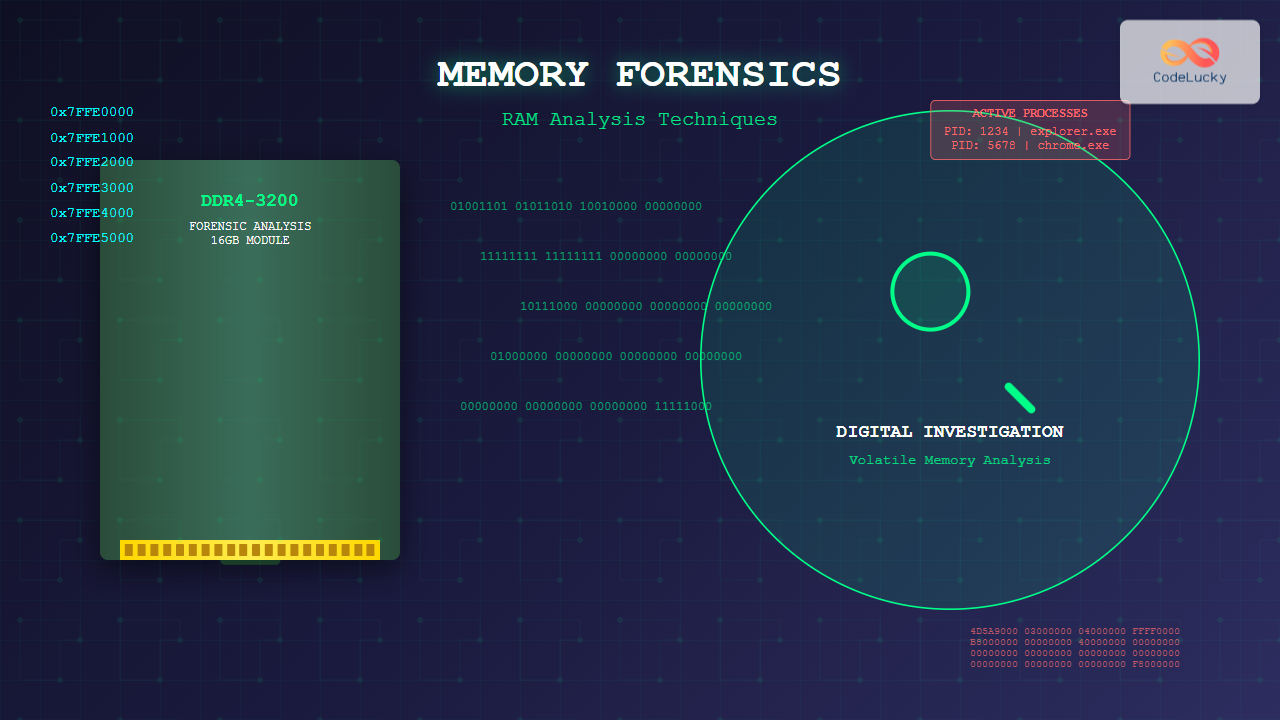
Memory forensics has become a cornerstone of modern digital investigations, offering investigators the ability to extract critical evidence from volatile memory that traditional disk-based forensics might miss. This comprehensive guide explores the essential techniques, tools, and methodologies for conducting thorough RAM analysis in various scenarios.
Understanding Memory Forensics Fundamentals
Memory forensics involves the acquisition and analysis of volatile data stored in a computer’s Random Access Memory (RAM). Unlike traditional hard drive forensics, memory analysis captures the live state of a system, including running processes, network connections, loaded modules, and potentially sensitive data that exists only in memory.

Key Components of Memory Architecture
Virtual Memory Management: Modern operating systems use virtual memory to provide each process with its own address space, mapped to physical RAM through page tables. Understanding this mapping is crucial for effective memory analysis.
Memory Segments: Each process contains distinct memory regions including code segments (executable instructions), data segments (initialized variables), heap (dynamic allocation), and stack (function calls and local variables).
Memory Acquisition Techniques
Successful memory forensics begins with proper memory acquisition. Several methods exist for capturing RAM contents, each with specific advantages and limitations.
Hardware-Based Acquisition
Cold Boot Attacks: This technique exploits the data remanence property of DRAM, where memory contents persist for seconds to minutes after power loss, especially at low temperatures.
# Example cold boot acquisition process
# 1. Cool the RAM modules (optional but increases data retention)
# 2. Quickly reboot to acquisition environment
# 3. Dump memory before data degradation

dd if=/dev/mem of=/mnt/usb/memory_dump.raw bs=1M
DMA-Based Acquisition: Direct Memory Access tools can read memory directly without involving the CPU, making them harder to detect and less likely to alter memory contents.
Software-Based Acquisition
Live System Acquisition: Tools like WinPmem, LiME (Linux Memory Extractor), and OSXPmem can capture memory from running systems.
# Linux Memory Extractor (LiME) example
insmod lime.ko "path=/tmp/memory.dump format=raw"

# Windows using WinPmem
winpmem.exe -o memory.raw

# macOS using OSXPmem
osxpmem -o memory.raw
Essential Memory Analysis Tools
Volatility Framework
Volatility remains the gold standard for memory analysis, supporting multiple operating systems and offering extensive plugin capabilities.
# Basic Volatility commands
# Identify the operating system profile
python vol.py -f memory.raw imageinfo

# List running processes
python vol.py -f memory.raw --profile=Win7SP1x64 pslist

# Extract process memory
python vol.py -f memory.raw --profile=Win7SP1x64 procdump -p 1234 -D output/

# Network connections
python vol.py -f memory.raw --profile=Win7SP1x64 netscan
Rekall Framework
Rekall offers advanced memory analysis capabilities with a focus on performance and extensibility.
# Rekall analysis examples
rekall -f memory.raw pslist
rekall -f memory.raw netstat
rekall -f memory.raw handles --pid 1234

Process Analysis Techniques
Process analysis forms the backbone of memory forensics, revealing running applications, their relationships, and potential malicious activity.
Process Enumeration
Multiple techniques exist for identifying processes in memory, each with different levels of reliability against anti-forensic techniques.
# Different process enumeration methods in Volatility
python vol.py -f memory.raw --profile=Win7SP1x64 pslist    # EPROCESS list
python vol.py -f memory.raw --profile=Win7SP1x64 psscan    # Pool scanning
python vol.py -f memory.raw --profile=Win7SP1x64 psxview   # Cross-reference view
Process Tree Analysis
Understanding parent-child relationships between processes helps identify process injection attacks and unusual spawning patterns.
# Process tree visualization
python vol.py -f memory.raw --profile=Win7SP1x64 pstree

# Example output interpretation:
# cmd.exe (PID: 1234)
#  └── powershell.exe (PID: 5678) [Suspicious: cmd spawning PowerShell]
#      └── rundll32.exe (PID: 9012) [Potential malware execution]
Process Memory Dumping
Extracting individual process memory allows for detailed analysis of specific applications and potential malware.
# Dump specific process memory
python vol.py -f memory.raw --profile=Win7SP1x64 memdump -p 1234 -D output/

# Dump executable images
python vol.py -f memory.raw --profile=Win7SP1x64 procdump -p 1234 -D output/
Network Artifact Analysis
Memory forensics excels at revealing network activities that might not be captured by traditional network monitoring tools.

Network Connection Analysis
# Network connection analysis
python vol.py -f memory.raw --profile=Win7SP1x64 netscan
python vol.py -f memory.raw --profile=Win7SP1x64 netstat  # For older Windows versions

# Example output analysis:
# TCP 192.168.1.100:1234 -> 10.0.0.1:80 ESTABLISHED (PID: 5678)
# Potential indicators:
# - Connections to suspicious IPs
# - Unusual port usage
# - High-numbered source ports indicating outbound connections
DNS Cache Extraction
DNS cache analysis reveals domain resolution history, potentially exposing malicious domains or data exfiltration attempts.
# Extract DNS cache
python vol.py -f memory.raw --profile=Win7SP1x64 dns

# Analyze suspicious domains
# Look for:
# - Recently registered domains
# - Domains with unusual TLDs
# - Domain generation algorithm patterns
Malware Detection and Analysis
Memory forensics provides powerful capabilities for detecting and analyzing malware that employs anti-forensic techniques to evade disk-based detection.
Rootkit Detection
Rootkits often hide processes and network connections from standard system utilities, but memory analysis can reveal these hidden artifacts.
# SSDT (System Service Descriptor Table) analysis
python vol.py -f memory.raw --profile=Win7SP1x64 ssdt

# IDT (Interrupt Descriptor Table) analysis
python vol.py -f memory.raw --profile=Win7SP1x64 idt

# Driver analysis for rootkit detection
python vol.py -f memory.raw --profile=Win7SP1x64 driverscan
python vol.py -f memory.raw --profile=Win7SP1x64 devicetree
Code Injection Detection
Various code injection techniques can be detected through memory analysis by examining process memory layouts and identifying anomalies.
# Detect process hollowing and DLL injection
python vol.py -f memory.raw --profile=Win7SP1x64 hollowfind
python vol.py -f memory.raw --profile=Win7SP1x64 ldrmodules

# VAD (Virtual Address Descriptor) analysis
python vol.py -f memory.raw --profile=Win7SP1x64 vadinfo -p 1234
python vol.py -f memory.raw --profile=Win7SP1x64 vadwalk -p 1234
Malware Configuration Extraction
Memory dumps often contain malware configuration data, command and control servers, and encryption keys.
# Extract strings from process memory
python vol.py -f memory.raw --profile=Win7SP1x64 strings -p 1234

# Look for configuration patterns:
# - IP addresses and domains
# - Encryption keys
# - Registry keys
# - File paths
# - Command and control protocols
File System Artifacts in Memory
Memory analysis can recover file system artifacts that provide insights into recent file activities and potentially deleted files.

Master File Table (MFT) Analysis
# Extract MFT entries from memory
python vol.py -f memory.raw --profile=Win7SP1x64 mftparser

# File handle analysis
python vol.py -f memory.raw --profile=Win7SP1x64 handles -t File

# Recently accessed files
python vol.py -f memory.raw --profile=Win7SP1x64 filescan
Registry Artifacts
Windows registry hives loaded in memory can provide valuable forensic artifacts even when the system registry has been modified.
# Extract registry hives from memory
python vol.py -f memory.raw --profile=Win7SP1x64 hivelist
python vol.py -f memory.raw --profile=Win7SP1x64 hivedump -o 0x... -D output/

# Analyze specific registry keys
python vol.py -f memory.raw --profile=Win7SP1x64 printkey -K "Software\Microsoft\Windows\CurrentVersion\Run"
Timeline Analysis and Correlation
Creating timelines from memory artifacts helps investigators understand the sequence of events and correlate different types of evidence.
# Create comprehensive timeline
python vol.py -f memory.raw --profile=Win7SP1x64 timeliner --output=body --output-file=timeline.body

# Process timeline with mactime
mactime -d -b timeline.body -z UTC > timeline.csv

# Key timeline events to analyze:
# - Process creation times
# - Network connection establishments
# - File access times
# - Module load times
# - Registry modification times
Advanced Analysis Techniques
Yara Rule Integration
Yara rules can be applied to memory dumps for automated malware detection and classification.
# Apply Yara rules to memory dump
python vol.py -f memory.raw --profile=Win7SP1x64 yarascan -Y malware_rules.yar

# Process-specific Yara scanning
python vol.py -f memory.raw --profile=Win7SP1x64 yarascan -Y rules.yar -p 1234

# Example Yara rule for memory analysis:
rule MemoryMalware {
    strings:
        $a = "cmd.exe /c" wide ascii
        $b = "powershell.exe -enc" wide ascii
        $c = { 4d 5a 90 00 03 00 00 00 } // PE header
    condition:
        2 of them
}
Volatility Plugin Development
Custom Volatility plugins can be developed for specialized analysis requirements.
# Basic Volatility plugin structure
import volatility.obj as obj
import volatility.plugins.common as common
import volatility.utils as utils

class CustomPlugin(common.AbstractWindowsCommand):
    """Custom memory analysis plugin"""

    def calculate(self):
        addr_space = utils.load_as(self._config)
        # Plugin logic here
        for process in self.filter_tasks(tasks.pslist(addr_space)):
            yield process

    def render_text(self, outfd, data):
        for process in data:
            outfd.write("Process: {0} PID: {1}\n".format(
                process.ImageFileName, process.UniqueProcessId))
Memory Analysis Best Practices
Acquisition Best Practices
- Minimize system interaction during acquisition to prevent memory contamination
- Document acquisition methods and tools used for legal admissibility
- Verify memory dump integrity using cryptographic hashes
- Acquire multiple copies when possible for redundancy
Analysis Methodology
- Start with process analysis to identify running applications and potential threats
- Correlate multiple artifact types to build comprehensive evidence
- Document findings thoroughly with screenshots and command outputs
- Maintain chain of custody throughout the analysis process

Challenges and Limitations
Technical Challenges
Memory Volatility: RAM contents change constantly, making timing critical for acquisition and analysis.
Anti-Forensic Techniques: Sophisticated malware may employ memory encryption, packing, or other techniques to evade analysis.
Scale and Complexity: Modern systems with large amounts of RAM can produce multi-gigabyte memory dumps requiring significant processing time and storage.
Legal and Ethical Considerations
Privacy Concerns: Memory dumps may contain sensitive personal information, passwords, and encryption keys.
Legal Admissibility: Proper acquisition procedures and chain of custody documentation are essential for legal proceedings.
Future Trends in Memory Forensics
Memory forensics continues to evolve with advancing technology and emerging threats. Cloud-based systems, containerized applications, and hardware security features present new challenges and opportunities for memory analysis.
Machine Learning Integration: AI-powered analysis tools are beginning to automate malware detection and behavioral analysis in memory dumps.
Hardware Security Features: Modern processors include security features like Intel CET and ARM Pointer Authentication that affect memory analysis techniques.
Cloud and Virtual Environments: Specialized tools and techniques are being developed for analyzing memory in cloud and virtualized environments.
Conclusion
Memory forensics represents a critical capability in modern digital investigations, offering unique insights into system behavior and potential security incidents. Success in memory analysis requires a combination of technical expertise, proper tooling, and methodical approaches to evidence gathering and analysis.
As systems become more complex and threats more sophisticated, memory forensics techniques must continue to evolve. Investigators who master these techniques will be better equipped to uncover digital evidence and respond effectively to security incidents in increasingly challenging environments.
The field continues to advance with new tools, techniques, and research addressing emerging challenges in memory analysis. Staying current with these developments and maintaining hands-on practice with memory forensics tools remains essential for practitioners in digital forensics and incident response.