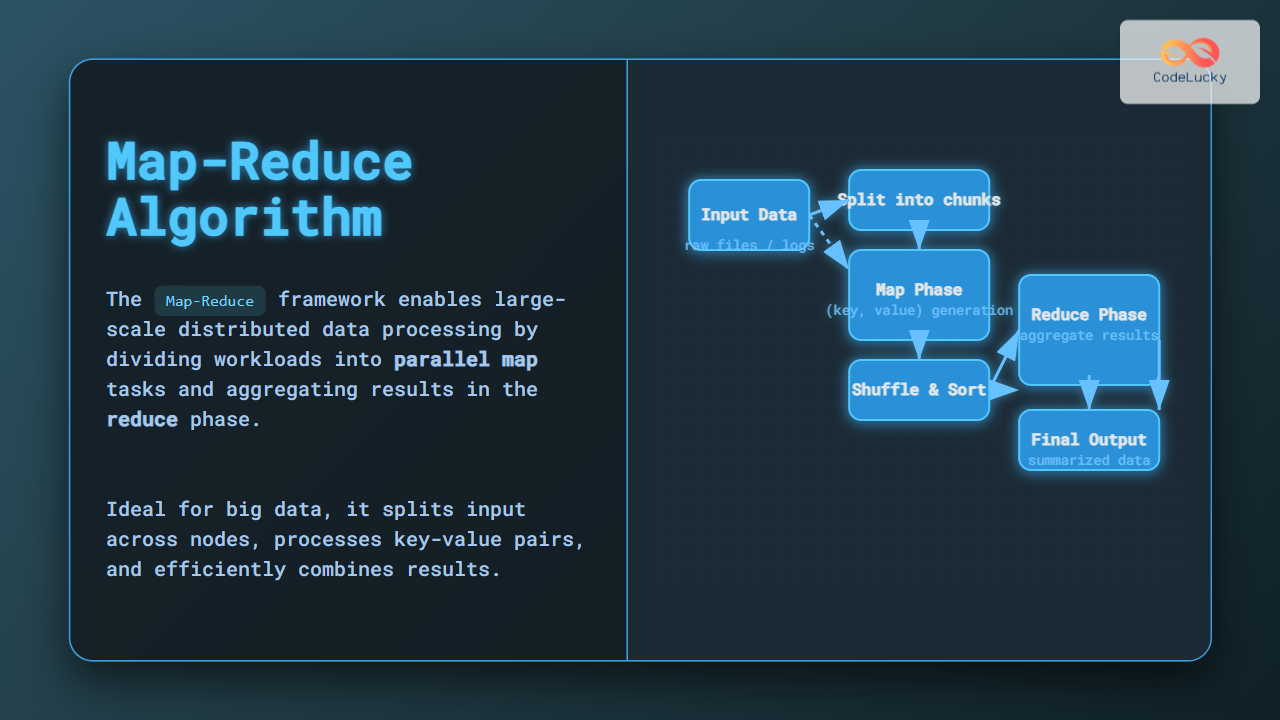
The Map-Reduce algorithm revolutionized big data processing by providing an elegant, scalable, and fault-tolerant approach to distributed computing. Originally popularized by Google, Map-Reduce underpins many modern data processing frameworks like Apache Hadoop and Apache Spark. This article offers an in-depth look into the Map-Reduce algorithm, its architecture, working principles, and practical examples with clear visual aids to foster deep understanding.
What is Map-Reduce?
Map-Reduce is a programming model and associated implementation for processing and generating large data sets with a parallel, distributed algorithm on a cluster. It simplifies processing by decomposing the task into two primary functions: Map and Reduce. The Map function filters and sorts data, while the Reduce function aggregates the results.
Core Concepts of Map-Reduce
The fundamental flow of the Map-Reduce algorithm involves three stages:
- Map phase: Data is divided into smaller chunks and processed in parallel through the Map function that emits intermediate key-value pairs.
- Shuffle and Sort phase: Intermediate pairs are grouped by keys and distributed to reducers.
- Reduce phase: The Reduce function merges all values associated with the same key to produce a summarized output.

Map-Reduce Architecture
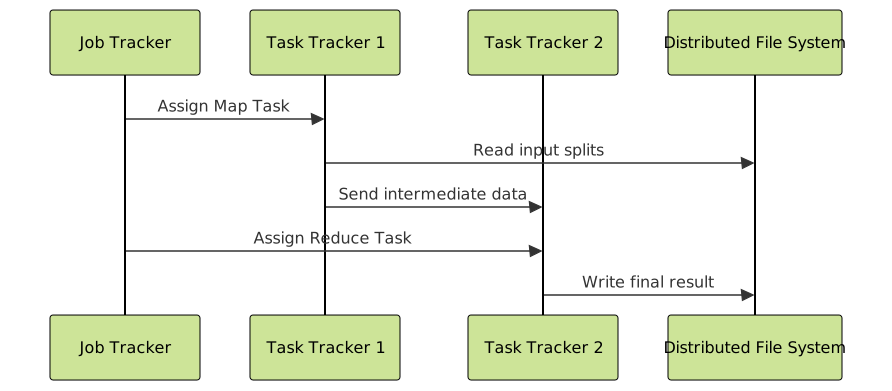
The architecture typically comprises three components:
- Job Tracker: Coordinates the job, assigns map and reduce tasks across nodes.
- Task Tracker (Workers): Executes individual Map and Reduce tasks.
- Distributed File System (DFS): For storing input data and intermediate/final outputs, e.g., HDFS.
This design ensures high fault tolerance and scalability, handling enormous data volumes by distributing the workload across many nodes.
Detailed Walkthrough of Map-Reduce Process
Suppose we want to count the frequency of words in a large collection of documents. The Map-Reduce algorithm processes as follows:
Map Function
Processes each document line or chunk, emitting (word, 1) for every word encountered.
function map(String document):
  for each word in document:
    emit(word, 1)
Shuffle and Sort Phase
Groups all the (word, 1) pairs across data splits into (word, list_of_ones) by key (word).
Reduce Function
Aggregates the counts for each word:
function reduce(String word, Iterable counts):
  sum = 0
  for count in counts:
    sum += count
  emit(word, sum)

Illustrative Example Output
Input paragraphs:
"apple banana apple"
"banana orange apple"
Map outputs (key-value pairs):
- (apple, 1), (banana, 1), (apple, 1)
- (banana, 1), (orange, 1), (apple, 1)
After shuffle and sort:
- (apple, [1, 1, 1])
- (banana, [1, 1])
- (orange, [1])
Reduced output:
- (apple, 3)
- (banana, 2)
- (orange, 1)
Advantages of Map-Reduce
- Scalability: Easily processes petabytes of data across thousands of machines.
- Fault Tolerance: Automatic recovery from failures with task re-execution.
- Simplicity: Allows developers to focus on logic without managing parallelization intricacies.
- Cost Efficiency: Utilizes commodity hardware effectively.
Common Real-World Use Cases
- Log analysis and aggregation
- Indexing large document collections for search engines
- Data transformation and cleaning in ETL pipelines
- Recommendation systems and machine learning preprocessing
Interactive Visualization: Word Count Example
The following interactive example simulates the basic Map-Reduce word count process:
Summary
The Map-Reduce algorithm is a foundational paradigm enabling efficient processing of vast datasets by dividing computational work across distributed nodes. Its simplicity, scalability, and fault tolerance have made it a cornerstone of big data frameworks. Understanding the Map and Reduce phases along with data flow provides a practical grasp for designing distributed applications.
In contemporary computing, Map-Reduce remains a vital concept with adaptations and enhancements continuing in modern data processing ecosystems.