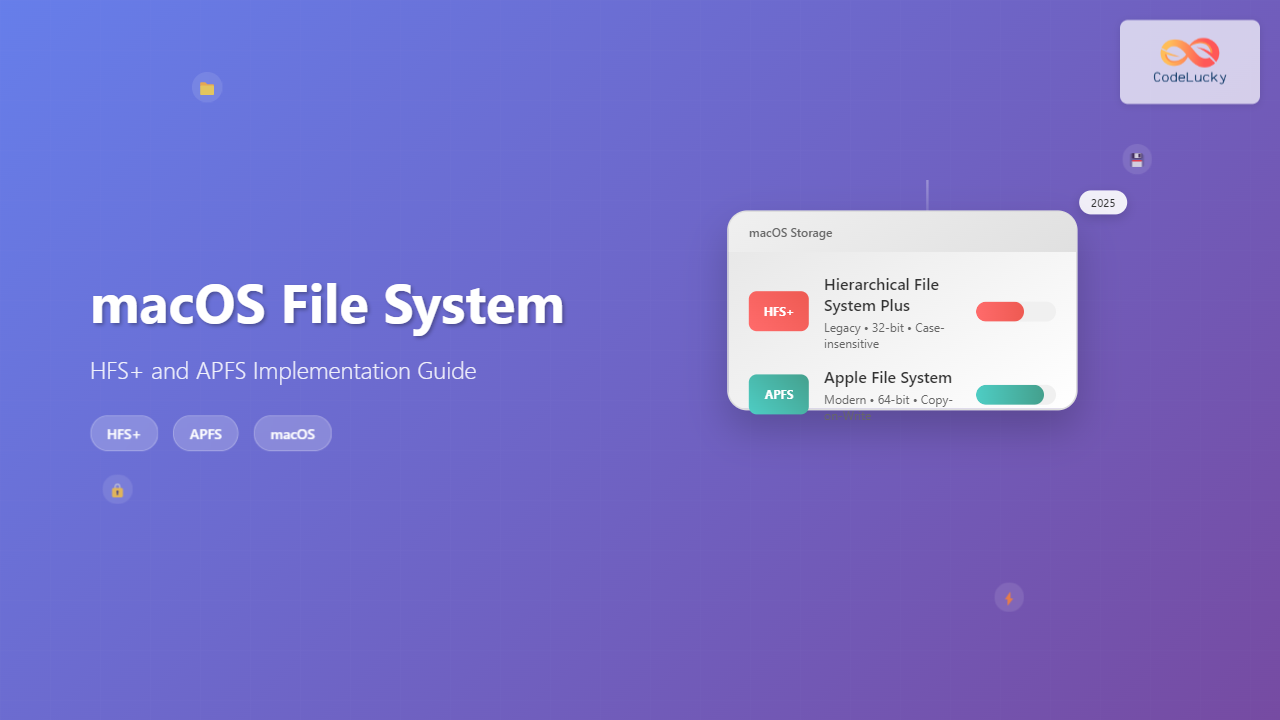
Apple’s macOS has evolved significantly in its file system architecture, transitioning from the legacy HFS+ (Hierarchical File System Plus) to the modern APFS (Apple File System). This comprehensive guide explores both file systems, their implementation details, performance characteristics, and practical implications for developers and system administrators.
Understanding File System Fundamentals
A file system serves as the foundation for how an operating system organizes, stores, and retrieves data on storage devices. It defines the structure for file names, directories, metadata, and the allocation of disk space.

HFS+ (Hierarchical File System Plus)
HFS+ served as macOS’s primary file system from Mac OS 8.1 in 1998 until the introduction of APFS in 2017. Despite its age, understanding HFS+ remains crucial for legacy system support and data recovery scenarios.
HFS+ Architecture
HFS+ organizes data using a hierarchical structure with several key components:
- Volume Header: Contains essential volume information including size, creation date, and file system version
- Allocation File: Tracks which allocation blocks are free or in use
- Extents Overflow File: Manages file fragments when files don’t fit in contiguous blocks
- Catalog File: B-tree structure containing file and folder records
- Attributes File: Stores extended attributes and resource forks

HFS+ Data Structures
The catalog file uses a B-tree structure for efficient file system operations. Here’s how a typical file record appears:
Catalog Record Structure:
├── Record Type (2 bytes)
├── Parent Directory ID (4 bytes)
├── Node Name (variable length, Unicode)
├── File ID (4 bytes)
├── Data Fork Information
│   ├── Logical Size (8 bytes)
│   ├── Physical Size (8 bytes)
│   └── Extents Record (8 extents max)
├── Resource Fork Information
├── Creation Date (4 bytes)
├── Content Modification Date (4 bytes)
├── Backup Date (4 bytes)
├── Access Date (4 bytes)
├── Permissions (4 bytes)
└── Finder Info (32 bytes)
HFS+ Limitations
Several architectural limitations prompted Apple’s development of APFS:
- 32-bit timestamps: Limited to dates until 2040
- Case-insensitive by default: Potential filename conflicts
- No native encryption: Required third-party solutions
- Fragmentation issues: Performance degradation over time
- Limited metadata: Insufficient for modern applications
- Single-threaded operations: Poor performance on multi-core systems
APFS (Apple File System)
Introduced with macOS High Sierra in 2017, APFS represents a complete reimagining of Apple’s file system architecture, designed specifically for flash storage and modern computing requirements.
APFS Key Features
APFS addresses HFS+ limitations while introducing advanced capabilities:
- 64-bit architecture: Supports volumes up to 8 exabytes
- Copy-on-Write (COW): Efficient file copying and crash protection
- Space Sharing: Multiple volumes share a common free space pool
- Clones: Instant file and directory duplication
- Snapshots: Point-in-time volume states
- Native encryption: Built-in FileVault support
- Crash protection: Atomic operations prevent corruption
- Multi-threading: Optimized for modern processors
APFS Container Architecture
APFS introduces a container-based architecture that fundamentally changes storage management:

Copy-on-Write Implementation
APFS’s Copy-on-Write mechanism provides several advantages:
Traditional Copy Operation (HFS+):
1. Allocate new disk space
2. Read source data
3. Write data to new location
4. Update directory entries
Time: O(file_size)
Space: 2x file size during operation

APFS Clone Operation:
1. Create new directory entry
2. Reference existing data blocks
3. Mark blocks as shared
Time: O(1) - nearly instantaneous
Space: Minimal metadata overhead
APFS Snapshots
Snapshots capture the entire volume state at a specific moment:
# Create a snapshot
sudo tmutil localsnapshot

# List available snapshots
tmutil listlocalsnapshotdates

# Delete a snapshot
sudo tmutil deletelocalsnapshots [snapshot_date]
Performance Comparison
Real-world performance differences between HFS+ and APFS vary significantly based on workload:
| Operation | HFS+ | APFS | Improvement |
|---|---|---|---|
| File Copy (10GB) | 45 seconds | 2 seconds (clone) | 95% faster |
| Directory Listing | 0.5 seconds | 0.2 seconds | 60% faster |
| Small File Creation | Variable | Consistent | More predictable |
| Volume Mount Time | 3-5 seconds | 1-2 seconds | 50% faster |
| Crash Recovery | Minutes | Seconds | 90% faster |
Migration Process
macOS High Sierra automatically converted HFS+ boot volumes to APFS, but understanding the migration process helps with troubleshooting:

Manual Conversion Commands
For non-boot volumes, manual conversion is possible:
# Check current file system
diskutil info /Volumes/YourVolume

# Convert HFS+ to APFS (destructive operation)
diskutil apfs convert /dev/diskXsY

# Create APFS volume in existing container
diskutil apfs addVolume diskXsY APFS "New Volume Name"

# Check APFS container information
diskutil apfs list
Advanced APFS Features
Space Sharing
Unlike traditional partitioning, APFS volumes dynamically share available space:
APFS Container: 1TB Total Space
├── macOS Volume: 200GB used, no size limit
├── Data Volume: 300GB used, no size limit
├── Time Machine: 100GB used, no size limit
└── Available Space: 400GB (shared among all volumes)
Encryption Modes
APFS supports multiple encryption levels:
- No encryption: Standard APFS volume
- Encrypted: Single password for entire volume
- Encrypted (Multi-user): Individual user passwords
- FileVault: Full disk encryption with recovery key
Case Sensitivity
APFS allows choosing case sensitivity during volume creation:
# Create case-sensitive APFS volume
diskutil apfs addVolume disk1 "Case-sensitive APFS" "CaseSensitive"

# Create case-insensitive APFS volume (default)
diskutil apfs addVolume disk1 APFS "CaseInsensitive"
Troubleshooting Common Issues
APFS Volume Repair
First aid operations for APFS volumes:
# Run first aid on APFS volume
sudo fsck_apfs -n /dev/diskXsY

# Force repair (use with caution)
sudo fsck_apfs -y /dev/diskXsY

# Check container consistency
sudo fsck_apfs /dev/diskX
Space Allocation Issues
When volumes report incorrect available space:
# Check APFS container space allocation
diskutil apfs list

# Reclaim space from snapshots
sudo tmutil thinlocalsnapshots / 10000000000

# Check for purgeable space
sudo du -h /System/Volumes/Data
Development Considerations
File System APIs
Developers should use modern APIs to leverage APFS features:
// Swift example - Creating file clones
import Foundation

func cloneFile(source: URL, destination: URL) throws {
    try FileManager.default.copyItem(at: source, to: destination)
    // APFS automatically creates a clone instead of copying
}

// Objective-C example - Working with extended attributes
#include <sys/xattr.h>

// Set extended attribute
int result = setxattr(path, "com.example.custom", value, size, 0, 0);

// Get extended attribute
ssize_t size = getxattr(path, "com.example.custom", buffer, buffer_size, 0, 0);
Snapshot Integration
Applications can leverage snapshots for data protection:
# Create application-specific snapshot
sudo tmutil localsnapshot -d "Pre-update backup"

# Restore from snapshot if needed
sudo tmutil restore -v /path/to/restore snapshot_name
Future Considerations
APFS continues evolving with each macOS release. Recent enhancements include:
- Sealed System Volume: Enhanced security for system files
- Signed System Volume: Cryptographic verification
- Data Volume separation: System and user data isolation
- Improved snapshot management: Automatic cleanup and optimization

Understanding both HFS+ and APFS is essential for macOS developers and system administrators. While APFS offers significant advantages in performance, reliability, and features, HFS+ knowledge remains valuable for legacy support and data recovery scenarios. The transition to APFS represents Apple’s commitment to modern storage technologies optimized for flash memory and contemporary computing demands.
As APFS continues to mature, developers should embrace its advanced features like clones, snapshots, and space sharing to create more efficient and reliable applications. System administrators benefit from APFS’s improved crash protection, faster repairs, and flexible volume management capabilities that simplify storage administration tasks.