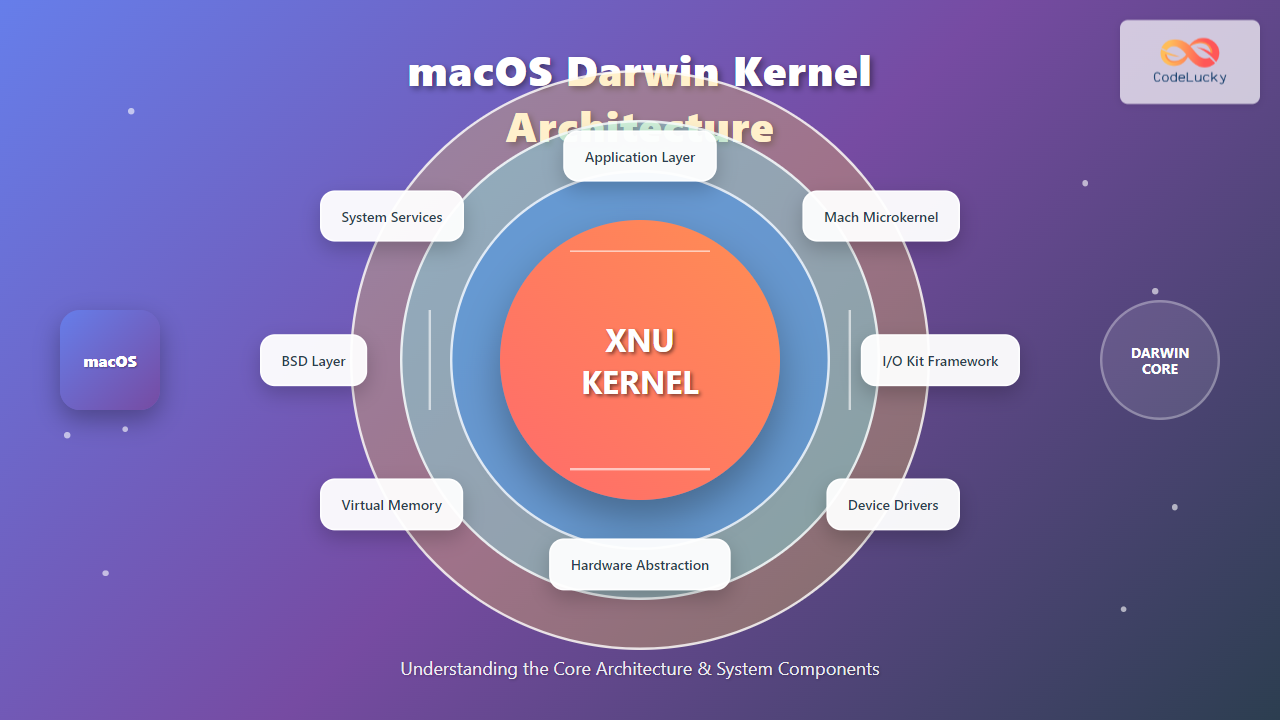
Apple’s macOS stands as one of the most sophisticated operating systems in the modern computing landscape, built upon a robust foundation known as Darwin. At its core lies the XNU (X is Not Unix) kernel, a hybrid microkernel architecture that combines the best aspects of monolithic and microkernel designs. This comprehensive guide explores the intricate architecture of Darwin and its role in powering macOS.
Understanding Darwin: The Foundation of macOS
Darwin represents the open-source Unix-like foundation that underlies macOS, iOS, watchOS, and tvOS. Released under the Apple Public Source License, Darwin provides the core system services, kernel, and low-level utilities that form the backbone of Apple’s operating systems.

The Darwin architecture consists of several key components:
- XNU Kernel: The core kernel providing memory management, process scheduling, and system calls
- BSD Layer: POSIX-compliant layer offering Unix-like functionality
- I/O Kit: Object-oriented device driver framework
- Libkern: Kernel-level C++ runtime and utility libraries
XNU Kernel Architecture Deep Dive
The XNU (X is Not Unix) kernel represents a hybrid approach, combining elements from both monolithic and microkernel architectures. This design philosophy allows macOS to achieve optimal performance while maintaining modularity and security.
Core XNU Components

The XNU kernel architecture encompasses several critical subsystems:
1. Mach Microkernel
At the heart of XNU lies the Mach microkernel, originally developed at Carnegie Mellon University. Mach provides fundamental services including:
- Virtual Memory Management: Advanced memory allocation and protection mechanisms
- Inter-Process Communication (IPC): Message passing between processes and kernel services
- Task and Thread Management: Low-level process and thread abstraction
- Processor Scheduling: Real-time and time-sharing scheduling policies
2. BSD Layer
The BSD (Berkeley Software Distribution) layer provides POSIX compliance and Unix-like functionality, including:
// Example: BSD system call implementation
#include <sys/syscall.h>
#include <unistd.h>

// Getting process ID using BSD system call
pid_t process_id = getpid();
printf("Current process ID: %d\n", process_id);
3. I/O Kit Framework
The I/O Kit represents Apple’s object-oriented approach to device driver development, built on a restricted subset of C++:
// Basic I/O Kit driver structure
class MyDeviceDriver : public IOService {
public:
    virtual bool init(OSDictionary* properties = 0);
    virtual IOService* probe(IOService* provider, SInt32* score);
    virtual bool start(IOService* provider);
    virtual void stop(IOService* provider);
};
Darwin System Architecture Layers
Darwin employs a layered architecture that promotes modularity and maintainability while ensuring optimal performance.

Kernel Extensions (KEXTs)
Darwin supports dynamically loadable kernel extensions, allowing third-party drivers and kernel modules to extend system functionality:
<!-- Example KEXT Info.plist structure -->
<key>CFBundlePackageType</key>
<string>KEXT</string>
<key>OSBundleLibraries</key>
<dict>
    <key>com.apple.kpi.iokit</key>
    <string>19.0</string>
    <key>com.apple.kpi.libkern</key>
    <string>19.0</string>
</dict>
Memory Management in Darwin
Darwin implements sophisticated memory management through the Mach virtual memory subsystem, providing both performance and security benefits.
Virtual Memory Architecture
The virtual memory system manages memory through several key concepts:
- VM Objects: Abstract representations of memory regions
- VM Maps: Collections of VM map entries defining address space layout
- Paging: On-demand loading and swapping of memory pages
- Copy-on-Write: Efficient memory sharing between processes

Memory Protection and Security
Darwin implements multiple layers of memory protection:
// Example: Memory mapping with protection flags
#include <sys/mman.h>

void* mapped_memory = mmap(NULL, 4096,
                          PROT_READ | PROT_WRITE,
                          MAP_PRIVATE | MAP_ANONYMOUS,
                          -1, 0);

// Set memory region as executable
mprotect(mapped_memory, 4096, PROT_READ | PROT_EXEC);
Process and Thread Management
Darwin’s process model builds upon Mach tasks and threads, providing a robust foundation for multitasking and concurrency.
Task and Thread Hierarchy
In Darwin terminology:
- Task: Collection of system resources (address space, port rights)
- Thread: Unit of CPU utilization within a task
- Process: BSD abstraction combining task with additional process state
// Creating threads using pthread API
#include <pthread.h>

void* thread_function(void* arg) {
    printf("Thread %d executing\n", *(int*)arg);
    return NULL;
}

int main() {
    pthread_t thread;
    int thread_id = 1;

    pthread_create(&thread, NULL, thread_function, &thread_id);
    pthread_join(thread, NULL);

    return 0;
}
Scheduling Algorithms
Darwin employs sophisticated scheduling algorithms optimized for different workload types:
- Time-sharing: Default scheduling for interactive processes
- Real-time: Low-latency scheduling for time-critical tasks
- Fixed-priority: Static priority scheduling for system services
File System Architecture
Darwin supports multiple file systems through the Virtual File System (VFS) layer, with HFS+ and APFS being the primary file systems used in macOS.
VFS Layer Implementation
The VFS provides a unified interface for different file system implementations:
// Example: File system operations through VFS
#include <sys/mount.h>
#include <sys/stat.h>

// Getting file system information
struct statfs fs_info;
if (statfs("/", &fs_info) == 0) {
    printf("File system: %s\n", fs_info.f_fstypename);
    printf("Block size: %u\n", fs_info.f_bsize);
    printf("Total blocks: %llu\n", fs_info.f_blocks);
}
APFS (Apple File System)
APFS represents Apple’s modern file system, designed for flash and SSD storage with features including:
- Copy-on-Write: Efficient file copying and versioning
- Snapshots: Point-in-time file system state preservation
- Space Sharing: Dynamic space allocation between volumes
- Clones: Instant file and directory duplication
Security Architecture
Darwin implements multiple security mechanisms to protect system integrity and user data.
System Integrity Protection (SIP)
SIP restricts access to critical system files and directories, even for the root user:
# Checking SIP status
csrutil status

# Example output:
# System Integrity Protection status: enabled.
Code Signing and Gatekeeper
Darwin enforces code signing requirements to ensure software authenticity:
# Verifying code signature
codesign --verify --verbose /Applications/TextEdit.app

# Checking signature details
codesign --display --verbose=4 /Applications/TextEdit.app
Performance Optimization Features
Darwin incorporates several performance optimization technologies:
Grand Central Dispatch (GCD)
GCD provides efficient task parallelization through dispatch queues:
#include <dispatch/dispatch.h>

// Creating concurrent queue
dispatch_queue_t concurrent_queue =
    dispatch_queue_create("com.example.concurrent", DISPATCH_QUEUE_CONCURRENT);

// Asynchronous task execution
dispatch_async(concurrent_queue, ^{
    // Perform background task
    printf("Executing background task\n");
});
Automatic Reference Counting (ARC)
ARC automatically manages memory for Objective-C objects, reducing memory leaks and improving performance.
Development and Debugging Tools
Darwin provides comprehensive tools for system development and debugging:
DTrace Integration
DTrace enables dynamic tracing of kernel and user-space activities:
# Monitoring system calls
sudo dtrace -n 'syscall:::entry { @[execname] = count(); }'

# Tracing file operations
sudo dtrace -n 'syscall::open*:entry { printf("%s opened %s\n", execname, copyinstr(arg0)); }'
Kernel Debugging
Darwin supports kernel debugging through various mechanisms including kernel core dumps and live debugging sessions.
Modern Darwin Evolution
Recent versions of Darwin have introduced significant enhancements:
- DriverKit: Modern userspace driver framework replacing kernel extensions
- System Extensions: Safer alternative to kernel extensions for system functionality
- Hardened Runtime: Enhanced security features for application isolation
- Apple Silicon Support: Native ARM64 architecture support with Rosetta 2 translation
The Darwin kernel continues to evolve, incorporating cutting-edge technologies while maintaining backward compatibility and system stability. Understanding its architecture provides valuable insights into modern operating system design and the engineering excellence that powers macOS and other Apple platforms.
This deep dive into Darwin’s architecture reveals the sophisticated engineering behind macOS, demonstrating how careful design decisions create a robust, secure, and high-performance operating system foundation that serves millions of users worldwide.