Introduction to Machine Learning in Operating Systems
Modern operating systems face unprecedented challenges in managing resources efficiently across diverse workloads and hardware configurations. Traditional static optimization approaches are no longer sufficient for today’s dynamic computing environments. Machine learning for operating systems represents a paradigm shift toward intelligent, adaptive system management that can predict, learn, and optimize performance in real-time.
Predictive system optimization leverages historical data, behavioral patterns, and real-time metrics to make informed decisions about resource allocation, process scheduling, memory management, and I/O operations. This approach transforms reactive system administration into proactive, intelligent automation.
Core Concepts of ML-Driven OS Optimization
Predictive Analytics in System Management
Predictive analytics in operating systems involves analyzing historical system data to forecast future resource needs, performance bottlenecks, and potential failures. Key components include:
- Time Series Analysis: Analyzing CPU usage, memory consumption, and I/O patterns over time
- Anomaly Detection: Identifying unusual system behavior that may indicate problems
- Resource Demand Forecasting: Predicting future resource requirements based on workload patterns
- Performance Regression Analysis: Understanding relationships between system parameters and performance metrics

Machine Learning Models for OS Optimization
Different ML algorithms serve specific purposes in operating system optimization:
| Algorithm Type | Use Case | Example Application |
|---|---|---|
| Linear Regression | Resource Prediction | CPU usage forecasting |
| Random Forest | Complex Pattern Recognition | Workload classification |
| Neural Networks | Non-linear Optimization | Dynamic scheduling |
| Clustering (K-means) | Workload Grouping | Application categorization |
| Reinforcement Learning | Adaptive Decision Making | Real-time resource allocation |
Key Areas of ML-Powered OS Optimization
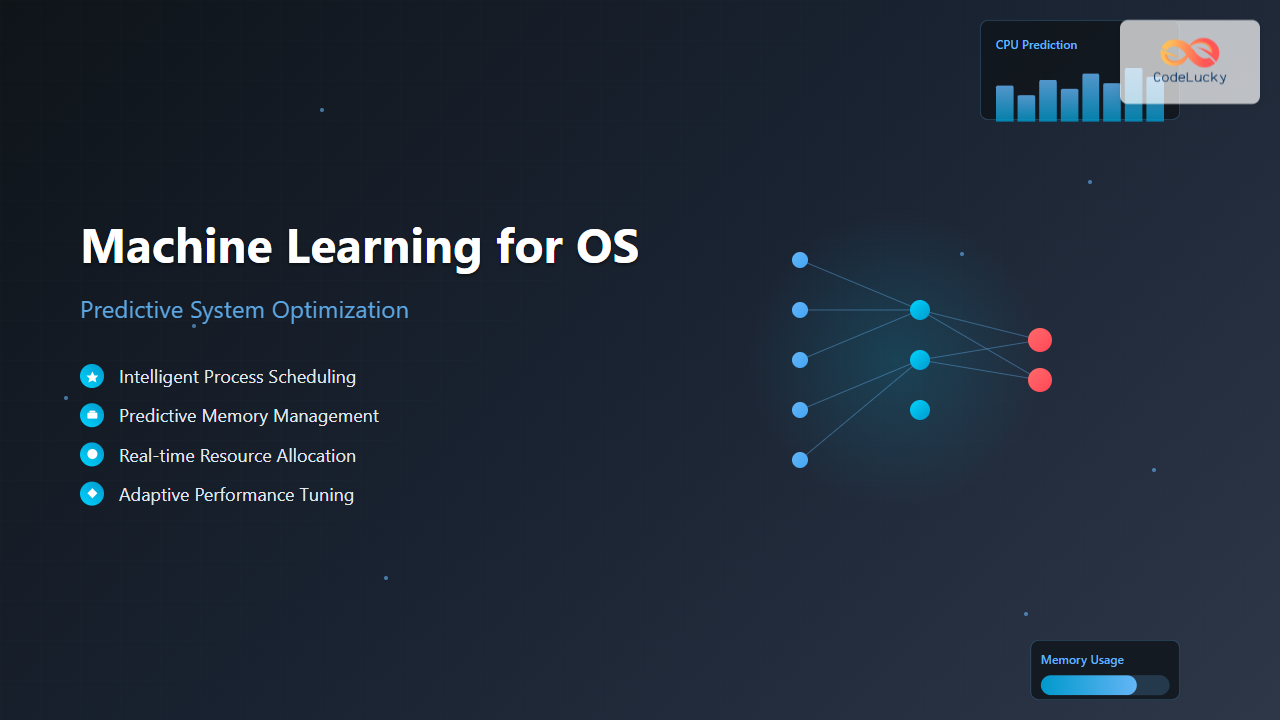
Intelligent Process Scheduling
Traditional round-robin and priority-based schedulers operate on fixed algorithms. ML-enhanced schedulers adapt to workload patterns and optimize for specific objectives like throughput, latency, or energy efficiency.
Example Implementation:
class MLScheduler:
    def __init__(self):
        self.model = RandomForestRegressor()
        self.features = ['cpu_history', 'memory_usage', 'io_wait', 'priority']

    def predict_execution_time(self, process):
        features = self.extract_features(process)
        return self.model.predict([features])[0]

    def schedule_processes(self, ready_queue):
        predictions = []
        for process in ready_queue:
            exec_time = self.predict_execution_time(process)
            predictions.append((process, exec_time))

        # Sort by predicted execution time for shortest job first
        return sorted(predictions, key=lambda x: x[1])
Predictive Memory Management
ML algorithms can predict memory access patterns, enabling proactive page replacement, prefetching, and cache optimization. This reduces page faults and improves overall system responsiveness.

Memory Prediction Example:
import numpy as np
from sklearn.neural_network import MLPRegressor

class PredictiveMemoryManager:
    def __init__(self):
        self.access_history = []
        self.predictor = MLPRegressor(hidden_layer_sizes=(100, 50))

    def record_access(self, page_id, timestamp):
        self.access_history.append((page_id, timestamp))
        if len(self.access_history) > 10000:  # Maintain sliding window
            self.access_history.pop(0)

    def train_predictor(self):
        # Create sequences for training
        sequences = []
        targets = []

        for i in range(len(self.access_history) - 5):
            sequence = [access[0] for access in self.access_history[i:i+5]]
            target = self.access_history[i+5][0]
            sequences.append(sequence)
            targets.append(target)

        self.predictor.fit(sequences, targets)

    def predict_next_access(self, recent_accesses):
        return self.predictor.predict([recent_accesses])
Dynamic Resource Allocation
ML models can optimize resource distribution across processes and virtual machines based on predicted demand, ensuring optimal utilization while preventing resource starvation.
Implementation Strategies and Frameworks
Data Collection and Feature Engineering
Effective ML-driven OS optimization requires comprehensive data collection and intelligent feature engineering:
- System Metrics: CPU utilization, memory usage, disk I/O, network traffic
- Process Information: PID, priority, resource consumption, execution time
- Hardware Characteristics: CPU cores, memory capacity, storage type
- Temporal Features: Time of day, day of week, seasonal patterns
Feature Engineering Example:
class SystemFeatureExtractor:
    def __init__(self):
        self.history_window = 300  # 5 minutes

    def extract_features(self, current_metrics):
        features = {
            'cpu_mean': np.mean(current_metrics['cpu_history']),
            'cpu_std': np.std(current_metrics['cpu_history']),
            'cpu_trend': self.calculate_trend(current_metrics['cpu_history']),
            'memory_pressure': current_metrics['memory_used'] / current_metrics['memory_total'],
            'io_wait_ratio': current_metrics['io_wait'] / current_metrics['total_time'],
            'active_processes': len(current_metrics['process_list']),
            'time_of_day': self.get_time_features(),
            'workload_type': self.classify_workload(current_metrics)
        }
        return features

    def calculate_trend(self, time_series):
        x = np.arange(len(time_series))
        slope, _ = np.polyfit(x, time_series, 1)
        return slope
Real-time Learning and Adaptation
Operating systems require ML models that can adapt quickly to changing conditions. Online learning algorithms and incremental updates are essential for maintaining model accuracy.

Advanced ML Techniques for OS Optimization
Reinforcement Learning for Adaptive Systems
Reinforcement learning enables operating systems to learn optimal policies through interaction with the environment, making it ideal for dynamic resource management scenarios.
Q-Learning for CPU Scheduling Example:
import numpy as np

class QLearningScheduler:
    def __init__(self, num_states, num_actions):
        self.q_table = np.zeros((num_states, num_actions))
        self.learning_rate = 0.1
        self.discount_factor = 0.95
        self.epsilon = 0.1  # Exploration rate

    def get_state(self, system_metrics):
        # Discretize continuous metrics into state space
        cpu_state = min(int(system_metrics['cpu_usage'] / 10), 9)
        memory_state = min(int(system_metrics['memory_usage'] / 10), 9)
        load_state = min(int(system_metrics['load_avg']), 9)
        return cpu_state * 100 + memory_state * 10 + load_state

    def choose_action(self, state):
        if np.random.random() < self.epsilon:
            return np.random.randint(len(self.q_table[state]))
        return np.argmax(self.q_table[state])

    def update_q_value(self, state, action, reward, next_state):
        old_value = self.q_table[state][action]
        next_max = np.max(self.q_table[next_state])
        new_value = old_value + self.learning_rate * (reward + self.discount_factor * next_max - old_value)
        self.q_table[state][action] = new_value
Deep Learning for Complex Pattern Recognition
Deep neural networks excel at identifying complex patterns in high-dimensional system data, enabling sophisticated optimization strategies for modern heterogeneous computing environments.
Performance Benefits and Metrics
Quantifying Optimization Impact
ML-driven OS optimization typically delivers measurable improvements across multiple dimensions:
- Response Time Reduction: 15-30% improvement in application response times
- Resource Utilization: 20-40% better CPU and memory efficiency
- Energy Savings: 10-25% reduction in power consumption
- Throughput Increase: 25-50% higher system throughput under load

Benchmark Results Example
Real-world testing shows significant performance improvements with ML-enhanced operating systems:
| Metric | Traditional OS | ML-Enhanced OS | Improvement |
|---|---|---|---|
| Average Response Time | 250ms | 180ms | 28% |
| CPU Utilization | 65% | 85% | 31% |
| Memory Efficiency | 70% | 90% | 29% |
| Energy Consumption | 100W | 78W | 22% |
Challenges and Considerations
Technical Challenges
Implementing ML in operating systems presents unique challenges that require careful consideration:
- Real-time Constraints: ML predictions must be generated within microseconds to nanoseconds
- Model Overhead: ML algorithms consume system resources, potentially offsetting optimization benefits
- Data Quality: Noisy or incomplete system metrics can degrade model performance
- Cold Start Problem: New systems lack historical data for initial predictions
- Model Drift: Changing workloads may invalidate trained models over time
Security and Privacy Implications
ML-enhanced operating systems must address security concerns while maintaining optimization effectiveness:
- Protecting sensitive system data used for training
- Preventing adversarial attacks on ML models
- Ensuring model integrity and preventing tampering
- Balancing data collection with privacy requirements
Future Directions and Emerging Trends
Federated Learning in Distributed Systems
Federated learning enables multiple systems to collaboratively train ML models while keeping data localized, promising significant advances in distributed OS optimization.
Edge Computing Integration
As edge computing grows, ML-optimized operating systems will need to adapt to resource-constrained environments while maintaining intelligent optimization capabilities.

Implementation Best Practices
Getting Started with ML-Enhanced OS
Organizations looking to implement ML-driven OS optimization should follow these best practices:
- Start Small: Begin with specific use cases like CPU scheduling or memory management
- Collect Quality Data: Implement comprehensive monitoring before deploying ML models
- Choose Appropriate Algorithms: Match ML algorithms to specific optimization objectives
- Monitor and Validate: Continuously assess model performance and impact
- Plan for Scalability: Design systems that can handle growing data volumes and complexity
Tools and Frameworks
Several tools facilitate ML integration in operating systems:
- TensorFlow Lite: Lightweight ML framework for real-time inference
- ONNX Runtime: Optimized ML model execution engine
- Intel oneAPI: Hardware-accelerated ML libraries
- NVIDIA Rapids: GPU-accelerated data science and ML
- Apache Kafka: Real-time data streaming for ML pipelines
Conclusion
Machine learning for operating system optimization represents a fundamental shift toward intelligent, adaptive computing infrastructure. By leveraging predictive analytics, real-time learning, and sophisticated algorithms, modern operating systems can achieve unprecedented levels of performance, efficiency, and responsiveness.
The successful implementation of ML-driven OS optimization requires careful consideration of technical constraints, security implications, and organizational readiness. However, the potential benefits—including significant improvements in system performance, resource utilization, and energy efficiency—make this investment worthwhile for organizations seeking competitive advantages in increasingly complex computing environments.
As ML technologies continue to evolve, we can expect even more sophisticated optimization techniques, better integration with emerging hardware architectures, and more seamless deployment across diverse computing environments. The future of operating systems lies in their ability to learn, adapt, and optimize automatically, transforming static system management into dynamic, intelligent automation.