Introduction to Linux Kernel Architecture
The Linux kernel represents one of the most successful implementations of a monolithic kernel architecture in modern computing. Unlike microkernel designs that distribute functionality across multiple user-space processes, the Linux kernel consolidates all core operating system services into a single, large kernel space program. This architectural decision has profound implications for system performance, security, and maintainability.
Understanding the monolithic nature of the Linux kernel is crucial for system administrators, developers, and anyone working with Linux-based systems. This comprehensive guide explores the intricate details of how Linux implements its monolithic architecture, the trade-offs involved, and practical implications for system performance.
What is a Monolithic Kernel?
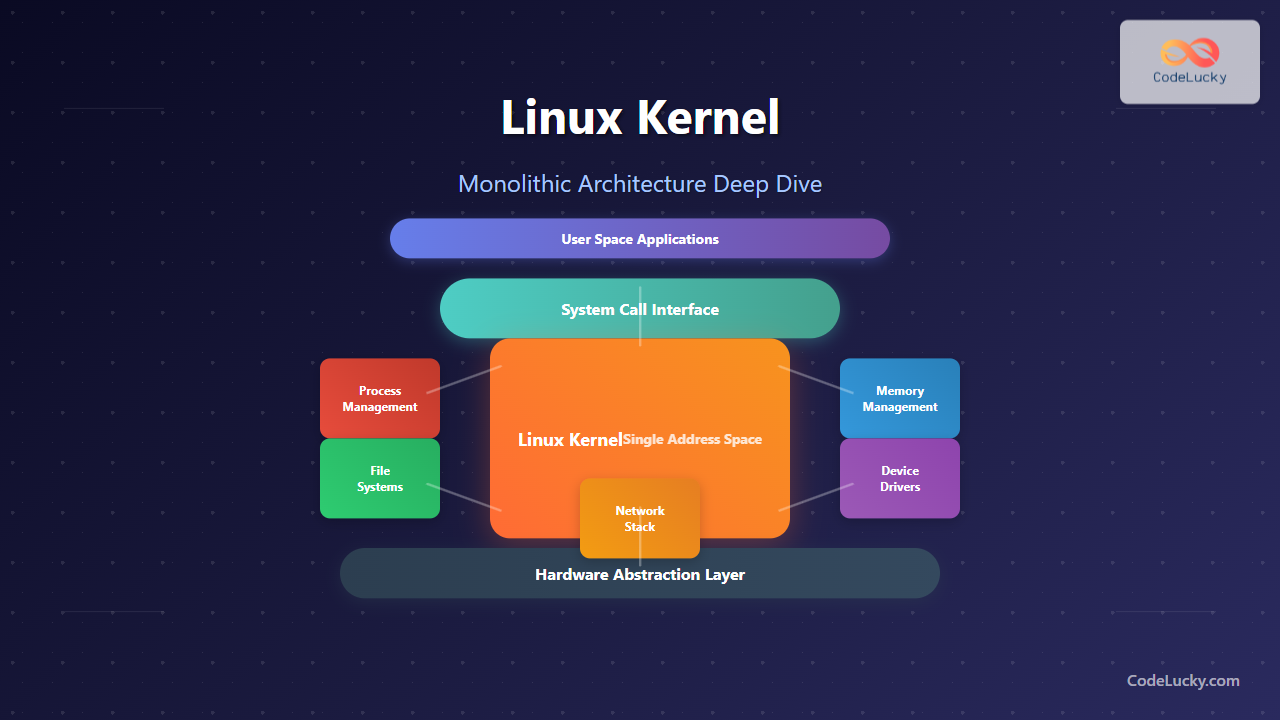
A monolithic kernel is an operating system architecture where the entire kernel runs in a single address space with unrestricted access to hardware resources. In this design, all kernel services including process management, memory management, file systems, device drivers, and network protocols execute in kernel mode with full system privileges.

This contrasts sharply with microkernel architectures where kernel services run as separate processes in user space, communicating through message passing mechanisms. The monolithic approach offers significant performance advantages due to direct function calls between kernel components, eliminating the overhead of inter-process communication.
Key Characteristics of Monolithic Kernels
- Single Address Space: All kernel code runs in the same memory space
- Direct Function Calls: Kernel components communicate through direct function invocation
- Shared Data Structures: Common data structures accessible by all kernel subsystems
- Privileged Execution: Entire kernel runs with full hardware access
- Static or Dynamic Linking: Kernel modules can be compiled in or loaded at runtime
Linux Kernel Architecture Overview
The Linux kernel architecture consists of several interconnected subsystems that work together to provide a complete operating system foundation. Each subsystem handles specific aspects of system operation while maintaining tight integration with other components.

Core Kernel Subsystems
The Linux kernel comprises several major subsystems, each responsible for specific functionality:
Process Management
The process management subsystem handles process creation, scheduling, and termination. It implements the Completely Fair Scheduler (CFS) that provides efficient CPU time allocation across multiple processes and threads.
// Example: Process creation system call
pid_t fork(void) {
    // Kernel creates new process descriptor
    // Duplicates parent's memory space
    // Returns PID to parent, 0 to child
    return do_fork(SIGCHLD, 0, 0, NULL, NULL);
}
Memory Management
Linux implements sophisticated virtual memory management with features like demand paging, copy-on-write, and memory-mapped files. The kernel manages both physical and virtual memory through page tables and memory descriptors.
Virtual File System (VFS)
The VFS provides a unified interface for accessing different file systems. It abstracts file system operations, allowing applications to work with various file system types through a common API.
Network Stack
The kernel includes a complete TCP/IP network stack with support for multiple protocols, socket interfaces, and network device drivers. This enables comprehensive networking capabilities directly within the kernel.
Monolithic vs. Microkernel Architecture Comparison
Understanding the differences between monolithic and microkernel architectures helps appreciate the design decisions in the Linux kernel:
| Aspect | Monolithic Kernel (Linux) | Microkernel |
|---|---|---|
| Performance | High – Direct function calls | Lower – Message passing overhead |
| Security | Lower – Single failure domain | Higher – Isolated services |
| Reliability | Lower – Kernel crash affects entire system | Higher – Service crashes isolated |
| Development | Complex – Tight coupling | Modular – Loose coupling |
| Size | Large – All services included | Small – Minimal kernel |
| Extensibility | Loadable modules | User-space services |
Linux’s Hybrid Approach
While fundamentally monolithic, Linux incorporates some microkernel concepts through loadable kernel modules (LKMs). This provides a balance between monolithic performance and modular flexibility:
# Loading a kernel module
sudo modprobe ext4

# Viewing loaded modules
lsmod | head -10

# Module information
modinfo ext4

System Call Interface
The system call interface serves as the primary gateway between user space applications and kernel space services. This interface maintains strict separation between user and kernel modes while providing controlled access to kernel functionality.
System Call Mechanism
When a user application needs kernel services, it invokes a system call that triggers a mode switch from user space to kernel space:
// User space code
#include <unistd.h>
#include <sys/types.h>

int main() {
    pid_t pid;

    // System call to get process ID
    pid = getpid();

    printf("Process ID: %d\n", pid);
    return 0;
}
The kernel implements hundreds of system calls, each identified by a unique number. The system call table maps these numbers to corresponding kernel functions:
// Simplified system call implementation
asmlinkage long sys_getpid(void) {
    return task_tgid_vnr(current);
}
System Call Categories
- Process Control: fork(), exec(), exit(), wait()
- File Operations: open(), read(), write(), close()
- Device Management: ioctl(), select(), poll()
- Information Maintenance: getpid(), alarm(), sleep()
- Communication: pipe(), shmget(), msgget()
Kernel Memory Management
Memory management in the Linux kernel involves complex algorithms for handling both physical and virtual memory. The monolithic architecture allows direct access to memory management structures from any kernel subsystem.

Memory Zones
Linux divides physical memory into distinct zones based on hardware limitations:
- ZONE_DMA: Memory suitable for DMA operations (0-16MB)
- ZONE_NORMAL: Regular memory (16MB-896MB on 32-bit)
- ZONE_HIGHMEM: High memory (>896MB on 32-bit systems)
- ZONE_MOVABLE: Memory for movable allocations
Page Allocation Example
// Kernel code for page allocation
struct page *page;

// Allocate a single page
page = alloc_pages(GFP_KERNEL, 0);

if (page) {
    void *addr = page_address(page);
    // Use the allocated memory

    // Free the page when done
    __free_pages(page, 0);
}
Device Driver Integration
In the monolithic Linux kernel, device drivers run in kernel space with full hardware access. This design choice provides excellent performance but requires careful programming to avoid system crashes.
Driver Categories
- Character Devices: Serial interfaces, keyboards, mice
- Block Devices: Hard drives, SSDs, CD-ROMs
- Network Devices: Ethernet cards, WiFi adapters
Basic Device Driver Structure
// Simple character device driver
#include <linux/module.h>
#include <linux/kernel.h>
#include <linux/fs.h>

static int device_open(struct inode *inode, struct file *file) {
    printk(KERN_INFO "Device opened\n");
    return 0;
}

static int device_release(struct inode *inode, struct file *file) {
    printk(KERN_INFO "Device closed\n");
    return 0;
}

static struct file_operations fops = {
    .open = device_open,
    .release = device_release,
};

static int __init init_module(void) {
    int major = register_chrdev(0, "mydevice", &fops);
    if (major < 0) {
        printk(KERN_ALERT "Failed to register device\n");
        return major;
    }
    printk(KERN_INFO "Device registered with major number %d\n", major);
    return 0;
}

static void __exit cleanup_module(void) {
    // Cleanup code
    printk(KERN_INFO "Device unregistered\n");
}

MODULE_LICENSE("GPL");
MODULE_DESCRIPTION("Simple Character Device Driver");
Advantages of Monolithic Architecture
The monolithic architecture of the Linux kernel provides several significant advantages that have contributed to its widespread adoption:
Performance Benefits
- Fast System Calls: Direct kernel function invocation without context switching overhead
- Efficient Inter-subsystem Communication: Shared memory and direct function calls
- Optimized Data Sharing: Common data structures accessible by all kernel components
- Reduced Memory Overhead: No duplication of data structures across processes
Development and Maintenance
- Simplified Debugging: All kernel code in single address space
- Easier Optimization: Cross-subsystem optimizations possible
- Mature Ecosystem: Extensive driver support and development tools
Disadvantages and Challenges
Despite its advantages, the monolithic architecture also presents several challenges:
Security and Reliability Concerns
- Single Point of Failure: Kernel crash affects entire system
- Privilege Escalation Risk: Bugs in drivers can compromise system security
- Large Attack Surface: More code running in privileged mode
Development Complexity
- Tight Coupling: Changes in one subsystem may affect others
- Large Codebase: Millions of lines of code to maintain
- Integration Challenges: Ensuring compatibility across subsystems
Real-World Performance Analysis
To understand the practical implications of Linux’s monolithic architecture, consider these performance characteristics:
System Call Overhead
# Measuring system call performance
time -p ls /dev/null > /dev/null

# Output example:
# real 0.00
# user 0.00
# sys  0.00
Context Switching Performance
The monolithic kernel excels in scenarios requiring frequent kernel services:
#include <sys/time.h>
#include <unistd.h>

// Benchmark system call overhead
int main() {
    struct timeval start, end;
    int i;

    gettimeofday(&start, NULL);

    for (i = 0; i < 1000000; i++) {
        getpid(); // Simple system call
    }

    gettimeofday(&end, NULL);

    long duration = (end.tv_sec - start.tv_sec) * 1000000 +
                   (end.tv_usec - start.tv_usec);

    printf("Average system call time: %ld microseconds\n",
           duration / 1000000);

    return 0;
}
Modern Enhancements to Linux Kernel
The Linux kernel has evolved to address some traditional monolithic kernel limitations while maintaining performance advantages:
Kernel Modules
Loadable kernel modules provide dynamic extensibility without requiring kernel recompilation:
# Creating a simple kernel module
echo 'obj-m += hello.o' > Makefile

# Module source (hello.c)
cat > hello.c << 'EOF'
#include
#include
#include

static int __init hello_init(void) {
    printk(KERN_INFO "Hello, World!\n");
    return 0;
}

static void __exit hello_exit(void) {
    printk(KERN_INFO "Goodbye, World!\n");
}

module_init(hello_init);
module_exit(hello_exit);
MODULE_LICENSE("GPL");
EOF

# Build the module
make -C /lib/modules/$(uname -r)/build M=$(pwd) modules
Namespace and Container Support
Modern Linux kernels support containerization technologies through namespaces and control groups, providing isolation within the monolithic architecture:
- PID Namespaces: Process ID isolation
- Network Namespaces: Network stack isolation
- Mount Namespaces: File system mount point isolation
- User Namespaces: User and group ID isolation
eBPF Integration
Extended Berkeley Packet Filter (eBPF) allows safe kernel programming by running sandboxed programs within the kernel:
// eBPF program example for packet filtering
#include
#include

SEC("classifier")
int packet_filter(struct __sk_buff *skb) {
    // Safe packet processing logic
    return TC_ACT_OK;
}

char _license[] SEC("license") = "GPL";
Future of Monolithic Kernels
The Linux kernel continues to evolve while maintaining its monolithic foundation. Future developments focus on:
- Rust Integration: Memory-safe system programming for critical components
- Real-time Capabilities: Enhanced real-time performance through preemption improvements
- Security Enhancements: Hardware-assisted security features and memory protection
- Performance Optimizations: Continued optimization for modern hardware architectures
Conclusion
The Linux kernel’s monolithic architecture represents a highly successful approach to operating system design. By consolidating all kernel services into a single address space, Linux achieves exceptional performance while providing comprehensive system functionality. Despite inherent security and reliability challenges, ongoing development efforts continue to enhance the kernel’s capabilities while maintaining its fundamental architectural advantages.
Understanding this architecture is essential for anyone working with Linux systems, from system administrators managing servers to developers creating system-level applications. The monolithic design’s emphasis on performance and direct hardware access makes it particularly well-suited for everything from embedded systems to high-performance computing clusters.
As computing requirements continue to evolve, the Linux kernel adapts through innovations like eBPF, containerization support, and enhanced security features, proving that monolithic architectures can remain relevant and competitive in modern computing environments.