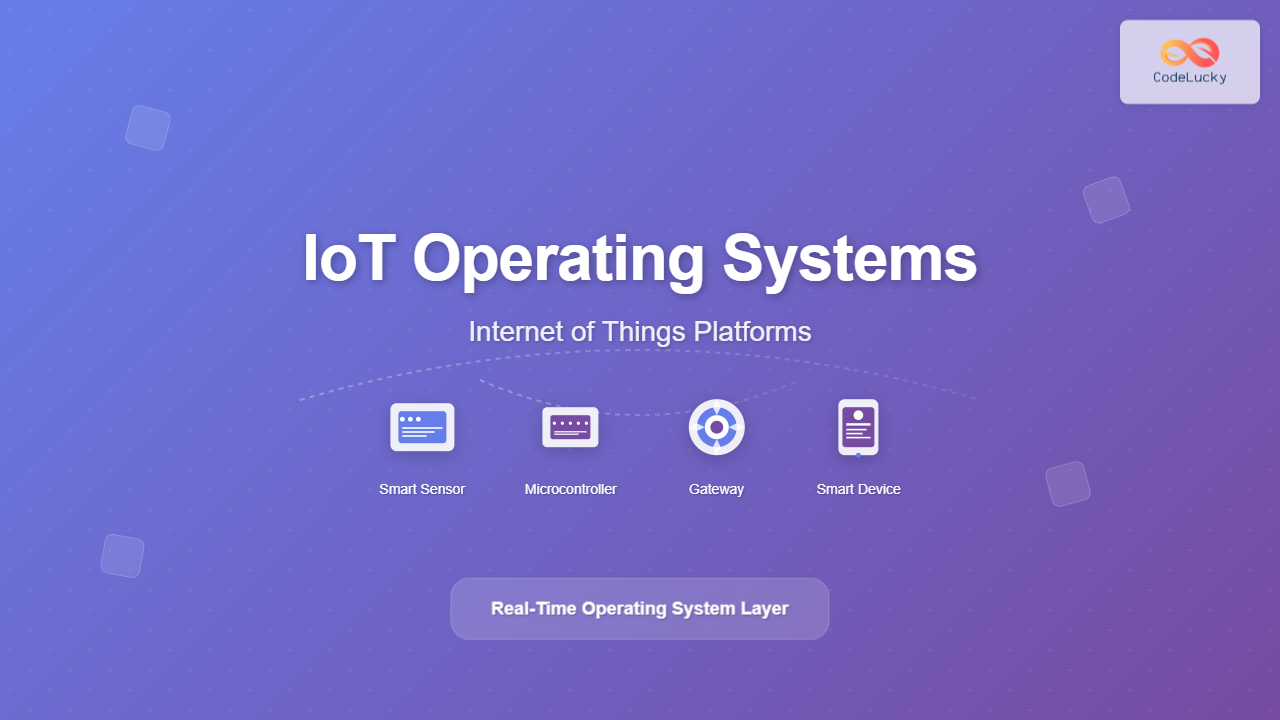
The Internet of Things (IoT) revolution has transformed how we interact with technology, from smart home devices to industrial sensors. At the heart of every IoT device lies an operating system specifically designed to handle the unique challenges of connected, resource-constrained environments. Understanding IoT operating systems is crucial for developers, engineers, and technology enthusiasts working in this rapidly evolving field.
What are IoT Operating Systems?
IoT operating systems are specialized software platforms designed to manage hardware resources and provide services for Internet of Things devices. Unlike traditional desktop or server operating systems, IoT OS are optimized for:
- Low power consumption – Essential for battery-operated devices
- Real-time processing – Critical for responsive sensor data handling
- Minimal memory footprint – Working within severe hardware constraints
- Network connectivity – Built-in support for various communication protocols
- Security – Protection against cyber threats in connected environments

Key Characteristics of IoT Operating Systems
Real-Time Processing Capabilities
Most IoT applications require deterministic response times. Whether it’s a smoke detector responding to danger or an industrial control system managing machinery, IoT operating systems must guarantee that critical tasks execute within specified time constraints.
Resource Optimization
IoT devices often operate with limited resources:
- RAM: Typically 4KB to 512KB
- Storage: 32KB to 4MB flash memory
- Processing Power: 8-bit to 32-bit microcontrollers
- Battery Life: Must operate for months or years
Connectivity and Networking
Built-in support for various communication protocols is essential:
- WiFi and Ethernet for high-bandwidth applications
- Bluetooth LE for short-range, low-power connections
- LoRa and Sigfox for long-range, low-power wide-area networks
- Zigbee and Thread for mesh networking
- Cellular (2G/3G/4G/5G) for mobile IoT applications
Popular IoT Operating Systems
FreeRTOS
FreeRTOS is one of the most widely adopted real-time operating systems for IoT devices. It’s open-source, highly portable, and designed for microcontrollers with limited resources.
Key Features:
- Preemptive multitasking kernel
- Memory footprint as small as 6KB
- Support for 40+ processor architectures
- AWS IoT integration capabilities
- Extensive community support
Use Cases: Smart home devices, industrial sensors, automotive systems
Zephyr
Developed by the Linux Foundation, Zephyr is a scalable, secure RTOS designed for resource-constrained devices.
Key Features:
- Modular architecture
- Built-in security features
- Support for multiple architectures (ARM, x86, RISC-V)
- Comprehensive device driver model
- Active development community
Use Cases: Wearables, smart lighting, building automation
Contiki-NG
Contiki-NG is specifically designed for low-power wireless IoT devices, with excellent networking capabilities.
Key Features:
- Ultra-low power consumption
- Advanced IPv6 networking stack
- CoAP protocol support
- Simulation tools for development
- Focus on sensor networks
Use Cases: Environmental monitoring, smart agriculture, wireless sensor networks
RIOT
RIOT aims to provide a developer-friendly environment similar to Linux but optimized for IoT constraints.
Key Features:
- Partial POSIX compliance
- Standard programming languages (C/C++)
- Real-time capabilities
- Energy-efficient design
- Modular network stack
Use Cases: Smart city infrastructure, industrial IoT, research applications

IoT Operating System Architecture
Layered Architecture Model
IoT operating systems typically follow a layered architecture approach:
- Hardware Abstraction Layer (HAL): Provides interface to physical hardware
- Kernel Layer: Manages system resources, scheduling, and memory
- System Services: File systems, networking, and device drivers
- Middleware: Communication protocols and data management
- Application Layer: User applications and business logic

Memory Management
Effective memory management is critical in resource-constrained IoT devices:
- Static Allocation: Memory allocated at compile time for predictable behavior
- Dynamic Allocation: Runtime memory allocation with careful fragmentation management
- Memory Protection: Preventing applications from corrupting system memory
- Garbage Collection: Automatic memory cleanup in higher-level IoT platforms
Task Scheduling
IoT operating systems employ various scheduling algorithms:
- Preemptive Scheduling: Higher priority tasks interrupt lower priority ones
- Cooperative Scheduling: Tasks voluntarily yield control
- Rate Monotonic: Static priority assignment based on task periods
- Earliest Deadline First: Dynamic priority based on task deadlines
Security in IoT Operating Systems
Security Challenges
IoT devices face unique security challenges:
- Limited processing power for complex encryption
- Physical access to devices in remote locations
- Long deployment cycles making updates difficult
- Default credentials often unchanged by users
- Insecure communication protocols
Security Implementation
Modern IoT operating systems implement security through:
- Hardware Security Modules (HSM): Dedicated security chips for encryption
- Secure Boot: Verifying software authenticity during startup
- Over-the-Air (OTA) Updates: Secure remote software updates
- Transport Layer Security (TLS): Encrypted communication channels
- Access Control: Role-based permissions for device functions

Development and Deployment
Development Tools
IoT operating system development requires specialized tools:
- Cross-compilation toolchains: Building code for target hardware
- Hardware emulators: Testing without physical devices
- Debugging tools: JTAG/SWD interfaces for low-level debugging
- Power analysis tools: Measuring and optimizing energy consumption
- Protocol analyzers: Monitoring network communication
Testing and Validation
Rigorous testing ensures IoT system reliability:
- Unit Testing: Individual component verification
- Integration Testing: System component interaction
- Performance Testing: Real-time constraints and resource usage
- Security Testing: Vulnerability assessment and penetration testing
- Environmental Testing: Temperature, humidity, and electromagnetic interference
Performance Optimization
Power Management
Extending battery life requires sophisticated power management:
- Sleep Modes: Reducing power consumption during idle periods
- Dynamic Voltage Scaling: Adjusting processor voltage based on workload
- Peripheral Power Control: Selectively powering down unused components
- Wake-up Optimization: Minimizing startup time and energy
Code Optimization
Efficient code is essential for resource-constrained devices:
- Compiler Optimizations: Size and speed optimization flags
- Algorithm Selection: Choosing efficient data structures and algorithms
- Memory Access Patterns: Optimizing cache usage and reducing latency
- Interrupt Handling: Minimizing interrupt service routine overhead

Future Trends and Considerations
Edge Computing Integration
IoT operating systems are evolving to support edge computing capabilities:
- Local data processing to reduce latency and bandwidth usage
- Machine learning inference on resource-constrained devices
- Distributed computing across IoT device networks
- Intelligent data filtering before cloud transmission
5G and Advanced Connectivity
Next-generation connectivity standards are reshaping IoT OS requirements:
- Ultra-low latency for real-time applications
- Massive device connectivity in dense deployments
- Network slicing for dedicated IoT channels
- Enhanced mobile broadband for data-intensive applications
Artificial Intelligence Integration
AI capabilities are becoming essential in IoT operating systems:
- TinyML frameworks for on-device machine learning
- Predictive maintenance algorithms
- Adaptive behavior based on usage patterns
- Anomaly detection for security and performance
Best Practices for IoT OS Selection
Requirements Analysis
Choose the right IoT operating system by evaluating:
- Hardware constraints: Memory, processing power, and power consumption
- Real-time requirements: Response time guarantees and scheduling needs
- Connectivity needs: Supported protocols and network interfaces
- Security requirements: Threat model and compliance standards
- Development ecosystem: Tools, documentation, and community support
Implementation Guidelines
- Start simple: Begin with basic functionality and add features incrementally
- Profile early: Measure performance and resource usage from the beginning
- Plan for updates: Design secure update mechanisms from the start
- Consider lifecycle: Plan for device maintenance and end-of-life
- Test thoroughly: Validate functionality under various conditions
Conclusion
IoT operating systems form the foundation of the connected device ecosystem, enabling billions of smart devices to collect, process, and communicate data efficiently. Understanding their architecture, capabilities, and constraints is essential for successful IoT implementation.
As the IoT landscape continues to evolve with advances in edge computing, 5G connectivity, and artificial intelligence, these specialized operating systems will play an increasingly critical role in enabling intelligent, responsive, and secure connected devices. Whether you’re developing a simple sensor node or a complex industrial IoT system, choosing the right operating system and implementing it correctly will determine your project’s success.
The future of IoT operating systems lies in balancing resource efficiency with advanced capabilities, ensuring that even the smallest devices can participate meaningfully in our connected world while maintaining security, reliability, and performance standards.