Introduction to Interrupt Handling
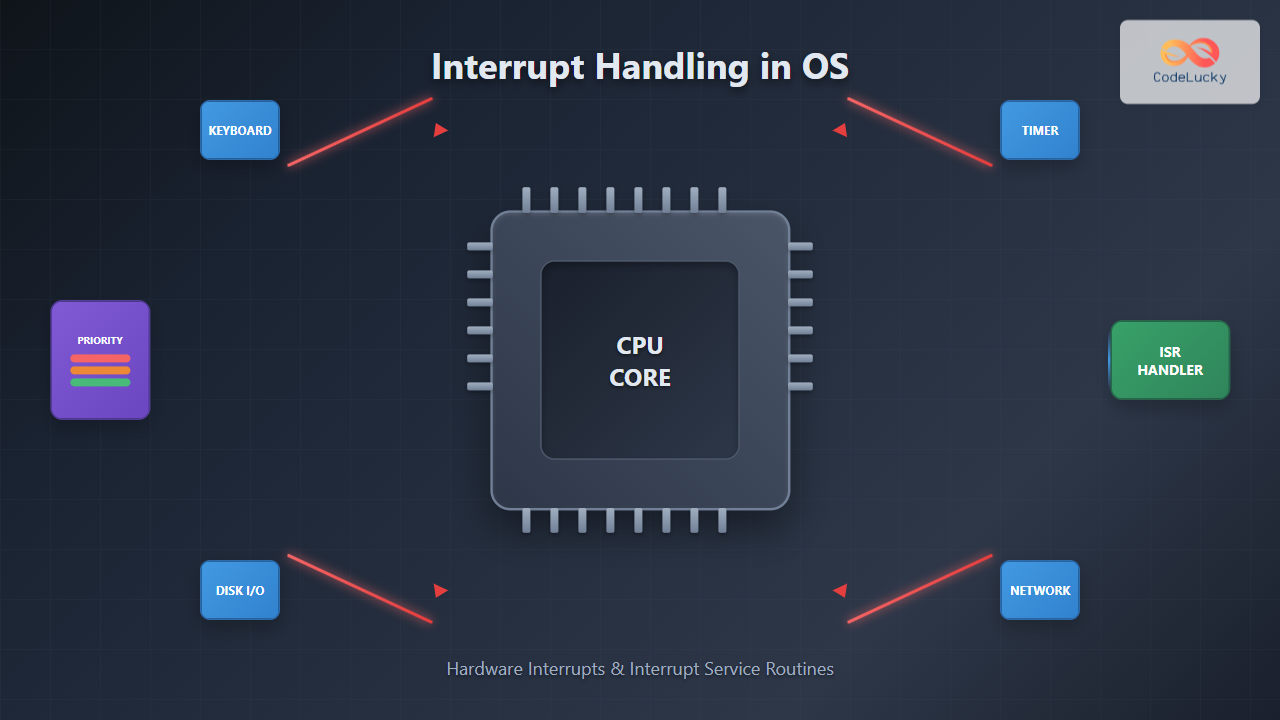
Interrupt handling is a fundamental mechanism in operating systems that enables efficient communication between hardware devices and the CPU. When a hardware device needs attention from the processor, it sends an interrupt signal to temporarily suspend the current execution and handle the device’s request through specialized routines called Interrupt Service Routines (ISR).
This mechanism ensures that the CPU can respond to time-critical events without continuously polling hardware devices, making modern computing systems both responsive and efficient.
What are Interrupts?
An interrupt is a signal sent to the processor by hardware or software indicating that an event needs immediate attention. When an interrupt occurs, the processor temporarily stops its current activity and executes a special function called an interrupt handler or ISR.
Types of Interrupts
- Hardware Interrupts: Generated by hardware devices (keyboard, mouse, timer, disk drives)
- Software Interrupts: Generated by executing specific instructions (system calls, exceptions)
- Maskable Interrupts: Can be disabled by the processor
- Non-maskable Interrupts (NMI): Cannot be disabled and must be handled immediately
Hardware Interrupts: The Foundation
Hardware interrupts are signals generated by external devices to request service from the CPU. These interrupts are essential for:
- I/O Operations: Notifying completion of data transfer
- Timer Events: Triggering periodic system activities
- Error Conditions: Reporting hardware failures or exceptions
- User Input: Processing keyboard and mouse events

Common Hardware Interrupt Sources
| Device | IRQ Number | Purpose | Priority |
|---|---|---|---|
| System Timer | IRQ 0 | Clock ticks, scheduling | High |
| Keyboard | IRQ 1 | Key press/release events | Medium |
| Serial Port 1 | IRQ 4 | Serial communication | Medium |
| Hard Disk | IRQ 14 | Disk I/O completion | High |
| Network Card | IRQ 11 | Network packet arrival | High |
Interrupt Service Routines (ISR)
An Interrupt Service Routine is a special function that handles specific interrupt events. ISRs must be carefully designed to be fast, efficient, and non-blocking to maintain system responsiveness.
ISR Characteristics
- Fast Execution: Must complete quickly to avoid blocking other interrupts
- Atomic Operations: Cannot be interrupted by lower-priority interrupts
- Minimal Stack Usage: Limited stack space available during interrupt context
- No Blocking Calls: Cannot perform operations that might cause the handler to sleep
Sample ISR Implementation
Here’s a simplified example of a keyboard interrupt handler in C:
// Keyboard ISR example
void keyboard_interrupt_handler() {
    // Save processor state (done automatically by hardware)

    // Read the scancode from keyboard port
    unsigned char scancode = inb(KEYBOARD_DATA_PORT);

    // Process the scancode
    if (scancode < 128) {
        // Key pressed
        process_key_press(scancode);
    } else {
        // Key released
        process_key_release(scancode - 128);
    }

    // Send End of Interrupt signal to PIC
    outb(PIC1_COMMAND, EOI);

    // Return from interrupt (restores processor state automatically)
}
Interrupt Handling Process
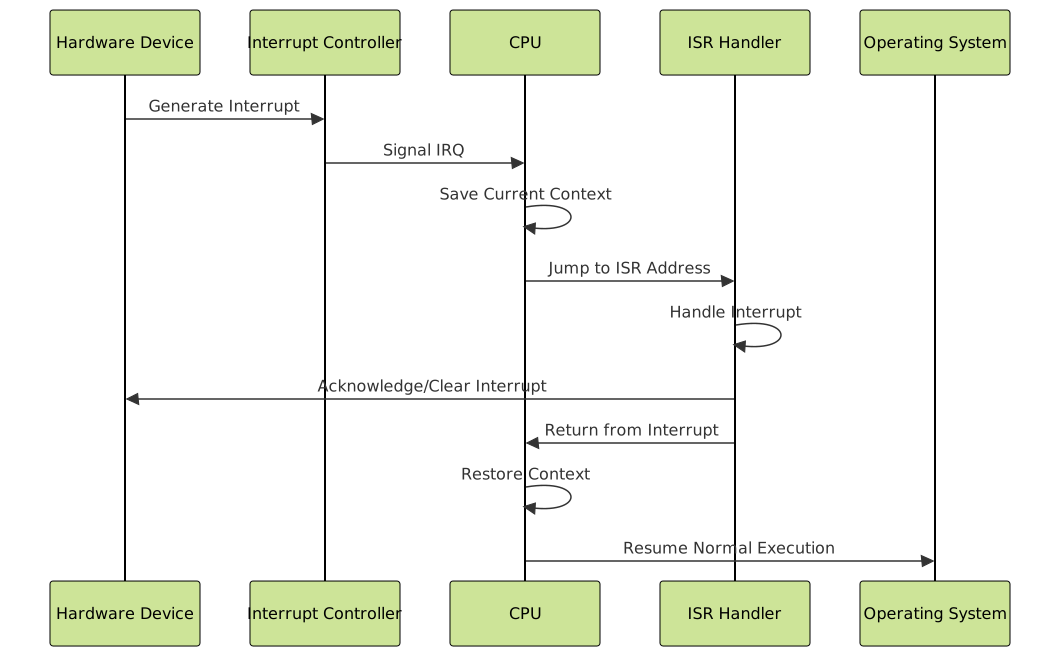
The interrupt handling process follows a well-defined sequence to ensure system stability and proper resource management.

Step-by-Step Process
- Interrupt Detection: Hardware device raises an interrupt signal
- Interrupt Controller: Routes the interrupt to the appropriate CPU
- Context Saving: CPU automatically saves current instruction pointer and flags
- Interrupt Disable: Prevents nested interrupts during critical handling
- Vector Lookup: CPU uses Interrupt Descriptor Table (IDT) to find ISR address
- ISR Execution: Transfer control to the appropriate interrupt handler
- Interrupt Acknowledgment: Signal to hardware that interrupt is being processed
- Handler Logic: Execute device-specific handling code
- Context Restoration: Restore all saved registers and flags
- Return: Resume execution of interrupted program
Interrupt Priority and Nesting
Modern systems implement interrupt priority schemes to ensure that critical interrupts can preempt less important ones. This hierarchical approach prevents low-priority interrupts from blocking time-critical operations.

Priority Levels Example
| Priority Level | Interrupt Type | Example | Can Be Preempted By |
|---|---|---|---|
| 0 (Highest) | Non-Maskable | Memory errors, power failure | None |
| 1 | System Timer | Clock tick, scheduling | NMI only |
| 2 | Critical I/O | Disk controller, network | NMI, Timer |
| 3 (Lowest) | User Input | Keyboard, mouse | All higher priorities |
Practical Examples and Code Implementation
Timer Interrupt Handler
The system timer interrupt is crucial for task scheduling and timekeeping:
volatile unsigned long system_ticks = 0;

void timer_interrupt_handler() {
    // Increment system tick counter
    system_ticks++;

    // Update system time
    update_system_time();

    // Trigger process scheduler every 10ms
    if (system_ticks % 10 == 0) {
        schedule_next_process();
    }

    // Send EOI to interrupt controller
    outb(PIC1_COMMAND, EOI);
}
Network Interrupt Handler
Network card interrupts handle incoming packet notifications:
void network_interrupt_handler() {
    // Read network card status
    uint16_t status = read_network_status();

    if (status & RX_PACKET_READY) {
        // Packet received - add to receive queue
        packet_t *packet = read_network_packet();
        enqueue_received_packet(packet);

        // Wake up network processing thread
        wakeup_network_thread();
    }

    if (status & TX_COMPLETE) {
        // Transmission complete - free buffer
        free_transmit_buffer();
    }

    // Clear interrupt flags
    clear_network_interrupt();
    outb(PIC1_COMMAND, EOI);
}
Interrupt Descriptor Table (IDT)
The Interrupt Descriptor Table is a data structure used by x86 processors to determine the correct response to interrupts and exceptions. Each entry in the IDT contains information about how to handle a specific interrupt.

IDT Entry Structure
| Field | Size | Description |
|---|---|---|
| Offset Low | 16 bits | Lower 16 bits of ISR address |
| Selector | 16 bits | Code segment selector |
| Reserved | 8 bits | Must be zero |
| Type & Attributes | 8 bits | Gate type and privilege level |
| Offset High | 16 bits | Upper 16 bits of ISR address |
Performance Considerations
Efficient interrupt handling is crucial for system performance. Poor interrupt handling can lead to system responsiveness issues and potential data loss.
Optimization Strategies
- Minimize ISR Duration: Keep interrupt handlers as short as possible
- Deferred Processing: Use bottom halves or tasklets for complex operations
- Interrupt Coalescing: Batch multiple interrupts to reduce overhead
- NAPI (New API): Polling mode for high-frequency interrupts
- Interrupt Affinity: Bind interrupts to specific CPU cores
Top Half vs Bottom Half
Modern operating systems split interrupt processing into two parts:
| Aspect | Top Half (ISR) | Bottom Half (Deferred) |
|---|---|---|
| Execution Context | Interrupt context | Process context |
| Duration | Very short (microseconds) | Longer (milliseconds) |
| Operations | Critical, time-sensitive | Complex processing |
| Interrupts | Disabled | Enabled |
| Example | Acknowledge hardware | Process network packets |
Common Issues and Debugging
Interrupt Storm
An interrupt storm occurs when a device generates interrupts faster than the system can handle them, potentially causing system lockup.
// Example: Interrupt rate limiting
static unsigned long last_interrupt_time = 0;
static int interrupt_count = 0;

void rate_limited_isr() {
    unsigned long current_time = get_system_time();

    // Reset counter every second
    if (current_time - last_interrupt_time > 1000) {
        interrupt_count = 0;
        last_interrupt_time = current_time;
    }

    interrupt_count++;

    // Disable interrupt if rate too high
    if (interrupt_count > MAX_INTERRUPTS_PER_SECOND) {
        disable_device_interrupt();
        schedule_delayed_re_enable();
        return;
    }

    // Normal interrupt processing
    handle_device_interrupt();
}
Lost Interrupts
Interrupts can be lost due to:
- Interrupt Masking: Interrupts disabled for too long
- Hardware Buffer Overflow: Device buffers full
- Slow ISR Processing: Handler takes too long to complete
- Priority Inversion: High-priority interrupts blocked by low-priority handlers
Best Practices for Interrupt Handling
Design Guidelines
- Keep ISRs Short: Minimize time spent in interrupt context
- Avoid Blocking Operations: No sleep, mutex, or I/O operations in ISRs
- Use Proper Synchronization: Employ spinlocks and atomic operations
- Handle Errors Gracefully: Implement robust error handling
- Document Interrupt Behavior: Clear documentation for maintainability
Sample Best Practice Implementation
// Good ISR implementation example
void optimized_network_isr() {
    // Quick acknowledgment
    uint32_t status = read_and_clear_interrupt_status();

    // Minimal processing in ISR
    if (status & RX_INTERRUPT) {
        // Just set flag and schedule bottom half
        set_rx_flag();
        schedule_rx_tasklet();
    }

    if (status & TX_INTERRUPT) {
        set_tx_flag();
        schedule_tx_tasklet();
    }

    // Quick EOI
    send_eoi();
}

// Bottom half processing
void network_rx_tasklet() {
    // Complex processing in process context
    while (packets_available()) {
        packet_t *pkt = get_next_packet();
        process_network_packet(pkt);
    }
}
Modern Interrupt Handling Mechanisms
Message Signaled Interrupts (MSI)
MSI is a modern alternative to traditional pin-based interrupts, offering better performance and scalability:
- No Shared Interrupt Lines: Each device gets unique interrupt vector
- Better Performance: Reduced interrupt latency
- Scalability: Supports more devices without IRQ conflicts
- Memory-Based: Uses memory writes instead of electrical signals
IOMMU and Interrupt Remapping
Modern systems use IOMMU (Input-Output Memory Management Unit) for interrupt security and virtualization support:
- Interrupt Isolation: Prevents malicious devices from triggering arbitrary interrupts
- Virtual Machine Support: Enables interrupt forwarding to guest VMs
- Interrupt Translation: Maps physical interrupts to virtual interrupt vectors
Conclusion
Interrupt handling is a cornerstone of modern operating system design, enabling efficient hardware-software communication and system responsiveness. Understanding the intricacies of hardware interrupts, ISR implementation, and performance optimization is essential for system programmers and kernel developers.
Key takeaways for effective interrupt handling include keeping ISRs minimal and fast, using deferred processing for complex operations, implementing proper synchronization mechanisms, and following established best practices for robust system design.
As hardware continues to evolve with technologies like MSI, IOMMU, and multi-core architectures, interrupt handling mechanisms will continue to adapt, but the fundamental principles of efficient, reliable interrupt processing remain constant.
Related Posts

C Signal Handling: Dealing with Interrupts
In the world of C programming, handling signals is a crucial skill that every developer should master. Signals are software...
Monitor in Operating System: High-level Synchronization for Process Coordination
What is a Monitor in Operating System? A monitor is a high-level synchronization construct in operating systems that provides a...
Operating System Functions: Core Components and System Responsibilities
An operating system (OS) serves as the fundamental software layer that manages computer hardware resources and provides essential services to...
Process in Operating System: Complete Guide to Definition, States and Lifecycle
What is a Process in Operating System? A process is a program in execution that consists of the program code...
Kernel in Operating System: Core Functions and Memory Management
The kernel stands as the fundamental cornerstone of any operating system, serving as the critical bridge between hardware components and...

Preemptive vs Non-Preemptive Scheduling: Complete Guide to CPU Scheduling in Operating Systems
Understanding CPU Scheduling in Operating Systems CPU scheduling is one of the most critical functions of an operating system, determining...
C++ Atomic Operations: Lock-Free Programming
In the world of modern C++ programming, concurrency and parallelism have become increasingly important. As developers, we often need to...

hotplug Linux: Complete Guide to Hardware Hotplug Event Handling and Management
Hardware hotplug functionality in Linux enables the dynamic addition and removal of hardware components without requiring system restarts. This powerful...
C in Embedded Systems: Basics of Embedded Programming
Embedded systems are ubiquitous in our modern world, powering everything from smart home devices to automotive control systems. At the...
Input Output Systems: Complete Guide to Device Management and I/O Operations
Input/Output (I/O) systems form the critical bridge between a computer's internal processing capabilities and the external world. These systems manage...
Operating System Basics: Complete Guide to What is an OS and How it Works
An operating system (OS) is the fundamental software that manages computer hardware and software resources, acting as an intermediary between...
Multithreading in Operating Systems: Benefits, Challenges, and Implementation Guide
What is Multithreading in Operating Systems? Multithreading is a fundamental concept in modern operating systems that allows a single process...
- Introduction to Interrupt Handling
- What are Interrupts?
- Hardware Interrupts: The Foundation
- Interrupt Service Routines (ISR)
- Interrupt Handling Process
- Interrupt Priority and Nesting
- Practical Examples and Code Implementation
- Interrupt Descriptor Table (IDT)
- Performance Considerations
- Common Issues and Debugging
- Best Practices for Interrupt Handling
- Modern Interrupt Handling Mechanisms
- Conclusion