Introduction to Page Replacement Algorithms
Page replacement algorithms are fundamental components of virtual memory systems in modern operating systems. When physical memory becomes full and a new page needs to be loaded, the operating system must decide which existing page to remove (or “replace”) to make room. The choice of which page to evict can significantly impact system performance, making the study of these algorithms crucial for system optimization.
Virtual memory allows programs to use more memory than physically available by storing some pages on disk and swapping them in and out as needed. When a page fault occurs and all physical memory frames are occupied, a page replacement algorithm determines the victim page to be replaced.
Understanding Page Faults and Memory Frames
Before diving into specific algorithms, let’s establish key concepts:
- Page Fault: Occurs when a program tries to access a page not currently in physical memory
- Memory Frame: A fixed-size block of physical memory that can hold one page
- Reference String: The sequence of page numbers accessed by a program
- Hit Ratio: Percentage of memory accesses that don’t cause page faults
- Page Fault Rate: Number of page faults per total memory accesses

FIFO (First-In-First-Out) Algorithm
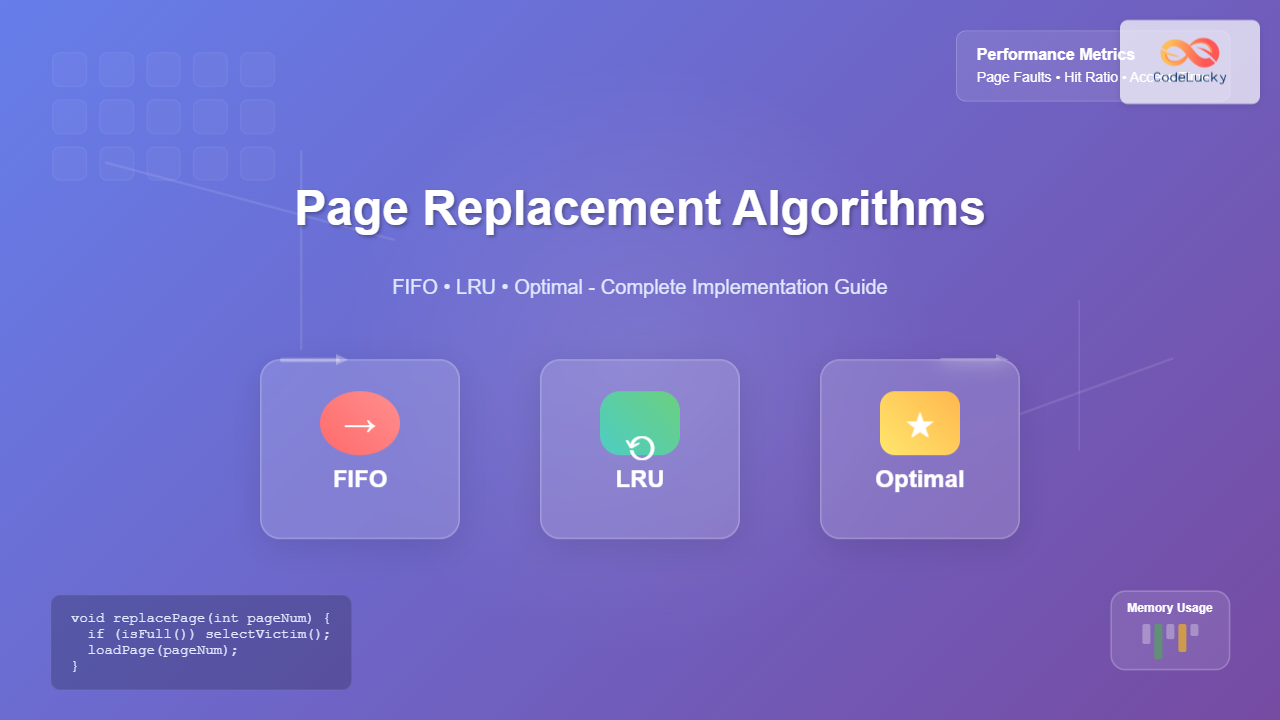
The FIFO algorithm is the simplest page replacement strategy. It maintains the order in which pages were loaded into memory and always replaces the oldest page first. This algorithm treats memory frames like a queue – the first page loaded is the first to be replaced.
FIFO Algorithm Characteristics
- Implementation: Simple queue-based structure
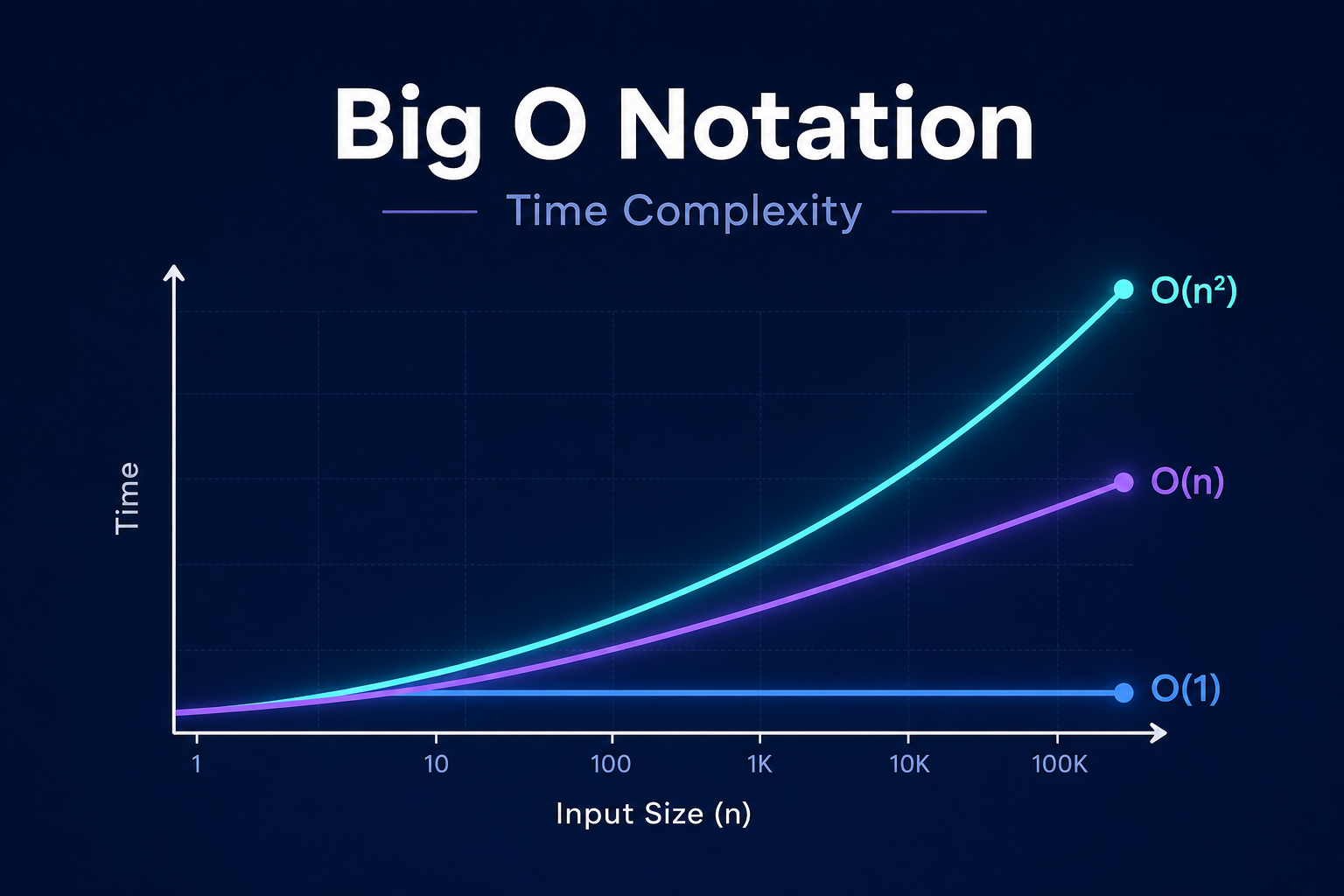
- Time Complexity: O(1) for replacement decision
- Space Complexity: O(n) where n is the number of frames
- Advantage: Easy to implement and understand
- Disadvantage: Doesn’t consider page usage patterns
FIFO Example Walkthrough
Let’s trace through an example with 3 memory frames and the reference string: 1, 2, 3, 4, 1, 2, 5, 1, 2, 3, 4, 5
Step-by-Step FIFO Execution
| Step | Page Reference | Frame 0 | Frame 1 | Frame 2 | Page Fault? |
|---|---|---|---|---|---|
| 1 | 1 | 1 | – | – | Yes |
| 2 | 2 | 1 | 2 | – | Yes |
| 3 | 3 | 1 | 2 | 3 | Yes |
| 4 | 4 | 4 | 2 | 3 | Yes |
| 5 | 1 | 4 | 1 | 3 | Yes |
| 6 | 2 | 4 | 1 | 2 | Yes |
Legend: Green = New page loaded | Red = Page replaced
Belady’s Anomaly in FIFO
FIFO suffers from a counterintuitive phenomenon called Belady’s Anomaly, where increasing the number of memory frames can actually increase the number of page faults. This occurs because FIFO doesn’t consider the future usage of pages.
Example of Belady’s Anomaly
Reference string: 1, 2, 3, 4, 1, 2, 5, 1, 2, 3, 4, 5
- With 3 frames: 9 page faults
- With 4 frames: 10 page faults
LRU (Least Recently Used) Algorithm
The LRU algorithm is based on the principle of temporal locality – recently accessed pages are more likely to be accessed again soon. It replaces the page that has been unused for the longest period of time.
LRU Algorithm Characteristics
- Implementation: Requires tracking access times or maintaining access order
- Time Complexity: O(1) with proper data structures (doubly-linked list + hash map)
- Space Complexity: O(n) for tracking structures
- Advantage: Better performance than FIFO, respects temporal locality
- Disadvantage: More complex implementation, overhead for tracking
LRU Implementation Approaches
There are several ways to implement LRU:
- Counter Method: Associate a counter with each page, increment on access
- Stack Method: Maintain a stack of page numbers, move accessed page to top
- Doubly Linked List + Hash Map: Most efficient O(1) implementation
LRU Example Walkthrough
Using the same reference string: 1, 2, 3, 4, 1, 2, 5, 1, 2, 3, 4, 5 with 3 frames:
| Step | Page Reference | Memory State | LRU Order | Page Fault? |
|---|---|---|---|---|
| 1 | 1 | [1, -, -] | 1 (most recent) | Yes |
| 2 | 2 | [1, 2, -] | 2, 1 | Yes |
| 3 | 3 | [1, 2, 3] | 3, 2, 1 | Yes |
| 4 | 4 | [4, 2, 3] | 4, 3, 2 (1 removed) | Yes |
| 5 | 1 | [4, 1, 3] | 1, 4, 3 (2 removed) | Yes |
| 6 | 2 | [4, 1, 2] | 2, 1, 4 (3 removed) | Yes |

Optimal Page Replacement Algorithm
The Optimal algorithm, also known as Farthest-in-Future or MIN, replaces the page that will be accessed farthest in the future. If a page will never be accessed again, it’s the perfect candidate for replacement.
Optimal Algorithm Characteristics
- Implementation: Requires knowledge of future page accesses
- Time Complexity: O(n×m) where n is reference string length, m is number of frames
- Practicality: Not implementable in real systems
- Purpose: Theoretical benchmark for comparison
- Advantage: Minimum possible page fault rate
- Disadvantage: Requires future knowledge (impossible in practice)
Optimal Algorithm Example
Using the reference string: 1, 2, 3, 4, 1, 2, 5, 1, 2, 3, 4, 5 with 3 frames:
| Step | Page Reference | Memory State | Future Accesses | Page Fault? |
|---|---|---|---|---|
| 4 | 4 | [1, 2, 3] → [4, 2, 3] | 1→next at pos 5, 2→next at pos 6, 3→next at pos 10 | Yes (replace 3) |
| 7 | 5 | [4, 2, 1] → [5, 2, 1] | 4→next at pos 11, 2→next at pos 8, 1→next at pos 8 | Yes (replace 4) |
Comparison of Page Replacement Algorithms
| Algorithm | Page Faults (Example) | Implementation Complexity | Overhead | Belady’s Anomaly |
|---|---|---|---|---|
| FIFO | 9 | Very Low | Minimal | Yes |
| LRU | 8 | Medium | Moderate | No |
| Optimal | 6 | Impossible | N/A | No |
Advanced Page Replacement Techniques
Clock Algorithm (Second Chance)
The Clock algorithm is a practical approximation of LRU that uses a reference bit for each page. It’s also known as the Second Chance algorithm.
- Mechanism: Circular list with reference bits
- Operation: Give pages a “second chance” if referenced recently
- Advantage: Better than FIFO, simpler than LRU
- Use case: Many real operating systems
Enhanced Second Chance Algorithm
This algorithm considers both reference and modify bits, creating four categories:
- (0,0): Not recently used, not modified – best candidate
- (0,1): Not recently used, but modified – requires write to disk
- (1,0): Recently used, not modified – give second chance
- (1,1): Recently used and modified – give second chance
Performance Analysis and Metrics
Key Performance Indicators

Factors Affecting Performance
- Reference String Patterns: Sequential vs. random access
- Working Set Size: Number of pages actively used
- Memory Frame Count: More frames generally reduce page faults
- Page Size: Larger pages reduce fault frequency but waste space
- Temporal Locality: Recent pages likely to be accessed again
- Spatial Locality: Nearby pages likely to be accessed together
Implementation Considerations
Hardware Support Requirements
Different algorithms require varying levels of hardware support:
- FIFO: No special hardware needed
- LRU: Reference bits or counters for tracking access order
- Clock: Single reference bit per page
- Enhanced Second Chance: Reference and modify bits
Software Implementation Strategies
LRU Implementation with Doubly Linked List
struct PageNode {
    int pageNumber;
    struct PageNode* prev;
    struct PageNode* next;
};

struct LRUCache {
    int capacity;
    int size;
    struct PageNode* head; // Most recently used
    struct PageNode* tail; // Least recently used
    HashMap* pageMap;      // Page number -> Node mapping
};

void accessPage(struct LRUCache* cache, int pageNumber) {
    if (pageExists(cache, pageNumber)) {
        // Move to front (most recently used)
        moveToHead(cache, pageNumber);
    } else {
        if (cache->size >= cache->capacity) {
            // Remove LRU page
            removeTail(cache);
        }
        // Add new page to head
        addToHead(cache, pageNumber);
    }
}
Real-World Applications
Operating System Implementations
- Linux: Uses Clock algorithm variants (2Q, ARC)
- Windows: Working Set Clock algorithm
- macOS: Modified Clock with aging
- Unix variants: Different Clock implementations
Database Buffer Management
Database systems also use page replacement algorithms for buffer pool management:
- LRU-K: Considers K previous references
- ARC (Adaptive Replacement Cache): Adapts between LRU and LFU
- 2Q: Two-queue strategy for better performance
Optimization Techniques
Working Set Model
The working set model defines the set of pages a process references during a time window. Understanding working sets helps optimize page replacement decisions.
Prefetching Strategies
- Sequential Prefetching: Load next pages in sequence
- Spatial Prefetching: Load nearby pages
- Temporal Prefetching: Load previously co-accessed pages
Adaptive Algorithms
Modern systems often use adaptive algorithms that adjust their behavior based on observed access patterns:
- ARC (Adaptive Replacement Cache): Balances between recency and frequency
- CAR (Clock with Adaptive Replacement): Low-overhead adaptive approach
- LIRS (Low Inter-Reference Recency Set): Distinguishes hot and cold pages
Performance Tuning Guidelines
Choosing the Right Algorithm
Decision Framework
- Use FIFO when: Simplicity is priority, minimal overhead required
- Use LRU when: Good performance needed, moderate overhead acceptable
- Use Clock when: Balance between performance and simplicity required
- Use Adaptive when: Workload patterns vary significantly
System Tuning Parameters
- Memory Pool Size: Balance between memory usage and performance
- Page Size: Consider internal vs. external fragmentation
- Replacement Frequency: Batch replacements for efficiency
- Prefetch Distance: How many pages to prefetch ahead

Conclusion
Page replacement algorithms are crucial for virtual memory system performance. While the Optimal algorithm provides the theoretical minimum page fault rate, practical systems rely on algorithms like LRU and Clock that approximate optimal behavior with reasonable overhead.
The choice between algorithms depends on:
- Performance requirements: How much overhead is acceptable
- Hardware capabilities: Available reference and modify bits
- Workload characteristics: Access patterns and temporal locality
- System constraints: Memory, CPU, and implementation complexity
FIFO remains valuable for its simplicity, LRU offers better performance for most workloads, and adaptive algorithms provide the best results for varying access patterns. Understanding these algorithms enables system administrators and developers to make informed decisions about memory management optimization.
Modern systems increasingly use hybrid approaches that combine multiple strategies, adjusting their behavior based on runtime analysis of access patterns. As memory hierarchies become more complex with technologies like persistent memory and storage-class memory, page replacement algorithms continue to evolve to meet new performance challenges.
Related Posts
Demand Paging: Loading Pages on Demand for Efficiency
Introduction to Demand Paging Demand paging is a sophisticated memory management technique used by modern operating systems to optimize memory...
Paging in Operating System: Complete Guide to Memory Management and Page Tables
What is Paging in Operating Systems? Paging is a memory management scheme that allows the operating system to store and...
Working Set Model: Memory Management Strategy for Operating Systems
The Working Set Model is a fundamental memory management strategy that revolutionized how operating systems handle virtual memory allocation and...
Virtual Memory in OS: Complete Guide to Paging, Segmentation and Address Translation
Virtual memory is one of the most fundamental concepts in modern operating systems, enabling efficient memory management and providing crucial...
Thrashing in Operating System: Complete Guide to Causes, Effects and Prevention Techniques
What is Thrashing in Operating System? Thrashing is a critical performance degradation condition in operating systems where the system spends...
Memory Management in Operating System: Virtual and Physical Memory Fundamentals
Introduction to Memory Management Memory management is one of the most critical functions of an operating system, responsible for efficiently...

Garbage Collection in Operating System: Complete Guide to Automatic Memory Management
What is Garbage Collection in Operating Systems? Garbage collection is an automatic memory management technique used by operating systems and...
Memory Protection: Hardware and Software Mechanisms for Secure Computing
Understanding Memory Protection in Modern Computing Memory protection is a fundamental security mechanism that prevents programs from accessing memory regions...

Windows Memory Management: Virtual Memory Implementation and Optimization Guide
Introduction to Windows Virtual Memory Windows virtual memory is a sophisticated memory management system that allows programs to use more...
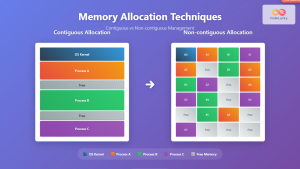
Memory Allocation Techniques: Contiguous vs Non-contiguous Management Strategies
Memory allocation is a fundamental aspect of operating system design that determines how programs and data are stored and accessed...
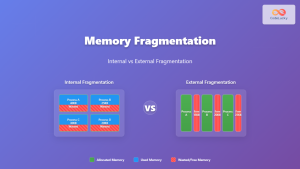
Memory Fragmentation: Internal vs External Fragmentation in Operating Systems
Memory fragmentation is one of the most critical challenges in operating system memory management, directly impacting system performance and resource...

C Memory Management: Advanced Techniques and Best Practices
Memory management is a critical aspect of C programming that can make or break your application's performance and reliability. In...