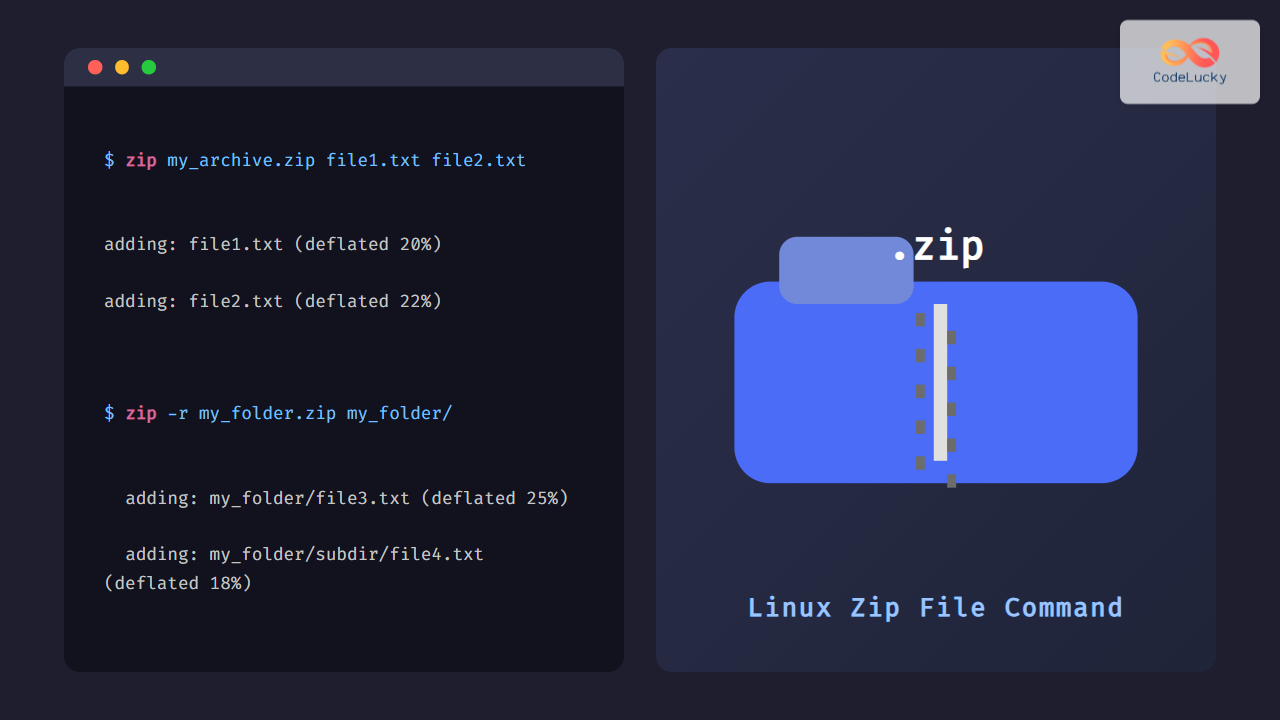
Creating zip files on Linux is an essential skill for developers, system administrators, and anyone working with files regularly. This tutorial provides a detailed, step-by-step guide on how to efficiently create zip archives using the Linux command line. Whether compressing a few files or entire directories, this article covers everything from basic commands to advanced options with clear, practical examples and helpful visual explanations.
What is a Zip File?
A zip file is a compressed archive that can store one or more files or directories in a reduced size format, making file storage and transfer faster and more efficient. Zip files use the widely supported .zip extension and can be easily created and extracted on Linux systems using command line tools.
Installing the zip Utility on Linux
Most Linux distributions come with the zip utility installed by default. To check if you have it installed, run:
zip -vIf it’s not installed, use your package manager to install it:
- Debian/Ubuntu:
sudo apt install zip - Fedora:
sudo dnf install zip - Arch Linux:
sudo pacman -S zip
Basic Zip Command Syntax
The basic syntax for creating a zip file is:
zip [options] archive_name.zip files_to_compressHere:
archive_name.zipis the name you want to give your zip file.files_to_compressare one or more files or directories you want to include.
Creating a Zip File with Multiple Files
To zip multiple files, simply list them after the archive name:
zip my_archive.zip file1.txt file2.txt file3.txtThis command creates my_archive.zip containing three text files.
Example with Output
$ zip my_archive.zip file1.txt file2.txt
  adding: file1.txt (deflated 20%)
  adding: file2.txt (deflated 22%)
Zipping a Directory Recursively
Use the -r (recursive) option to zip an entire directory and its contents:
zip -r my_folder.zip my_folder/This command compresses the my_folder directory and all files/subdirectories inside it.

Additional Useful Zip Options
-e— Encrypt the zip file with a password:zip -e secure.zip file.txt-q— Quiet mode (no output):zip -q archive.zip file.txt-u— Update existing zip archive with newer files or add new files:zip -u archive.zip file.txt-x— Exclude files by pattern:zip -r archive.zip my_folder/ -x "*.log"(exclude all .log files)
Viewing the Contents of a Zip Archive
To see what’s inside a zip archive without extracting it, use:
unzip -l archive.zipExample output:
$ unzip -l my_archive.zip
Archive:  my_archive.zip
  Length      Date    Time    Name
---------  ---------- -----   ----
      123  2025-08-30 18:45   file1.txt
      456  2025-08-30 18:46   file2.txt
---------                     -------
      579                     2 files
Extracting Zip Files
To unzip an archive, use the unzip command:
unzip archive.zipThis extracts contents into the current directory. Additional options allow specifying the target extraction directory or overwriting behavior.
Interactive Example: Creating and Extracting Zip Files
If running commands interactively in your Linux terminal, try the following workflow:
# Create some files
echo "Hello, Linux!" > file1.txt
echo "How to zip files" > file2.txt

# Zip them
zip mydocs.zip file1.txt file2.txt

# List zip contents
unzip -l mydocs.zip

# Extract zip contents to new directory
mkdir extracted_files
unzip mydocs.zip -d extracted_files
Summary of Key Commands
| Action | Command | Description |
|---|---|---|
| Create zip of files | zip archive.zip file1 file2 |
Compress specified files into one archive |
| Zip directory recursively | zip -r archive.zip directory/ |
Compress a directory including subfolders |
| Encrypt zip file | zip -e secure.zip file |
Password protect the zip archive |
| View zip contents | unzip -l archive.zip |
List files inside the zip without extracting |
| Extract zip | unzip archive.zip |
Extract files from the zip archive |
Troubleshooting Common Issues
- Command not found: Install zip using your distribution’s package manager.
- Permission denied: Run commands with appropriate user rights or using
sudoif necessary. - Corrupted zip archives: Try using
zip -FF archive.zip --out fixed.zipto fix damaged zip files.
Conclusion
Compressing files into zip archives on Linux is straightforward with the zip command line tool. This tutorial presented essential commands with practical examples, visuals, and an interactive guide ensuring both beginners and advanced users can easily archive their files securely and efficiently. Mastering these commands helps improve file management and data transfer workflows on Linux systems.