Gross Domestic Product (GDP) is one of the most important economic indicators used to measure a country’s overall economic health. Understanding GDP and economic growth provides a foundation for analyzing national performance, shaping policies, and making better financial or investment decisions.
What is GDP?
GDP stands for Gross Domestic Product. It represents the total monetary value of all final goods and services produced within a country’s borders over a specific period. Generally calculated annually or quarterly, GDP is the primary measure of a nation’s economic output.
GDP helps answer key questions like:
- How fast is an economy growing?
- Is the nation producing more goods and services than before?
- How does one country’s economy compare with another’s?
Formula for GDP
The most common approach to calculating GDP is the Expenditure Method, which sums total spending across the economy:
GDP = C + I + G + (X − M)
- C = Consumption spending by households
- I = Investment spending by firms
- G = Government spending
- X = Exports
- M = Imports
Example:
If households spend ₹5,000 billion, businesses invest ₹3,000 billion, government spends ₹2,000 billion, exports are ₹1,500 billion and imports ₹1,000 billion, then:
GDP = 5000 + 3000 + 2000 + (1500 - 1000) = ₹9,500 billion
Types of GDP
There are different variations of GDP that represent different aspects of economic performance:
- Nominal GDP: Measured at current market prices, without adjusting for inflation.
- Real GDP: Adjusted for inflation, showing true growth in output.
- Per Capita GDP: GDP divided by the population — indicates average income or standard of living.
Visual: Components of GDP Calculation
Economic Growth Explained
Economic growth refers to the increase in a country’s production of goods and services over time, reflected by the rise in real GDP. It indicates improved living standards, higher employment levels, and enhanced business opportunities.
When real GDP grows consistently, it signals a healthy and expanding economy. However, slow or negative growth could point to recession or policy inefficiencies.
Factors Driving Economic Growth
- Capital Formation: Investments in machines, infrastructure, and technology boost productivity.
- Labor Force: An educated and skilled workforce expands production capacity.
- Technological Innovation: Automating production or creating new products accelerates growth.
- Government Policy: Sound fiscal and monetary policies encourage business activities.
- Natural Resources: Efficient resource utilization adds to economic output.
Interactive Example: GDP Growth Simulator
Think of a simplified model where citizens’ income rises annually. Use this quick simulation example to visualize compound growth:
Initial GDP = 1000
Annual Growth Rate = 5%
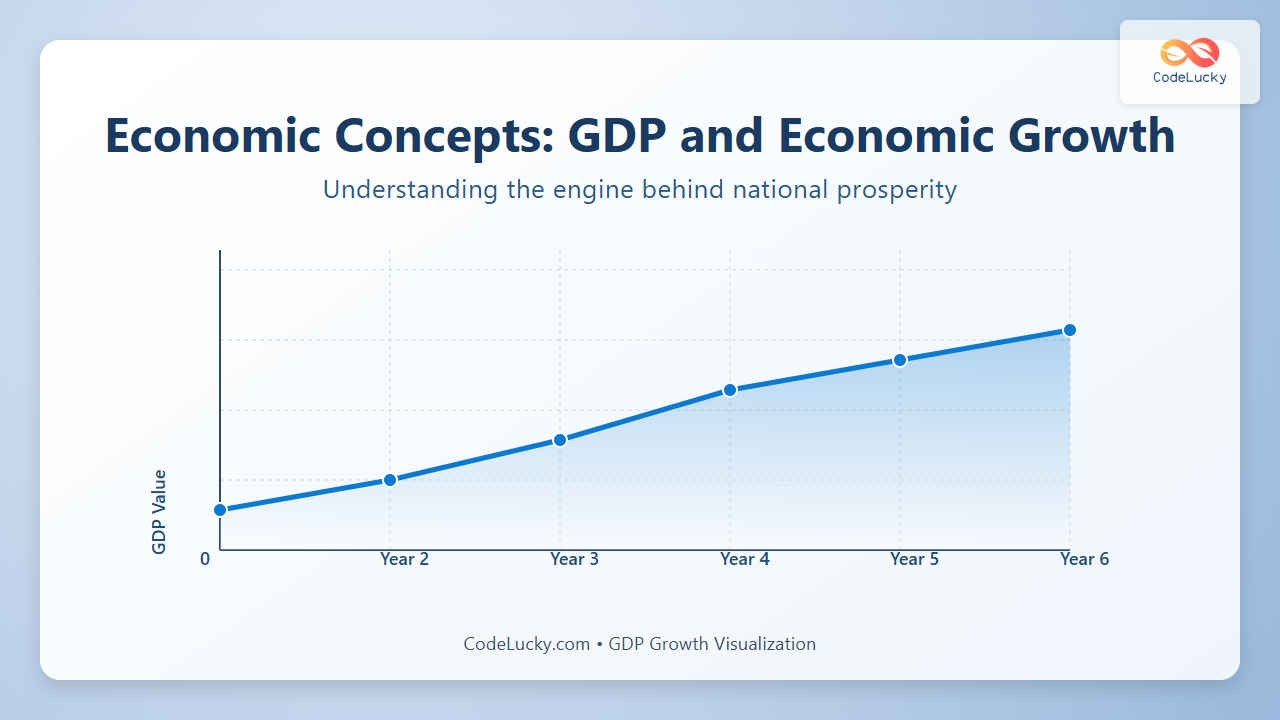
After 5 years: GDP = 1000 × (1 + 0.05)^5 = 1276.28
That’s a 27.6% total growth in just 5 years at a 5% annual rate!
Mermaid Visualization: GDP Growth Over Time

Why GDP and Growth Matter
GDP and economic growth are not just numbers on a graph — they represent living standards, employment, and overall national well-being. Policymakers, investors, and businesses rely on these figures to:
- Set interest rates through central banks like the RBI or Federal Reserve.
- Identify economic cycles — boom, recession, or recovery.
- Plan investment and production targets.
- Evaluate tax revenue potential.
- Compare economic performance internationally.
Diagram: GDP and Policy Relationship

Challenges in Measuring GDP
Though GDP is a powerful tool, it has limitations:
- It ignores non-market activities (like unpaid household work).
- It doesn’t measure income distribution or inequality.
- Environmental sustainability is often unaccounted for.
- Higher GDP doesn’t always mean improved quality of life.
Alternatives to GDP
Modern economists often complement GDP with other measures like:
- GNH (Gross National Happiness): Focuses on well-being over mere production.
- HDI (Human Development Index): Considers education, health, and income.
- GPI (Genuine Progress Indicator): Adjusts for environmental and social factors.
Conclusion
Understanding GDP and economic growth enables you to interpret financial news, investment trends, and government policies with clarity. Whether you’re a student, investor, or policymaker, these concepts form the backbone of sound economic reasoning.
In short: GDP measures how much an economy produces; economic growth measures how fast that production is rising. Together, they serve as key indicators of prosperity and economic resilience.