What is Garbage Collection in Operating Systems?
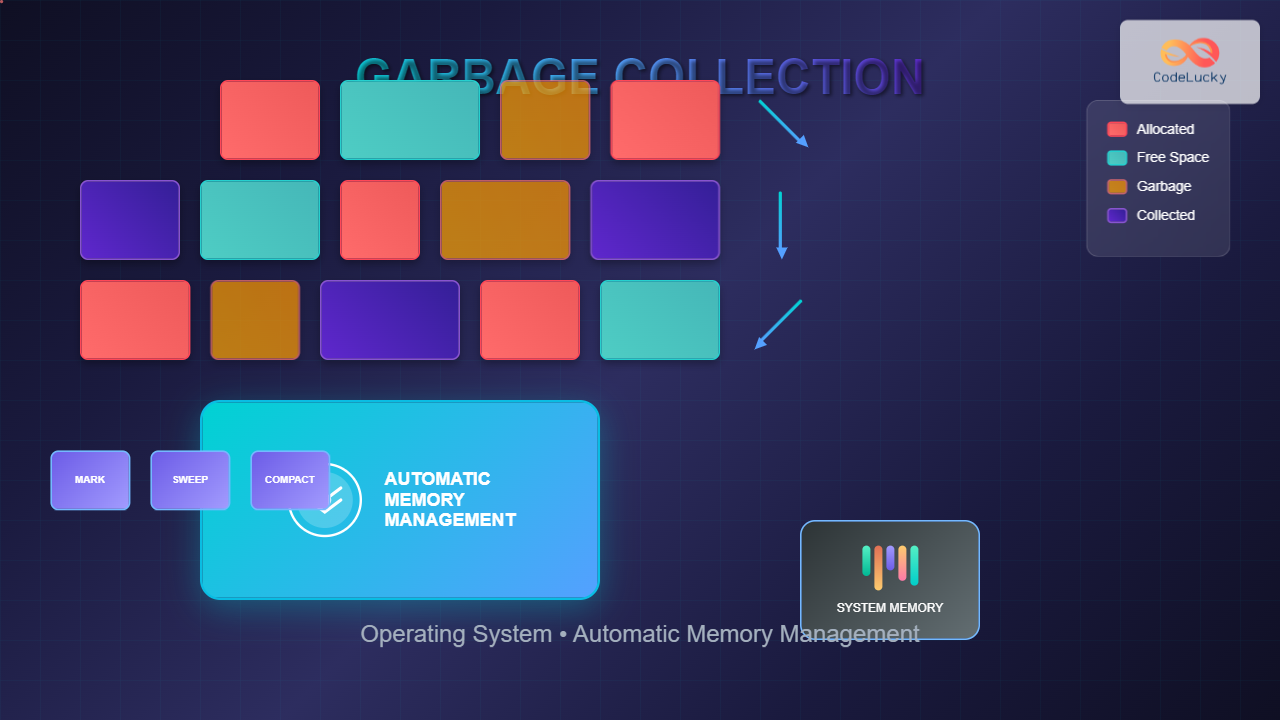
Garbage collection is an automatic memory management technique used by operating systems and runtime environments to automatically reclaim memory that is no longer in use by running programs. Unlike manual memory management where programmers explicitly allocate and deallocate memory, garbage collection handles this process transparently, preventing memory leaks and reducing programming errors.
In the context of operating systems, garbage collection can occur at multiple levels – from the OS kernel managing system resources to runtime environments managing application memory. This automated approach ensures optimal memory utilization and system stability.
How Garbage Collection Works
The garbage collection process involves several key steps:
- Object Tracking: The system maintains references to all allocated objects
- Reachability Analysis: Determines which objects are still accessible from active program execution
- Mark Phase: Identifies objects that are no longer reachable (garbage)
- Sweep Phase: Deallocates memory occupied by garbage objects
- Compaction: Optional step to reorganize memory and eliminate fragmentation

Types of Garbage Collection Algorithms
1. Mark and Sweep Algorithm
The mark and sweep algorithm is one of the most fundamental garbage collection techniques. It operates in two distinct phases:
- Mark Phase: Starting from root references, traverse all reachable objects and mark them as “live”
- Sweep Phase: Scan the entire heap and deallocate all unmarked objects
// Simplified Mark and Sweep Implementation
void mark_and_sweep() {
    // Mark phase
    for (each root reference r) {
        mark(r);
    }

    // Sweep phase
    for (each object o in heap) {
        if (!o.marked) {
            free(o);
        } else {
            o.marked = false; // Reset for next cycle
        }
    }
}

void mark(Object* obj) {
    if (obj && !obj->marked) {
        obj->marked = true;
        for (each reference r in obj) {
            mark(r);
        }
    }
}

2. Reference Counting
Reference counting maintains a count of how many references point to each object. When the count reaches zero, the object can be immediately deallocated.
typedef struct Object {
    int ref_count;
    void* data;
    struct Object** references;
} Object;

void increment_ref(Object* obj) {
    if (obj) {
        obj->ref_count++;
    }
}

void decrement_ref(Object* obj) {
    if (obj && --obj->ref_count == 0) {
        // Deallocate referenced objects
        for (int i = 0; obj->references[i]; i++) {
            decrement_ref(obj->references[i]);
        }
        free(obj);
    }
}
Advantages:
- Immediate memory reclamation
- Predictable pause times
- Good cache locality
Disadvantages:
- Cannot handle circular references
- Memory overhead for storing counts
- Performance overhead on each reference operation
3. Generational Garbage Collection
Generational GC is based on the observation that most objects die young. It divides the heap into generations:
- Young Generation: Newly allocated objects
- Old Generation: Long-lived objects that survived multiple GC cycles

// Generational GC Structure
typedef struct {
    void* young_gen_start;
    void* young_gen_end;
    void* old_gen_start;
    void* old_gen_end;
    int minor_gc_count;
} GenerationalHeap;

void minor_gc(GenerationalHeap* heap) {
    // Collect young generation only
    mark_young_generation(heap);
    sweep_young_generation(heap);
    promote_survivors(heap);
}

void major_gc(GenerationalHeap* heap) {
    // Collect entire heap
    mark_all_generations(heap);
    sweep_all_generations(heap);
}
4. Concurrent Garbage Collection
Concurrent GC runs simultaneously with the application threads to minimize pause times. This is crucial for real-time systems and interactive applications.
// Concurrent GC with tri-color marking
typedef enum {
    WHITE,  // Unvisited
    GRAY,   // Visited but children not processed
    BLACK   // Fully processed
} Color;

typedef struct {
    Color color;
    Object** references;
    void* data;
} ConcurrentObject;

void concurrent_mark() {
    while (gray_objects_exist()) {
        Object* obj = get_gray_object();
        for (each reference r in obj) {
            if (r->color == WHITE) {
                r->color = GRAY;
                add_to_gray_set(r);
            }
        }
        obj->color = BLACK;
    }
}
Operating System Level Garbage Collection
Kernel Memory Management
Operating system kernels implement their own garbage collection mechanisms for managing system resources:
// Linux kernel slab allocator example
struct kmem_cache {
    struct kmem_cache_cpu __percpu *cpu_slab;
    unsigned int size;
    unsigned int object_size;
    unsigned int align;
    const char *name;
    struct list_head list;
};

void* kmalloc(size_t size, gfp_t flags) {
    struct kmem_cache *s;
    void *ret;

    s = kmalloc_slab(size, flags);
    if (unlikely(ZERO_OR_NULL_PTR(s)))
        return s;

    ret = slab_alloc(s, flags, _RET_IP_);
    return ret;
}

void kfree(const void *objp) {
    struct kmem_cache *c;
    unsigned long flags;

    c = virt_to_cache(objp);
    debug_check_no_locks_freed(objp, c->object_size);
    __cache_free(c, (void *)objp, _RET_IP_);
}
Process Memory Cleanup
When processes terminate, the OS performs comprehensive memory cleanup:

// Simplified process cleanup in OS
void cleanup_process(struct task_struct *task) {
    // Close all file descriptors
    close_files(task->files);

    // Release memory mappings
    exit_mm(task);

    // Free process pages
    for (each vma in task->mm->mmap) {
        unmap_page_range(vma->vm_start, vma->vm_end);
        free_page_range(vma);
    }

    // Release page directory
    free_page_tables(task->mm->pgd);

    // Free process descriptor
    free_task_struct(task);
}
Runtime Environment Garbage Collection
Java Virtual Machine (JVM)
The JVM implements sophisticated garbage collection algorithms:
// Java example showing GC behavior
public class GCExample {
    private static List<byte[]> memory = new ArrayList<>();

    public static void main(String[] args) {
        // Monitor GC activity
        Runtime runtime = Runtime.getRuntime();

        System.out.println("Initial memory: " +
            (runtime.totalMemory() - runtime.freeMemory()));

        // Allocate memory
        for (int i = 0; i < 1000; i++) {
            memory.add(new byte[1024 * 1024]); // 1MB each

            if (i % 100 == 0) {
                System.gc(); // Suggest garbage collection
                System.out.println("After " + i + " allocations: " +
                    (runtime.totalMemory() - runtime.freeMemory()));
            }
        }

        // Clear references to trigger GC
        memory.clear();
        System.gc();

        System.out.println("After cleanup: " +
            (runtime.totalMemory() - runtime.freeMemory()));
    }
}
.NET Garbage Collector
The .NET runtime provides automatic memory management with generational collection:
using System;
using System.Collections.Generic;

class GCDemo {
    static void Main() {
        // Monitor GC generations
        Console.WriteLine($"Gen 0: {GC.CollectionCount(0)}");
        Console.WriteLine($"Gen 1: {GC.CollectionCount(1)}");
        Console.WriteLine($"Gen 2: {GC.CollectionCount(2)}");

        // Allocate objects
        List<object> objects = new List<object>();
        for (int i = 0; i < 100000; i++) {
            objects.Add(new object());
        }

        Console.WriteLine("After allocation:");
        Console.WriteLine($"Gen 0: {GC.CollectionCount(0)}");
        Console.WriteLine($"Gen 1: {GC.CollectionCount(1)}");
        Console.WriteLine($"Gen 2: {GC.CollectionCount(2)}");

        // Force full garbage collection
        GC.Collect();
        GC.WaitForPendingFinalizers();

        Console.WriteLine("After forced GC:");
        Console.WriteLine($"Gen 0: {GC.CollectionCount(0)}");
        Console.WriteLine($"Gen 1: {GC.CollectionCount(1)}");
        Console.WriteLine($"Gen 2: {GC.CollectionCount(2)}");
    }
}
Performance Considerations
GC Pause Times
Different garbage collection algorithms have varying impact on application performance:
| Algorithm | Pause Time | Throughput | Memory Overhead | Best Use Case |
|---|---|---|---|---|
| Mark & Sweep | High | Good | Low | Batch processing |
| Reference Counting | Very Low | Good | Medium | Real-time systems |
| Generational | Low-Medium | Very Good | Medium | Most applications |
| Concurrent | Very Low | Medium | High | Interactive applications |
Memory Fragmentation
Garbage collection helps reduce memory fragmentation through compaction:
// Memory compaction algorithm
void compact_heap(void* heap_start, void* heap_end) {
    void* scan = heap_start;
    void* free_ptr = heap_start;

    while (scan < heap_end) {
        Object* obj = (Object*)scan;

        if (obj->marked) {
            if (scan != free_ptr) {
                // Move object to eliminate gaps
                memmove(free_ptr, scan, obj->size);
                update_references(obj, free_ptr);
            }
            free_ptr += obj->size;
        }

        scan += obj->size;
    }

    // Update heap top pointer
    heap_top = free_ptr;
}
Advanced Garbage Collection Techniques
Incremental Garbage Collection
Incremental GC breaks the collection work into smaller chunks to reduce pause times:
typedef struct {
    int work_units_per_allocation;
    int work_units_remaining;
    GCState current_state;
} IncrementalGC;

void incremental_gc_step(IncrementalGC* gc) {
    int work_done = 0;

    while (work_done < gc->work_units_per_allocation &&
           gc->work_units_remaining > 0) {

        switch (gc->current_state) {
            case GC_MARK:
                work_done += mark_some_objects();
                break;
            case GC_SWEEP:
                work_done += sweep_some_objects();
                break;
            case GC_COMPACT:
                work_done += compact_some_memory();
                break;
        }

        gc->work_units_remaining--;
    }

    if (gc->work_units_remaining == 0) {
        advance_gc_state(gc);
    }
}
Parallel Garbage Collection
Parallel GC uses multiple threads to perform collection work simultaneously:

// Parallel marking with work stealing
typedef struct {
    Object** work_queue;
    int queue_head;
    int queue_tail;
    pthread_mutex_t queue_mutex;
} WorkStealingQueue;

void* parallel_mark_worker(void* arg) {
    WorkStealingQueue* queue = (WorkStealingQueue*)arg;
    Object* obj;

    while ((obj = steal_work(queue)) != NULL) {
        mark_object(obj);

        // Add children to work queue
        for (each reference r in obj) {
            if (!r->marked) {
                add_work(queue, r);
            }
        }
    }

    return NULL;
}

void parallel_mark_phase() {
    pthread_t workers[NUM_GC_THREADS];
    WorkStealingQueue queue;

    initialize_work_queue(&queue);

    // Start worker threads
    for (int i = 0; i < NUM_GC_THREADS; i++) {
        pthread_create(&workers[i], NULL, parallel_mark_worker, &queue);
    }

    // Wait for completion
    for (int i = 0; i < NUM_GC_THREADS; i++) {
        pthread_join(workers[i], NULL);
    }
}
Tuning Garbage Collection
JVM GC Tuning Parameters
# G1 Garbage Collector tuning
java -XX:+UseG1GC \
     -XX:MaxGCPauseMillis=100 \
     -XX:G1HeapRegionSize=16m \
     -XX:G1NewSizePercent=20 \
     -XX:G1MaxNewSizePercent=40 \
     -XX:InitiatingHeapOccupancyPercent=45 \
     MyApplication

# Parallel GC tuning
java -XX:+UseParallelGC \
     -XX:ParallelGCThreads=8 \
     -XX:MaxGCPauseMillis=200 \
     -XX:GCTimeRatio=19 \
     MyApplication

# CMS (Concurrent Mark Sweep) tuning
java -XX:+UseConcMarkSweepGC \
     -XX:+CMSIncrementalMode \
     -XX:CMSInitiatingOccupancyFraction=70 \
     -XX:+CMSClassUnloadingEnabled \
     MyApplication
Monitoring GC Performance
// Java GC monitoring
import java.lang.management.GarbageCollectorMXBean;
import java.lang.management.ManagementFactory;

public class GCMonitor {
    public static void printGCStats() {
        for (GarbageCollectorMXBean gcBean :
             ManagementFactory.getGarbageCollectorMXBeans()) {

            System.out.println("GC Name: " + gcBean.getName());
            System.out.println("Collection Count: " + gcBean.getCollectionCount());
            System.out.println("Collection Time: " + gcBean.getCollectionTime() + "ms");
            System.out.println("Memory Pools: " + gcBean.getMemoryPoolNames());
            System.out.println("---");
        }
    }
}
Best Practices for Garbage Collection
Application Design Considerations
- Object Lifecycle Management: Design objects with predictable lifetimes
- Pool Resources: Use object pools for frequently allocated/deallocated objects
- Avoid Circular References: Design data structures to minimize circular dependencies
- Monitor Memory Usage: Implement memory monitoring and alerting
// Object pooling example
public class ObjectPool<T> {
    private final Queue<T> pool = new ConcurrentLinkedQueue<>();
    private final Supplier<T> objectFactory;

    public ObjectPool(Supplier<T> factory) {
        this.objectFactory = factory;
    }

    public T borrow() {
        T object = pool.poll();
        return (object != null) ? object : objectFactory.get();
    }

    public void returnObject(T object) {
        if (object != null) {
            resetObject(object);
            pool.offer(object);
        }
    }

    private void resetObject(T object) {
        // Reset object state for reuse
    }
}
Performance Optimization
// Minimize GC pressure in C applications
void optimize_memory_usage() {
    // Use stack allocation when possible
    char buffer[1024];  // Stack allocated

    // Reuse objects instead of frequent allocation/deallocation
    static Object reusable_object;
    reset_object(&reusable_object);

    // Use memory pools for frequent allocations
    void* obj = pool_allocate(object_pool);
    // ... use object ...
    pool_deallocate(object_pool, obj);

    // Batch allocations to reduce overhead
    Object* objects = malloc(sizeof(Object) * BATCH_SIZE);
    for (int i = 0; i < BATCH_SIZE; i++) {
        initialize_object(&objects[i]);
    }
}
Conclusion
Garbage collection is a critical component of modern operating systems and runtime environments, providing automatic memory management that significantly reduces programming errors and improves system reliability. Understanding the various algorithms and their trade-offs allows developers and system administrators to make informed decisions about memory management strategies.
The choice of garbage collection algorithm depends on specific requirements such as pause time sensitivity, memory constraints, and application workload characteristics. Modern systems often employ sophisticated hybrid approaches that combine multiple techniques to achieve optimal performance across diverse scenarios.
As computing systems continue to evolve with multi-core processors and distributed architectures, garbage collection algorithms are also advancing to provide better performance, lower latency, and more predictable behavior. Staying informed about these developments and understanding the fundamental principles ensures effective utilization of automatic memory management in operating system environments.
Related Posts

Java Memory Management: Understanding Garbage Collection
Java's automatic memory management is one of its most powerful features, freeing developers from the burden of manual memory allocation...
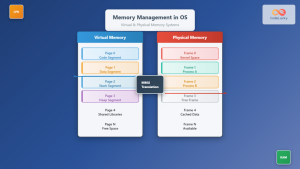
Memory Management in Operating System: Virtual and Physical Memory Fundamentals
Introduction to Memory Management Memory management is one of the most critical functions of an operating system, responsible for efficiently...

Process in Operating System: Complete Guide to Definition, States and Lifecycle
What is a Process in Operating System? A process is a program in execution that consists of the program code...

Memory Allocation Techniques: Contiguous vs Non-contiguous Management Strategies
Memory allocation is a fundamental aspect of operating system design that determines how programs and data are stored and accessed...

Virtual Memory in OS: Complete Guide to Paging, Segmentation and Address Translation
Virtual memory is one of the most fundamental concepts in modern operating systems, enabling efficient memory management and providing crucial...
Memory Protection: Hardware and Software Mechanisms for Secure Computing
Understanding Memory Protection in Modern Computing Memory protection is a fundamental security mechanism that prevents programs from accessing memory regions...

Windows Memory Management: Virtual Memory Implementation and Optimization Guide
Introduction to Windows Virtual Memory Windows virtual memory is a sophisticated memory management system that allows programs to use more...
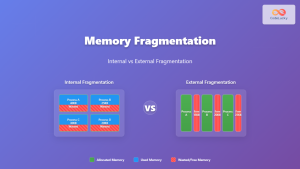
Memory Fragmentation: Internal vs External Fragmentation in Operating Systems
Memory fragmentation is one of the most critical challenges in operating system memory management, directly impacting system performance and resource...
Kernel in Operating System: Core Functions and Memory Management
The kernel stands as the fundamental cornerstone of any operating system, serving as the critical bridge between hardware components and...

Working Set Model: Memory Management Strategy for Operating Systems
The Working Set Model is a fundamental memory management strategy that revolutionized how operating systems handle virtual memory allocation and...

Thrashing in Operating System: Complete Guide to Causes, Effects and Prevention Techniques
What is Thrashing in Operating System? Thrashing is a critical performance degradation condition in operating systems where the system spends...
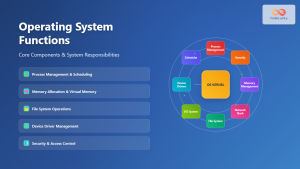
Operating System Functions: Core Components and System Responsibilities
An operating system (OS) serves as the fundamental software layer that manages computer hardware resources and provides essential services to...
- What is Garbage Collection in Operating Systems?
- How Garbage Collection Works
- Types of Garbage Collection Algorithms
- Operating System Level Garbage Collection
- Runtime Environment Garbage Collection
- Performance Considerations
- Advanced Garbage Collection Techniques
- Tuning Garbage Collection
- Best Practices for Garbage Collection
- Conclusion