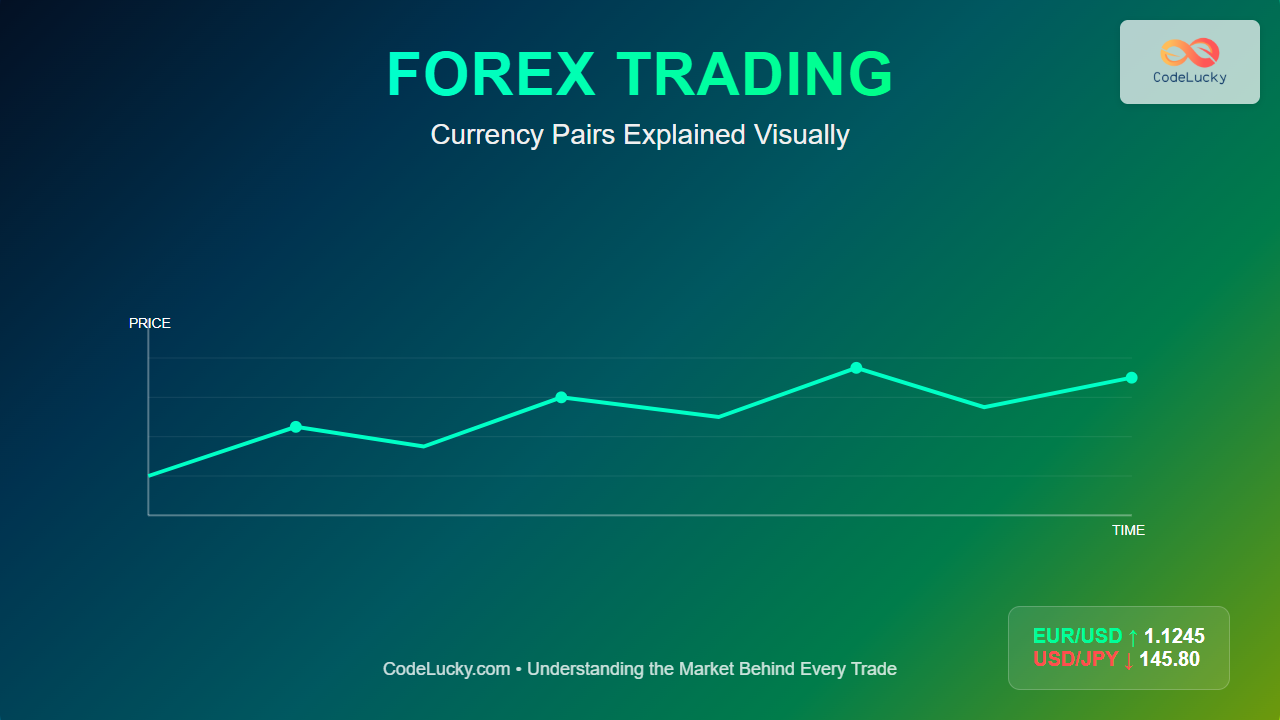
Forex Trading—short for “foreign exchange trading”—is the process of buying and selling currencies to make profits from changes in exchange rates. The global Forex market is the largest financial market in the world, with a daily turnover exceeding $6 trillion. Unlike stock exchanges that have physical locations, Forex operates 24 hours a day across time zones, making it accessible to traders worldwide.
What Is the Forex Market?
The Forex market is a decentralized marketplace where national currencies are traded. It primarily operates through electronic networks connecting large banks, corporations, governments, and individual traders. Currency values fluctuate constantly due to geopolitical, economic, and market sentiment factors.

This diagram illustrates how traders connect to the global market via brokers and liquidity providers that ensure buy/sell orders execute seamlessly.
How Forex Trading Works
Forex trading always happens in pairs—for example, EUR/USD or GBP/JPY. When you buy one currency, you automatically sell the other. The first currency in a pair is called the base currency, and the second is the quote currency. Exchange rates tell you how much of the quote currency you need to buy one unit of the base currency.
Example: If EUR/USD = 1.1000, you need 1.10 USD to buy 1 EUR. If the rate later rises to 1.1050, your euro becomes more valuable—meaning a trader holding EUR has gained.
Currency Pairs Categories
- Major Pairs: Always include the USD (e.g., EUR/USD, GBP/USD).
- Minor Pairs: Exclude the USD (e.g., EUR/GBP, NZD/JPY).
- Exotic Pairs: Combine a major currency with one from a developing economy (e.g., USD/INR, EUR/TRY).

As the chart shows, major pairs dominate trading activity due to high liquidity and narrow spreads.
Market Participants
Forex markets bring together various players, each with its own motivation:
- Central Banks: Manage national currency value and intervene to stabilize exchange rates.
- Commercial Banks & Corporations: Conduct currency exchanges for international trade and hedging.
- Retail Traders: Use online platforms to trade currencies for profit.
- Hedge Funds & Institutional Investors: Trade large volumes based on macroeconomic strategies.

Understanding Leverage and Margin
Leverage allows traders to control larger positions than their actual investment. For example, a leverage ratio of 100:1 means you can trade a $100,000 lot with just $1,000 of margin. However, leverage amplifies both profits and losses, making risk management crucial.
| Leverage Ratio | Control Amount | Your Equity | Potential Risk |
|---|---|---|---|
| 10:1 | $10,000 | $1,000 | Low |
| 50:1 | $50,000 | $1,000 | Medium |
| 100:1 | $100,000 | $1,000 | High |
How Forex Quotes Work (Bid/Ask)
Each Forex quote includes two prices:
- Bid: The price a broker will buy the base currency.
- Ask: The price the broker will sell the base currency.
The difference between these prices is the spread—the broker’s fee per trade. Tighter spreads generally occur on major pairs due to higher liquidity.
Example:
If EUR/USD = 1.1000 / 1.1002, the spread is 0.0002 (2 pips). Buying at 1.1002 and selling at 1.1000 would result in an immediate 2-pip loss due to spread cost.
Interactive Example: Simulating a Simple Trade
Try imagining this interactive scenario:
Initial: EUR/USD = 1.1000
You buy 10,000 EUR using 11,000 USD
Later: EUR/USD rises to 1.1050
Now 10,000 EUR = 11,050 USD
Profit = 50 USD
This simplified example shows how even small currency fluctuations can result in measurable gains or losses at scale.

Key Economic Factors Affecting Forex
- Interest Rates: Higher rates attract capital flows, strengthening a currency.
- Inflation: High inflation erodes purchasing power, weakening a currency.
- Political Stability: Strong governance increases investor confidence.
- Economic Growth: GDP trends and trade balance influence perception of currency strength.
Forex Trading Sessions
The Forex market operates 24 hours, split into major global sessions. Each session overlaps, creating opportunities for liquidity and volatility.

Most trading volume happens during London–New York overlap due to active participation from both Europe and North America.
Risk Management in Forex
Successful traders rely on strict risk rules:
- Use stop-loss orders to limit downside.
- Never risk more than 2% of capital per trade.
- Keep a trading journal tracking emotional and strategic decisions.
- Educate yourself continuously to adapt to market changes.
Final Thoughts
Understanding how Forex markets work can empower you to participate intelligently in one of the world’s most dynamic environments. Whether you aim to trade for profit, hedge exposures, or simply learn global economics, mastering Forex principles provides practical financial insight and valuable discipline for all investors.
Learn more about smart investment and financial strategies at CodeLucky.com’s Finance Series.