Forex trading, short for “foreign exchange trading,” is the process of buying and selling currencies in order to make a profit. It’s the largest and most liquid market in the world — even bigger than the stock and bond markets combined. Every day, trillions of dollars move through the forex market as individuals, institutions, and governments exchange currencies for trade, investment, and speculation.
What Is Forex Trading?
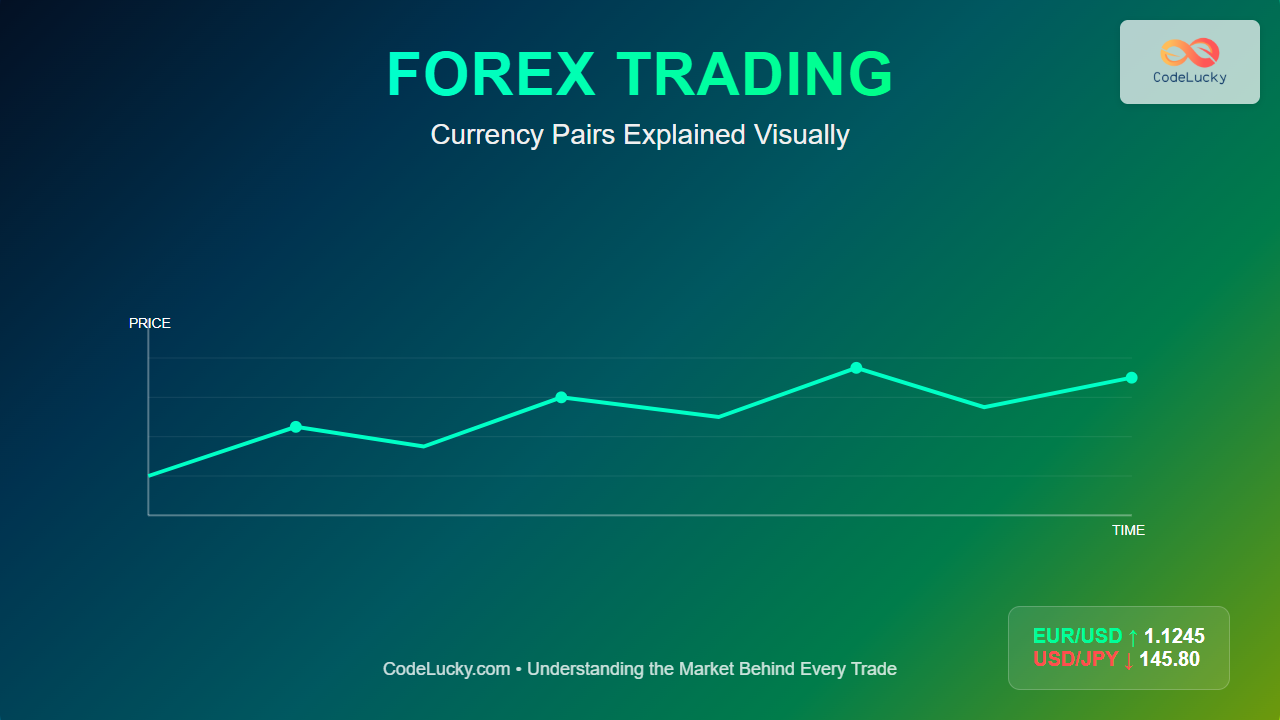
At its core, Forex trading involves exchanging one currency for another. The goal is to profit from changes in exchange rates between currency pairs such as EUR/USD, USD/INR, or GBP/JPY. When you trade forex, you’re effectively speculating on whether one currency will strengthen or weaken relative to another.
For example, if you believe the Euro will strengthen against the U.S. Dollar, you would buy EUR/USD. If your prediction is correct and the Euro’s value rises, you can sell it at a higher price for profit.
How the Forex Market Works
Unlike stock markets, the Forex market has no central exchange. It operates as an over-the-counter (OTC) network — a global web of banks, brokers, and traders communicating electronically.

This decentralized structure allows 24-hour trading, five days a week. Major trading sessions occur in London, New York, Tokyo, and Sydney, ensuring continuous market activity.
Currency Pairs Explained
Forex trading always happens in pairs because you trade one currency against another. Each pair consists of a base currency and a quote currency:
- Base Currency – The first currency in the pair (e.g., EUR in EUR/USD).
- Quote Currency – The second currency, showing how much it costs to buy one unit of the base currency.
For instance, if EUR/USD = 1.2000, it means 1 Euro equals 1.20 U.S. Dollars.
Types of Currency Pairs
- Major pairs – Include the U.S. Dollar (USD) and other strong global currencies like EUR, GBP, JPY, CHF.
- Minor pairs – Exclude the USD, like EUR/GBP or AUD/CAD.
- Exotic pairs – Combine a major currency with one from an emerging economy, like USD/INR or USD/THB.

How Forex Traders Make Money
Forex traders profit from price movements driven by global economic events and market psychology.
1. Buy Low, Sell High
If the EUR/USD pair rises from 1.2000 to 1.2100, buying one lot (100,000 units) would result in a $1,000 profit since each pip (0.0001) is worth $10 for that position size.
2. Use of Leverage
Forex trading often uses leverage, allowing traders to control large positions with smaller capital. For example, with 1:100 leverage, you can control $10,000 with just $100. However, leverage also magnifies losses if the market moves against you.

Example of a Live Forex Trade
Let’s say you open a buy position on EUR/USD at 1.1000 anticipating a rise. Ten hours later, the price climbs to 1.1050. You close your trade, earning 50 pips. If you traded 1 lot (100,000 EUR/USD), each pip equals $10, resulting in a $500 profit.
| Action | Price | Result |
|---|---|---|
| Buy EUR/USD | 1.1000 | Opened |
| Sell EUR/USD | 1.1050 | Closed (+50 pips) |
| Total Profit | – | $500 |
Who Trades in Forex?
The forex ecosystem includes a wide range of participants, from giant financial institutions to individual traders.

- Central Banks influence exchange rates through monetary policies.
- Commercial Banks facilitate liquidity and execute large transactions.
- Corporations trade forex to hedge against currency fluctuations in global trade.
- Retail Traders speculate on price movements through online trading platforms.
Risks Involved in Forex Trading
While forex trading offers potential for profit, it carries risks such as volatility, leverage-driven losses, and emotional trading errors. Risk management techniques, including stop-loss orders and position sizing, are essential to control exposure.
Getting Started with Forex Trading
Here’s a step-by-step path for beginners who want to start learning and trading forex safely:
- Learn the basics of currency pairs, pips, and leverage.
- Choose a regulated broker with good liquidity and low spreads.
- Practice on a demo account before investing real money.
- Develop a trading plan based on fundamental or technical analysis.
- Manage risk with stop-loss and take-profit levels.

Conclusion
Forex trading is an exciting market that empowers individuals to participate in global finance, offering opportunities for profit and skill development. Understanding how currency pairs, leverage, and market forces interact is key to trading responsibly. With the right strategy and continuous learning, even beginners can enter the forex world with confidence and clarity.