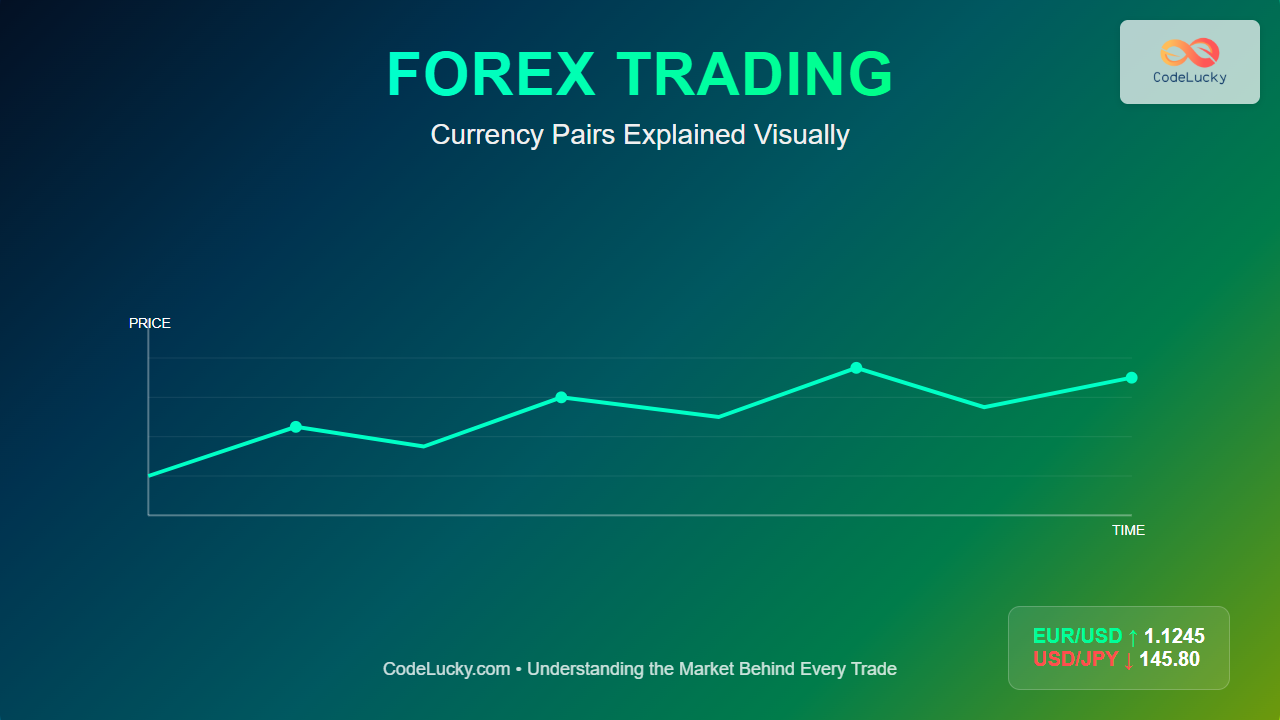
Forex Trading — short for foreign exchange — is the marketplace where currencies of different nations are traded. It’s the largest and most liquid financial market in the world, with trillions of dollars exchanged daily. To truly understand how forex trading works, it’s essential to grasp the concept of currency pairs.
This guide by CodeLucky.com dives deep into the structure of currency pairs, quoting mechanisms, and common trading examples — all focused on making you confident in reading, interpreting, and trading forex pairs effectively.
What Are Currency Pairs?
In forex trading, currencies are always traded in pairs. This is because every currency is valued relative to another. A pair consists of a base currency and a quote currency (also called counter currency).
Example: EUR/USD = 1.1200
- EUR is the base currency.
- USD is the quote currency.
- The rate 1.1200 means 1 Euro equals 1.12 US Dollars.
This quote tells you how much of the quote currency (USD) you’d need to buy one unit of the base currency (EUR). Traders buy or sell the base currency based on whether they expect it to strengthen or weaken against the quote.

Major, Minor, and Exotic Pairs
Currency pairs are grouped based on their liquidity and the economies they represent. Let’s explore the three main categories:
1. Major Pairs
These involve the US Dollar and the most traded global currencies. They have high liquidity and tight spreads.
- EUR/USD – Euro against the US Dollar
- GBP/USD – British Pound against the US Dollar
- USD/JPY – US Dollar against the Japanese Yen
- USD/CHF – US Dollar against the Swiss Franc
- AUD/USD – Australian Dollar against the US Dollar
2. Minor Pairs (Cross Currency Pairs)
Pairs that don’t include the US Dollar but involve major currencies.
- EUR/GBP – Euro against British Pound
- EUR/JPY – Euro against Japanese Yen
- GBP/JPY – British Pound against Japanese Yen
3. Exotic Pairs
These include one major currency and one from an emerging or smaller economy. They’re less liquid and more volatile.
- USD/INR – US Dollar vs Indian Rupee
- USD/TRY – US Dollar vs Turkish Lira
- EUR/SEK – Euro vs Swedish Krona
How Currency Quotes Work
Forex quotes are always presented with two prices — Bid and Ask (or Offer).
| Term | Description | Example (EUR/USD = 1.1200 / 1.1202) |
|---|---|---|
| Bid | Price at which the market will buy the base currency | 1.1200 |
| Ask | Price at which the market will sell the base currency | 1.1202 |
| Spread | Difference between Ask and Bid (broker’s commission) | 0.0002 or 2 pips |
Pips (percentage in points) are the smallest unit of movement in a forex rate. For most pairs, a pip equals 0.0001 of the quoted price.

Interactive Example: Understanding Profit/Loss
Let’s take an example to see how profits or losses are calculated.
Example: You buy 10,000 units of EUR/USD at 1.1200.
- If the price rises to 1.1250, the difference is 50 pips.
- You gained 50 pips × $1 per pip = $50 (for standard lot size of 10,000 units, assuming $1 per pip).
- If the price drops instead to 1.1180, you lose 20 pips ($20 loss).
Interactive Calculation:
Try adjusting the pip difference in a simple formula:
Profit/Loss = (Closing Price - Opening Price) × Lot Size × Pip ValueFor example, changing 1.1250 → 1.1260 would yield a 60 pip gain = $60.

Base vs Quote Currency Impact
Knowing which currency is base and which is quote is crucial. If you buy EUR/USD, you’re buying Euros and selling Dollars simultaneously. When EUR strengthens, your value increases. If EUR weakens, you lose.
Similarly, selling a pair means selling the base and buying the quote currency.

Why Forex Traders Focus on Currency Pairs
Currencies always move relative to one another, making pair movement the fundamental building block of forex strategy. Traders look for momentum, fundamental trends (like interest rate changes), or technical signals derived from chart patterns and indicators.
Understanding the type of pair helps plan the strategy:
- Major pairs – ideal for intraday trading with lower costs.
- Minor pairs – suitable for diversification.
- Exotic pairs – can generate high profits but come with higher volatility and slippage.
Final Thoughts
Currency pairs are the DNA of forex trading — everything you see, trade, or analyze revolves around them. Once you master how they’re structured, quoted, and move, you gain the clarity to make smarter trading decisions.
At CodeLucky.com, our mission is to simplify complex financial concepts through practical examples and intuitive explanations. If you found this tutorial useful, explore our other guides on technical analysis, lot sizing, and risk management for forex traders.