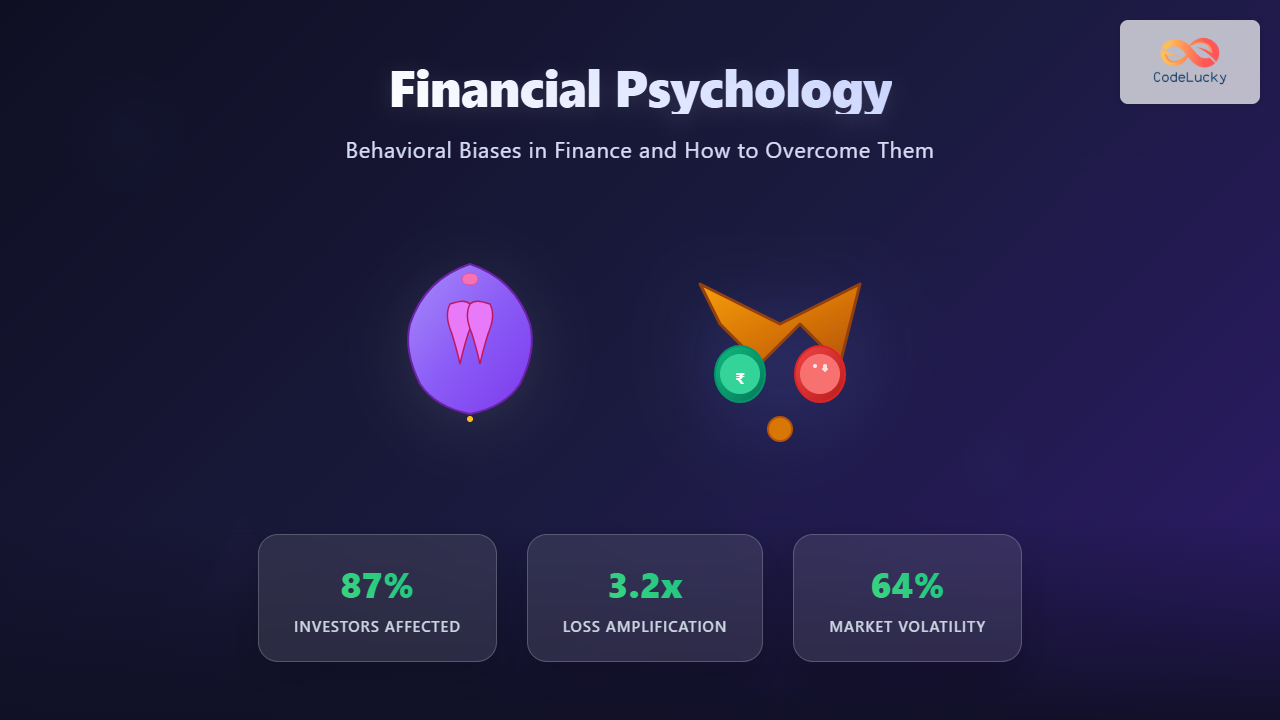
Financial Psychology explores the hidden forces of human behavior that drive financial decision-making. It reveals why investors often act irrationally and how emotions like fear, greed, and confidence shape market outcomes. Understanding behavioral biases in finance helps investors, traders, and individuals make smarter, evidence-based financial choices rather than emotional ones.
What is Financial Psychology?
Financial psychology is the study of how psychological influences—such as emotions, beliefs, and mental shortcuts—impact financial behavior. It blends behavioral economics and cognitive psychology to explain why people stray from purely rational decisions predicted by traditional finance theories.
For instance, two investors receiving the same market news may react differently—one sees it as an opportunity, the other as a threat. This is not randomness; it’s psychology at play.

Common Behavioral Biases in Finance
Every investor—new or experienced—faces certain cognitive biases that sway financial decisions. Below are the most influential ones and how they manifest in real-world scenarios.
1. Loss Aversion
People fear losses more than they value equivalent gains. Losing ₹1,000 feels worse than gaining ₹1,000 feels good. This leads to decisions like holding losing stocks hoping they’ll recover, or selling winners too early to “lock in” gains.
Example: Ravi invests ₹50,000 in a stock that drops to ₹40,000. Instead of selling, he holds on, convinced it will bounce back—this is loss aversion.

2. Overconfidence Bias
Investors often overestimate their knowledge or predictive ability. Overconfidence can lead to excessive trading, higher risks, and frequent portfolio turnover.
Example: An investor beats the market once and then assumes they have superior insight, increasing their trading volume without solid data.
How to manage it: Keep a record of trades and measure actual returns versus benchmarks like NIFTY or S&P 500.
3. Herd Mentality
Humans are social beings. In finance, this translates into herd behavior—buying when others buy, selling when others sell. It often leads to bubbles and crashes.

Example: During cryptocurrency booms, many buy based on social media hype rather than research, only to panic-sell later.
4. Anchoring Bias
Investors anchor their decisions on irrelevant reference points, such as the stock’s previous high or their purchase price.
Example: Anita refuses to sell a share bought at ₹900 that now trades at ₹750, waiting for it to “get back” to her anchor price—ignoring market fundamentals.
5. Confirmation Bias
Confirmation bias is the tendency to seek information that supports existing beliefs and ignore contrasting evidence.
Example: A cryptocurrency investor may only follow channels that confirm bullish sentiments, reinforcing risky optimism.
The Impact of Behavioral Biases on Financial Markets
When large groups of investors act on biases simultaneously, markets deviate from fundamentals. This collective irrationality fuels volatility, speculative bubbles, and sudden corrections.

Behavioral finance helps regulators, advisors, and portfolio managers identify such patterns early and design countermeasures like balanced fund strategies and investor education.
Interactive Self-Check: Identify Your Bias!
Try this quick reflection exercise:
- Think of your last financial decision. Did you buy or sell because of market news?
- Was the decision influenced by fear (loss aversion) or excitement (overconfidence)?
- Would you have made the same choice if no one else was doing it? (Herd mentality check.)
Scoring yourself on these questions can help uncover hidden biases that shape your financial habits.
Overcoming Behavioral Biases
Biases can’t be eliminated, but awareness reduces their power. Here are actionable ways to manage them:
- Set rules: Define clear investment goals and stop-loss levels before trading.
- Automate decisions: Use systematic investment plans (SIPs) or robo-advisors to avoid emotional timing.
- Keep a log: Record reasons for each financial move and review outcomes quarterly.
- Diversify: Broaden asset classes to reduce impact of overconfidence or anchoring.
- Seek feedback: Discuss your portfolio with an unbiased financial advisor.
Visual Summary: How Bias Influences Financial Outcomes

Final Thoughts
Behavioral biases in finance explain why even smart investors make costly mistakes. By recognizing emotional triggers and cognitive shortcuts, anyone can move toward more rational, consistent, and profitable decision-making. As markets evolve, mastering financial psychology becomes as crucial as understanding technical charts or economic indicators.
Understanding your mind is the first step to mastering your money.