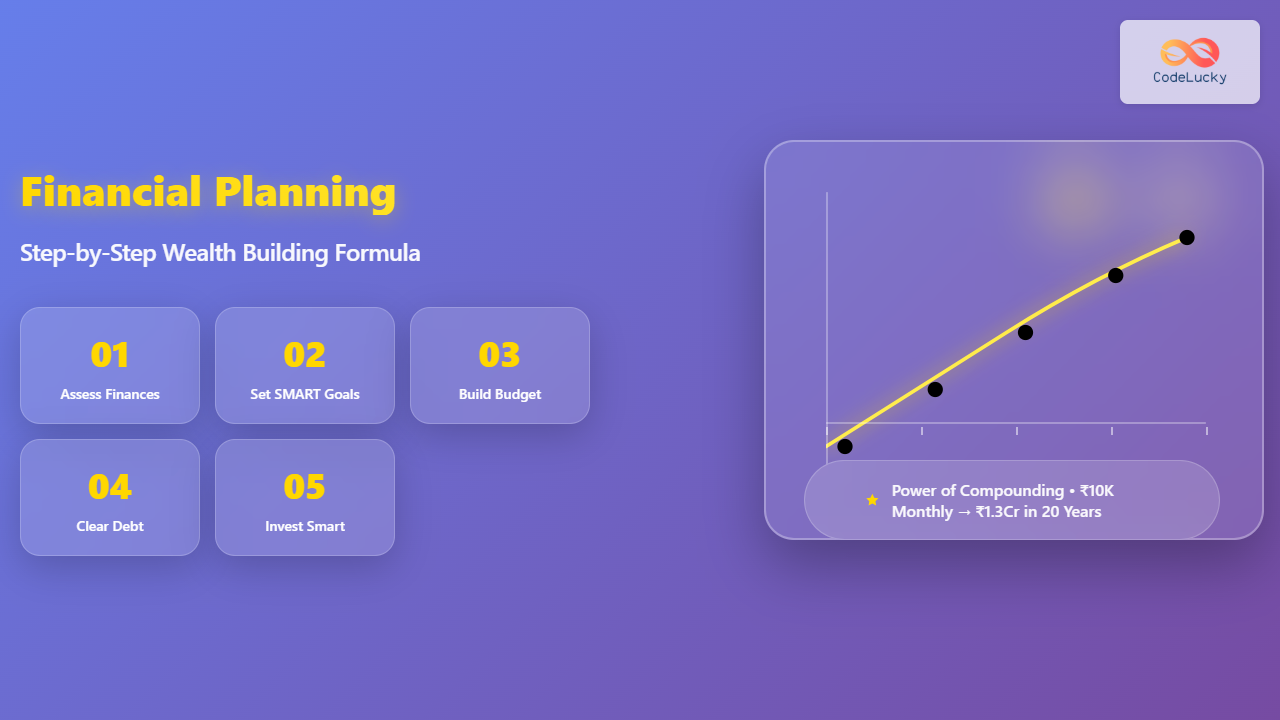

Financial planning transforms dreams into reality through disciplined wealth building. This comprehensive guide outlines a battle-tested formula used by millionaires worldwide. Follow these steps to secure your financial future.
Step 1: Assess Your Financial Health
Begin by calculating your net worth: assets minus liabilities. List all income sources, expenses, debts, savings, and investments. Use a simple spreadsheet to track monthly cash flow.
- Assets: Bank accounts, investments, property (e.g., ₹5 lakhs savings + ₹20 lakhs mutual funds).
- Liabilities: Loans, credit card debt (e.g., ₹3 lakhs personal loan at 12% interest).
- Net Worth Example: ₹25 lakhs assets – ₹8 lakhs debts = ₹17 lakhs positive net worth.
Track expenses for 3 months to identify leaks like unused subscriptions or impulse buys. This baseline reveals your starting point for wealth acceleration.
Step 2: Set SMART Financial Goals
Define Specific, Measurable, Achievable, Relevant, Time-bound goals across short (1-3 years), medium (5-10 years), and long-term (15+ years) horizons.
| Goal Type | Example | Target Amount | Timeline |
|---|---|---|---|
| Short-term | Emergency Fund | ₹6 lakhs | 12 months |
| Medium-term | Child’s Education | ₹25 lakhs | 7 years |
| Long-term | Retirement Corpus | ₹5 crores | 25 years |
Reverse-engineer: For ₹25 lakhs in 7 years at 12% returns, invest ₹25,000 monthly via SIPs. Tools like goal calculators confirm feasibility.

Step 3: Master Budgeting with 50/30/20 Rule
Allocate 50% income to needs (rent, groceries), 30% to wants (dining, entertainment), 20% to savings/investments. Adjust for Indian contexts: prioritize EMIs within 50%.
Monthly Income: ₹1,00,000
- Needs (50%): ₹50,000
- Wants (30%): ₹30,000
- Savings (20%): ₹20,000 → ₹10k Emergency + ₹10k Investments
Automate transfers on salary credit. Apps like Walnut or Excel templates enforce discipline, turning income into wealth engines.
Step 4: Build Emergency Fund & Eliminate Debt
Aim for 6-12 months expenses in liquid savings (₹3-6 lakhs for ₹50k monthly spend). High-interest debt (>10%) kills wealth—pay via debt snowball: smallest first for momentum.
- Credit Card (18%): ₹1 lakh → Pay ₹20k/month, clear in 6 months.
- Personal Loan (12%): ₹2 lakhs → Snowball next.
Post-debt freedom, redirect payments to investments for 20x returns via compounding.

Step 5: Invest Using Asset Allocation
Diversify: 60% Equity (Index Funds/Mutual Funds), 30% Debt (FDs/Bonds), 10% Gold. Use SIPs for rupee-cost averaging.
| Age Group | Equity% | Debt% | Gold% |
|---|---|---|---|
| 20-35 | 80% | 15% | 5% |
| 36-50 | 60% | 30% | 10% |
| 51+ | 40% | 50% | 10% |
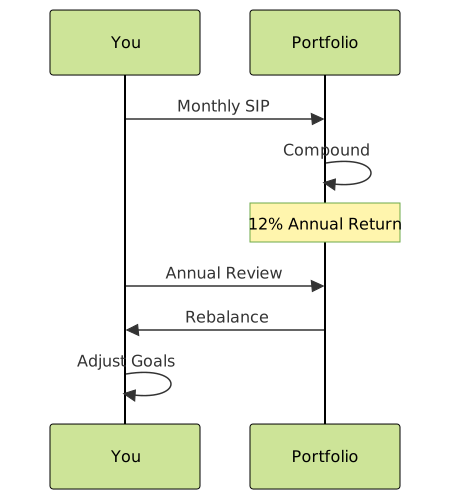
Example: ₹10,000 SIP at 12% for 20 years = ₹1.34 crores (principal ₹24 lakhs + gains ₹1.1 crores). Power of compounding visualized below.
Step 6: Protect Wealth with Insurance
Term life (15x annual income), health (₹10-20 lakhs cover), disability. Avoid ULIPs—pure protection first. Review nominees annually.
Step 7: Review, Track & Scale
Quarterly net worth updates, annual goal recalibration. Increase savings 10% yearly (10-10 rule). Tax optimization via ELSS, PPF.
Consistent execution of this formula guarantees wealth. Start today—small steps compound into fortunes.