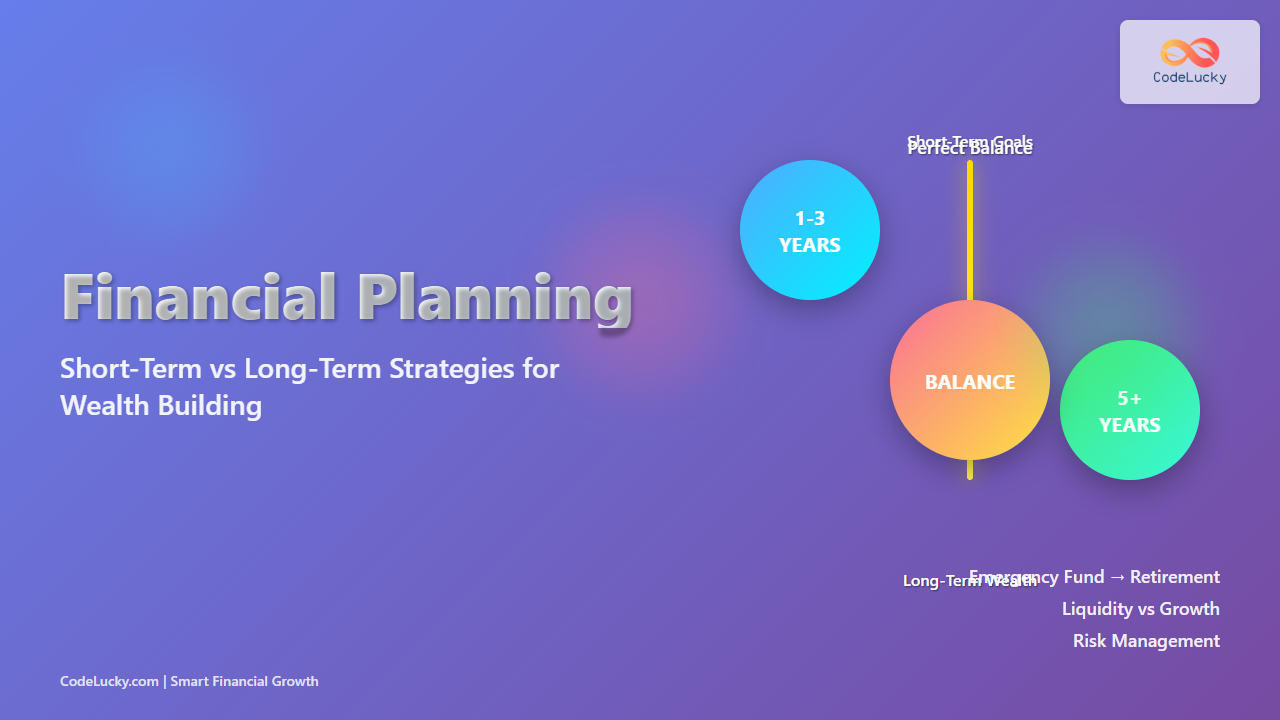
Financial planning is not just about saving money—it’s about making smart decisions that guide you toward financial independence. Whether you’re saving for a vacation next summer or planning for retirement decades ahead, understanding the balance between short-term and long-term financial planning is the foundation of personal finance success.
What Is Financial Planning?
Financial planning is the process of setting and managing goals to ensure financial stability and future security. It includes analyzing income, expenses, investments, and risks to build a roadmap for sustainable wealth growth. Effective financial planning aligns both immediate and distant goals with your financial capacity.
Short-Term vs Long-Term Financial Planning
Both short-term and long-term financial plans play critical but distinct roles in your financial strategy. Let’s explore how they differ and complement each other.

Short-Term Financial Planning
Short-term planning focuses on immediate or near-future goals—typically within 1 to 3 years. It helps you manage liquidity and maintain flexibility in your financial health.
- Timeframe: 1 to 3 years
- Purpose: Manage cash flow, meet immediate objectives
- Examples: Emergency funds, short vacations, paying off small debts, buying electronics
Example of Short-Term Planning
Suppose you plan to buy a laptop worth ₹60,000 within a year. If you save ₹5,000 per month, you’ll achieve your target in 12 months.
Visual Calculation:
Monthly Saving: ₹5,000
Duration: 12 months
Goal Achieved = ₹5,000 × 12 = ₹60,000
Long-Term Financial Planning
Long-term planning deals with building wealth and securing financial independence over extended periods—usually beyond 3 years. It requires disciplined investing, patience, and strategic growth through compounding returns.
- Timeframe: 5 years or more
- Purpose: Wealth creation, retirement security
- Examples: Retirement corpus, child’s education, buying a home
Example of Long-Term Planning
Imagine you start investing ₹10,000 per month for 20 years at an average annual return of 10%. Using compound interest, your corpus would grow substantially.
Formula: \( A = P \times \frac{(1 + r)^t – 1}{r} \)
P = ₹10,000/month
r = 10% annual return ≈ 0.0083 monthly
t = 240 months

Total corpus ≈ ₹76,56,000
Key Differences: Short-Term vs Long-Term Planning
| Aspect | Short-Term Planning | Long-Term Planning |
|---|---|---|
| Time Horizon | 1–3 years | 3–30 years |
| Objective | Meet immediate needs and goals | Build long-term wealth and security |
| Risk Level | Low risk (liquid funds) | Moderate to high (equities, real estate) |
| Examples | Emergency fund, vacation, minor purchases | Retirement savings, property, education fund |
| Liquidity | Highly liquid | Low liquidity |
How to Balance Short-Term and Long-Term Planning
Balancing both time horizons creates resilience in your financial journey. Here’s how you can do it:
- Create an emergency fund covering 3–6 months of expenses before long-term investing.
- Allocate percentages of your income (e.g., 30% short-term goals, 70% long-term investments).
- Review annually to adjust for income changes, inflation, or delays.
- Diversify across asset types—liquid funds for short term and equity or mutual funds for long term.

Practical Visual Example: Financial Journey Timeline

Interactive Idea for Users
You can make financial planning interactive on CodeLucky.com using simple JavaScript-based planners or sliders where users input monthly savings, interest rates, and durations to see projected outcomes. Such interactivity increases user engagement and helps them visualize their own financial path.
Conclusion
Both short-term and long-term financial planning are indispensable for achieving money goals. Short-term strategies ensure liquidity and stability, while long-term ones build lasting wealth and independence. The real success in financial planning lies in balancing both intelligently—meeting current needs without compromising your financial future.
Author: Team CodeLucky | Expert Financial Insights for Smart Planners